Keshi Yena: Curaçao's Stuffed Cheese
A hollowed Edam shell packed with spiced meat, born from plantation-house leftovers
Contents
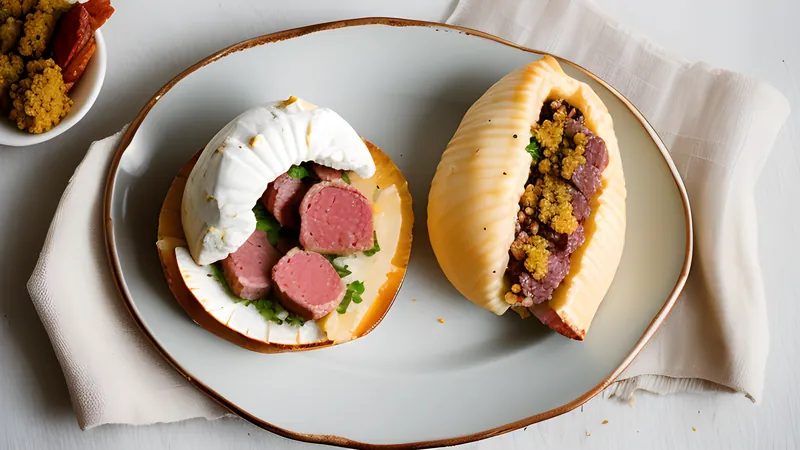
↓ Jump to recipeKeshi yena, literally “stuffed cheese” in Papiamentu, the Creole language of Curaçao, Aruba and Bonaire, is a whole hollowed wheel of Edam or Gouda packed with a rich, sweet-savoury filling of spiced meat, raisins and olives, then baked until the cheese shell softens into something between a crust and a sauce. It’s one of the most distinctive dishes in the Dutch Caribbean, built quite literally out of the region’s colonial trade routes: Curaçao imported enormous quantities of Dutch cheese from at least the seventeenth century onward, first as ballast on merchant ships and later as straightforward provisions, and that steady supply of Edam and Gouda eventually became raw material for a dish nobody in the Netherlands itself had thought to invent.
Keshi Yena: Curaçao's Stuffed Cheese
Ingredients
- 1 whole young Edam cheese (about 1.2kg), wax coating removed
- 500g minced beef or shredded cooked chicken
- 2 tbsp vegetable oil
- 1 onion, finely chopped
- 1 red bell pepper, finely chopped
- 3 garlic cloves, minced
- 2 tomatoes, chopped
- 2 tbsp tomato paste
- 1/2 scotch bonnet chilli, finely chopped (seeds removed for less heat)
- 1 tsp ground cumin
- 1 tsp smoked paprika
- 1/2 tsp ground cloves
- 50g raisins
- 50g pimento-stuffed green olives, halved
- 2 tbsp capers
- 2 tbsp Worcestershire sauce
- 2 large eggs, beaten
- Salt and black pepper, to taste
- Butter, for greasing
Method
- Heat the oven to 180C (160C fan, gas mark 4). Grease a baking dish or ovenproof bowl just large enough to hold the cheese shell snugly.
- Slice the top quarter off the Edam and set it aside as a lid. Using a sharp spoon or melon baller, hollow out the cheese, leaving a shell about 1cm thick all round; reserve the scooped-out cheese for later. Sit the shell and lid in a bowl of cold water for 15 minutes to firm up and become less rubbery, then drain and pat dry.
- Heat the oil in a large pan over medium heat. Brown the minced beef, breaking it up as it cooks, for 5-6 minutes, then remove any excess fat if there's a lot.
- Add the onion, bell pepper, garlic and scotch bonnet, and cook for 5 minutes until softened.
- Stir in the tomatoes, tomato paste, cumin, smoked paprika and cloves, and cook for 3-4 minutes until the tomatoes break down.
- Add the raisins, olives, capers and Worcestershire sauce, and simmer for 5 minutes until the mixture turns thick and holds together. Remove from the heat and let cool for 10 minutes.
- Grate or finely chop about 100g of the reserved scooped-out cheese and stir it, along with the beaten eggs, into the cooled meat mixture. Season with salt and black pepper.
- Pack the filling into the hollowed cheese shell, mounding it slightly, and set the lid on top. Place in the prepared dish.
- Bake for 35-40 minutes, until the cheese is fully melted and slumping slightly at the base but still holding its shape, and the filling is set and hot through.
- Rest for 5-10 minutes before slicing into wedges, so the melted cheese firms up enough to hold together on the plate.
A dish born from a plantation kitchen
The most widely told origin traces keshi yena back to the kitchens of Curaçao’s plantation houses during the Dutch colonial period, where enslaved cooks were given the wheels of Dutch cheese, usually already partly eaten or with the good centre cut away for the household’s table, and told to make something of what remained: a rind, essentially, hollow enough to become a container. Rather than discard it, those cooks packed the shell with leftover meat scraps, whatever spices and dried fruit were on hand, and baked the whole thing back into a dish substantial enough to feed a family, turning what had been considered kitchen waste into what’s now Curaçao’s most recognisable national dish, served today at celebrations, Sunday lunches and, once a year, at the elaborate feast marking the end of Ramadan among Curaçao’s Muslim community, alongside chicken versions of the dish for those not eating pork or beef mixed with dairy.
That layered history, colonial trade good repurposed by enslaved labour into something entirely new, is common across the Caribbean’s most celebrated dishes, but keshi yena wears it unusually literally: the cheese itself, rather than a spice or a technique, is the inherited colonial ingredient, and the raisins, olives, capers and sweet-savoury spicing in the filling are what turn a simple hollowed rind into a specific, recognisable national dish rather than just cheese with meat in it.
The raisins and olives inside point toward another, later layer of influence: Sephardic Jewish merchants and Portuguese traders who settled on Curaçao from the seventeenth century onward, bringing Iberian and Mediterranean cooking habits — sweet dried fruit folded into savoury meat dishes, capers and olives as standard pantry items — that fused into local Curaçaoan cooking alongside the plantation-kitchen ingenuity that gave the dish its cheese shell in the first place. Few dishes anywhere condense quite so many distinct migrations, Dutch, West African, Sephardic and Iberian, into a single, genuinely coherent plate of food. Curaçao’s Sephardic community, tracing back to Jewish merchants who fled the Iberian Peninsula and later Dutch Brazil for the relative religious tolerance of Dutch colonial territory, built one of the oldest continuously operating synagogues in the Americas on the island, and their culinary fingerprint shows up across Curaçaoan cooking well beyond keshi yena, in the sweet-and-sour sauces and dried-fruit pairings that turn up in stews and fish dishes across the island’s wider repertoire. Papiamentu itself, the Creole language keshi yena is named in, is a further marker of that layered colonial history, a language built from Portuguese and Spanish roots with heavy Dutch and West African input, spoken today across Curaçao, Aruba and Bonaire as the everyday tongue rather than a folk relic, which is part of why the dish’s name never got translated or Anglicised the way so much other Caribbean food has been for export.
Why the cheese gets a cold-water soak
Edam and Gouda both melt readily under sustained heat, which is exactly the problem a hollowed cheese shell needs solving before it goes anywhere near an oven: left at room temperature, the shell would slump and collapse well before the filling inside had time to cook through and set. Soaking the hollowed shell and its lid briefly in cold water firms the cheese slightly and, just as usefully, rinses away some of the surface fat and salt that would otherwise pool and separate unpleasantly during the longer bake, since Edam left whole under prolonged heat can weep an oily film that a quick pre-soak noticeably reduces.
The other safeguard is the eggs stirred into the cooled filling. Beaten egg acts as a binder here in much the same way it does in a meatloaf or a terrine, setting the meat mixture into a cohesive, sliceable mass as it bakes rather than leaving it loose and crumbly once the surrounding cheese has softened; without it, the filling would hold together reasonably well while hot but fall apart the moment a slice was lifted out, precisely the moment keshi yena is meant to look its best, cut open to show the layered cheese-and-filling cross-section.
Letting the cooked filling cool for ten minutes before it goes into the shell matters for the same reason the water soak does: filling packed in too hot begins melting the inside of the cheese shell immediately, well before the dish goes into the oven, weakening the structure exactly where it needs to be strongest to hold its shape through baking and slicing.
What can go wrong
A collapsed, slumped cheese shell that loses its shape entirely in the oven is the most visible failure, and it usually means either the shell was hollowed too thin, well under the 1cm the recipe calls for, or the cold-water soak was skipped or cut short. Thin walls simply don’t have enough structural cheese left to hold their own weight once heated through, no matter how careful the rest of the technique is, so it’s worth erring on the thicker side on a first attempt rather than scooping right to the rind. A filling that’s still wet and loose once the dish comes out of the oven, rather than sliceable, almost always means the meat mixture wasn’t reduced enough on the stove before it went into the shell; it should look thick and cohesive, holding its shape on a spoon, well before the eggs and reserved cheese are stirred through, since baking firms the filling further but doesn’t meaningfully reduce excess liquid the way stovetop simmering does. Cracking around the cheese lid, or a shell that splits down one side during baking, generally comes from an oven that runs hotter than it reads or a cheese that went in too cold from the fridge straight after its water soak; patting the shell fully dry and letting it sit at room temperature for ten minutes before filling helps it heat more evenly rather than seizing on one side before the rest catches up.
The recipe
Serves 6.
Ingredients
- 1 whole young Edam cheese (about 1.2kg), wax removed
- 500g minced beef or shredded cooked chicken
- 2 tbsp vegetable oil
- 1 onion, finely chopped
- 1 red bell pepper, finely chopped
- 3 garlic cloves, minced
- 2 tomatoes, chopped
- 2 tbsp tomato paste
- 1/2 scotch bonnet chilli, finely chopped
- 1 tsp ground cumin
- 1 tsp smoked paprika
- 1/2 tsp ground cloves
- 50g raisins
- 50g pimento-stuffed green olives, halved
- 2 tbsp capers
- 2 tbsp Worcestershire sauce
- 2 large eggs, beaten
- Salt and black pepper
- Butter, for greasing
Method
- Heat the oven to 180C. Grease a snug baking dish.
- Slice the top off the Edam, hollow it out leaving a 1cm-thick shell, and soak shell and lid in cold water 15 minutes. Drain and dry.
- Brown the mince, then soften the onion, pepper, garlic and scotch bonnet with it.
- Add tomatoes, tomato paste and spices; cook until thickened.
- Stir in raisins, olives, capers and Worcestershire sauce; simmer until thick. Cool 10 minutes.
- Mix in grated reserved cheese and beaten eggs; season.
- Pack the filling into the shell, top with the lid, and bake 35-40 minutes.
- Rest 5-10 minutes before slicing.
Tips, substitutions and storage
Buy the cheese specifically as a young, whole, wax-coated Edam or Gouda ball rather than a pre-cut wedge, since the whole shape is essential to the dish and most supermarket cheese counters sell it pre-sliced. If a whole cheese genuinely can’t be sourced, a deep, greased baking dish lined with thick slices of Edam, filling packed in and topped with more slices, gives a reasonable approximation of the same flavour without the theatre of the intact shell. Leftovers keep three days refrigerated and reheat well, covered, in a moderate oven, though the cheese shell softens further on reheating and won’t hold quite the same crisp-edged shape as fresh from the first bake. A melon baller genuinely earns its keep here over a regular spoon, giving cleaner, more even scoops that leave a uniformly thick wall rather than the gouged, uneven shell a tablespoon tends to produce. Young Edam, sold with its wax still bright red or yellow rather than aged and waxed a deeper amber, is worth seeking out specifically, since younger cheese is softer and easier to hollow without cracking than a well-aged wheel, which tends to be firmer, crumblier and more prone to splitting under the melon baller. Assembled and unbaked, the stuffed shell can sit covered in the fridge for up to a day before baking, which makes it a genuinely good make-ahead option for a dinner where the oven needs to be free for something else earlier in the day; add five extra minutes to the bake time to allow for the shell going in cold.
Keshi yena’s sweet-savoury filling, built on raisins and warm spice against savoury meat, sits in the same family as the fruited stuffing inside papa rellena, a Peruvian dish an ocean away from Curaçao that leans on nearly the same combination of ideas inside a completely different shell. For a lighter contrast on the same table, cou-cou and flying fish brings a much simpler, cornmeal-based dish from elsewhere in the Caribbean.
Variations
Chicken keshi yena is at least as common as the beef version and traditionally the one served at Ramadan gatherings, using shredded cooked chicken thigh in place of mince and needing slightly less cooking time for the filling itself, since the chicken is already cooked before it goes in. A pickled gherkin or two, chopped fine, is a common home addition alongside the olives and capers, adding another layer of brininess against the raisins’ sweetness. Whatever the filling, the cheese itself does the real defining work here, and it’s worth resisting the temptation to skimp on quality for the sake of a dish where the cheese is doing considerably more than half the job. A vegetarian version built on sautéed mushrooms, black beans and the same warm spice blend turns up in some modern Curaçaoan kitchens, using the meat’s savoury bulk as a template rather than a fixed requirement, though it needs a firmer binder, an extra egg or a spoonful of breadcrumbs, since mushrooms release considerably more liquid than browned meat during cooking. A miniature version, made in individual small Edam or Babybel-style wheels for single portions rather than one large shell, has become a popular dinner-party format on the island in recent decades, giving each guest their own sealed cheese parcel rather than a shared, sliced wheel, and it bakes in roughly half the time given the smaller mass of cheese and filling involved.
Related Content