Kashmiri Yakhni: Lamb in Yoghurt and Fennel
A pale, perfumed braise built without a single chilli
Contents
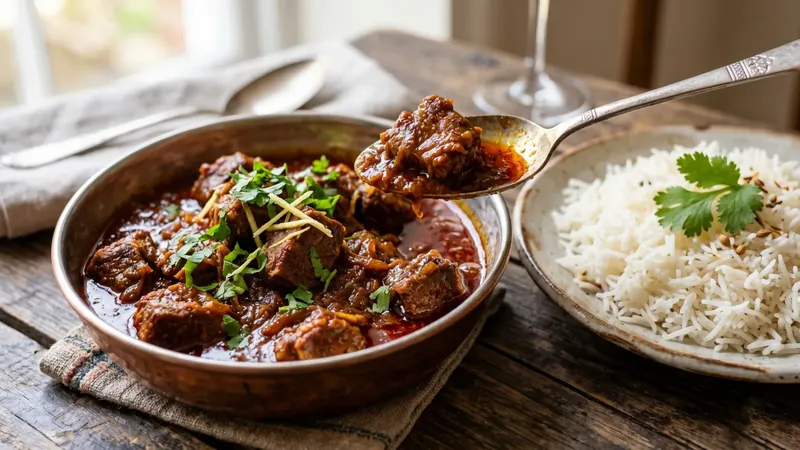
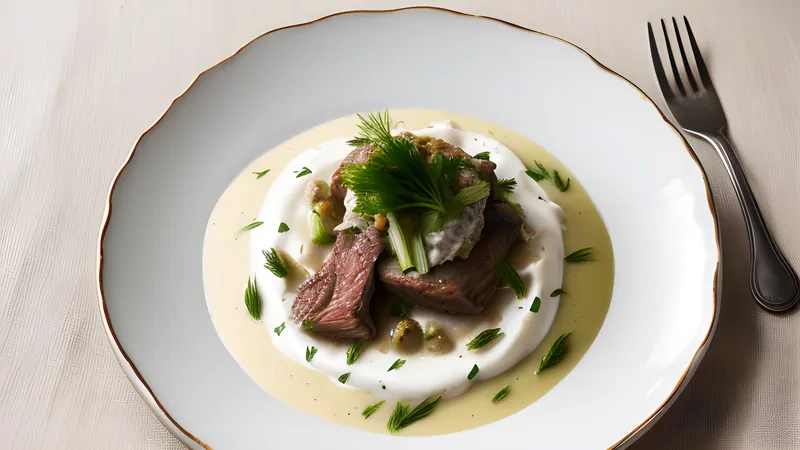
↓ Jump to recipeYakhni is the dish that makes the case for Kashmiri cooking having nothing to do with red chilli at all. Where rogan josh gets its glow from Kashmiri chilli powder, yakhni stays the colour of thin cream, built instead from whisked yoghurt, ground fennel and dried ginger, simmered slowly until the lamb falls apart and the sauce turns silky. It’s a braise in the truest sense: mustard oil, whole spice, patience, and almost nothing else.
The word itself comes from Persian, meaning simply broth, and it points at the older, plainer cooking this dish descends from before it became a fixture of the elaborate Kashmiri feast. What survives on the plate is proof that a curry doesn’t need heat or colour to carry weight; fennel and dried ginger do real work here, and a long simmer turns humble ingredients into something that tastes considerably richer than its ingredient list suggests.
Kashmiri Yakhni: Lamb in Yoghurt and Fennel
Ingredients
- 800g bone-in lamb shoulder or leg, cut into 4cm pieces
- 500g full-fat natural yoghurt, whisked smooth
- 3 tbsp mustard oil (or ghee)
- 4 green cardamom pods, bruised
- 2 black cardamom pods, bruised
- 1 cinnamon stick
- 4 cloves
- 2 bay leaves
- 1 tsp ground fennel (saunf)
- 1 tsp ground dried ginger (saunth)
- 0.25 tsp asafoetida (hing)
- 500ml water or light lamb stock
- 1 tbsp ghee, to finish
- 2 drops kewra (screwpine) water, optional
- Salt, to taste
Method
- Heat the mustard oil in a heavy pot until it smokes lightly, then take off the heat for a minute to lose its rawness.
- Return to a medium heat, add the green and black cardamom, cinnamon, cloves and bay leaves, and fry for 30 seconds until fragrant.
- Add the asafoetida, stir for 10 seconds, then add the lamb and turn it in the spiced oil for 5 minutes without browning it hard.
- Stir in the ground fennel and dried ginger and cook for 1 minute.
- Take the pot off the heat, whisk the yoghurt smooth if it has separated, and stir it in a few spoonfuls at a time, mixing well between additions.
- Return to a low heat, add the water or stock and a good pinch of salt, and bring to a bare simmer, stirring often for the first 5 minutes so the yoghurt does not split.
- Cover and cook on the lowest heat for 1.5 to 1.75 hours, stirring occasionally, until the lamb is tender and the sauce has thickened to a pale, silky gravy.
- Stir through the finishing ghee and the kewra water if using, rest for 5 minutes, and serve.
The story: broth cooking without onion or garlic
Yakhni belongs to the Kashmiri Pandit kitchen, the Hindu culinary tradition of the Kashmir valley, which historically avoids onion and garlic in savoury cooking and leans instead on asafoetida and dried ginger to build the base note a curry would otherwise get from an aromatic fried onion. That absence is not a restriction that weakens the dish; it’s the reason yakhni tastes the way it does, with a clean, warm depth that a heavier onion base would muddy. Asafoetida, used here in a pinch rather than a spoonful, does a lot of quiet work: fried briefly in hot oil it turns savoury and faintly of leek, rounding out the fennel and dried ginger rather than announcing itself.
Fennel and dried ginger together are close to a Kashmiri signature, showing up across both the Pandit and Muslim culinary traditions in dishes from rogan josh to this yakhni, but here they’re doing the entire job of seasoning rather than sharing it with chilli. Ground fennel gives a faint sweet aniseed note that mellows as it cooks; dried ginger powder, called saunth, is warmer and sharper than fresh ginger and doesn’t add the moisture fresh root would, which matters in a dish that depends on a thick, clinging sauce rather than a wet one. Traditional versions sometimes bloom a pinch of dried Kashmiri cockscomb flower, mawal, in the yoghurt for a faint pink blush; it’s decorative rather than essential, extremely hard to source outside Kashmir, and the recipe here leaves it out without losing anything that matters to the flavour.
At its grandest, yakhni appears in the wazwan, the multi-course Kashmiri banquet built almost entirely around meat, alongside dishes like rogan josh and rista, the pounded meatball curry. In that context it’s often made with mutton on the bone and served as one course among many, a pale counterpoint to the redder, richer dishes around it. At home, it’s simpler than that: a Sunday braise, mutton or lamb, yoghurt, and the time it takes to get tender.
The word yakhni also travels well beyond this specific dish, which is worth knowing if you come across it elsewhere. Across much of the wider Persian and Central Asian cooking world, yakhni describes a whole family of dishes built on a meat stock or broth base, and versions turn up as far as the Balkans and the Levant, often as a rice dish cooked in a well-seasoned meat stock rather than this yoghurt-thickened Kashmiri braise. What ties them together is the idea of using the cooking liquid itself as the main flavouring agent, rather than building a separate sauce around the meat afterwards, and that principle is exactly what’s happening here: the yoghurt and spices become the broth the lamb actually cooks in, thickening into the finished gravy as the braise reduces.
Technique: keeping the yoghurt smooth
The single point where this dish goes wrong is the yoghurt splitting into visible curds floating in a thin, watery sauce. Two habits prevent it. First, take the pot off the heat before you add the yoghurt, and whisk it smooth beforehand if it’s separated in the tub — cold yoghurt hitting a very hot pan is the fastest route to curdling. Second, add it gradually, a few spoonfuls at a time, stirring each addition in fully before the next, rather than tipping in the whole bowl at once. Once it’s all incorporated, return to a low heat and stir attentively for the first five minutes; after that the sauce has warmed through evenly and is far less likely to split even at a simmer.
Full-fat yoghurt is considerably more stable under heat than low-fat, which has less protein structure to hold together and curdles far more readily. If your only option is a lower-fat yoghurt, whisk in a teaspoon of cornflour before adding it to the pot; the starch helps the proteins stay suspended. Greek-style strained yoghurt, thicker again than standard full-fat natural yoghurt, is even more forgiving still and produces a slightly richer, more velvety sauce, though it’s worth thinning it with a splash of the measured water before whisking it in, since it can otherwise make the gravy heavier than the dish is meant to be.
Mustard oil is worth using rather than substituting if you can find it, ideally cold-pressed. It has a sharp, pungent smell raw that mellows into something nutty and rounded once heated past its smoke point, which is why the first step has you heat it until it smokes and then let it settle before cooking with it — used raw, or heated only lightly, it stays assertive in a way that fights the delicate yoghurt sauce rather than supporting it. Ghee is the fair substitute if mustard oil isn’t available, though the dish loses a genuine layer of its character. Look for it in the international aisle of a larger supermarket before assuming you’ll need a specialist shop; it’s become common enough that most decent-sized stores now stock at least one brand.
Bone-in cuts are worth the extra faff of eating around a bone, and genuinely change the dish. Shoulder or leg on the bone releases marrow and connective tissue slowly through the ninety-minute simmer, thickening the sauce naturally in a way boneless meat can’t replicate; a boneless yakhni tends to need a little cornflour or extra reduction time to reach the same body. Ask a butcher to cut bone-in shoulder into rough chunks rather than buying pre-cut boneless pieces, which are usually trimmed from leaner cuts that dry out over a long braise.
What to serve it with
Yakhni belongs on plain steamed rice, which soaks up the sauce without competing with it. If you’re building a fuller Kashmiri spread, it sits naturally alongside haak, the everyday mustard-oil greens that share its restraint, and against the deep red of dum aloo it becomes a genuine study in contrast — one dish built on colour and chilli, the other on fennel and patience. For a festive finish to the same meal, modur pulav, the sweet saffron rice served at Kashmiri weddings, closes things out the way it would at a real wazwan.
Storage, make-ahead and variations
Yakhni keeps for three days in the fridge and actually improves overnight, as the fennel and ginger settle further into the sauce; reheat it gently over a low heat with a splash of water, since the sauce thickens considerably once chilled. It freezes well for up to three months, though full-fat yoghurt sauces are always slightly more prone to a grainy texture after freezing than a tomato-based one, so thaw it slowly in the fridge rather than blasting it in a microwave.
Goat is the traditional substitute for lamb across much of Kashmir and works with identical timings, just add fifteen minutes if the pieces are larger or on a tougher bone, and check for tenderness with a fork before assuming the extra time has done its job, since goat cuts vary more in toughness than lamb does. A vegetarian version made with paneer, added in the last ten minutes so it doesn’t toughen, is a reasonable weeknight adaptation, though it changes the character of the dish considerably since there’s no bone or connective tissue to enrich the sauce over the long simmer. Resist the urge to add turmeric for colour; the pale, faintly golden hue of a properly made yakhni is the whole point, and turmeric pushes it toward a generic yellow curry rather than the specific, restrained dish this is meant to be.
Related Content