Käsespätzle: The Swabian Cheese Noodle
Eggs, flour, a scraping board and a mountain of fried onions
Contents
↓ Jump to recipeThe first time I made spätzle properly I did it the wrong way for forty minutes and then, mid-batch, did it right, and the difference arrived so abruptly that I stood there holding a dripping board like an idiot. The wrong way is a thick dough scraped nervously. The right way is a dough so wet it looks like a mistake, beaten until it is elastic enough to hang off the spoon in a ribbon, and scraped fast enough that you are almost throwing it. What comes out is not the same food.
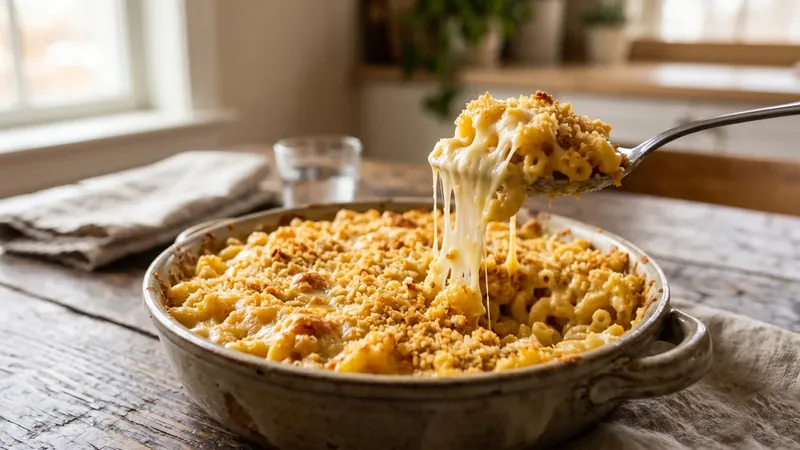
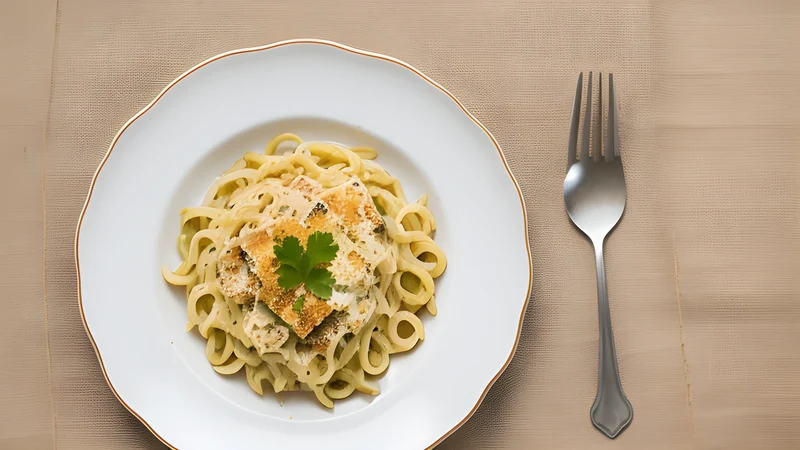
Käsespätzle is the Swabian answer to macaroni cheese, and treating it as a version of macaroni cheese is where most attempts go wrong. There is no béchamel. There is no roux, no cream, no milk, no thickener of any kind. There is cheese, there are hot noodles, and there is the water clinging to them, and those three things emulsify into a sauce or they do not. The technique is the recipe.
Käsespätzle: The Swabian Cheese Noodle
Ingredients
- 400 g plain flour
- 4 large eggs
- 180 ml sparkling water, cold
- 10 g fine salt
- 1/4 tsp freshly grated nutmeg
- 3 large onions (about 450 g), halved and sliced 3 mm thick
- 50 g butter, plus 20 g for the dish
- 1 tbsp neutral oil
- 1/2 tsp caster sugar
- 150 g Emmental, coarsely grated
- 150 g Bergkäse or mature Gruyère, coarsely grated
- 1 tbsp cider vinegar
- Black pepper
- 2 tbsp chopped chives, to finish
Method
- Put the flour, eggs, 10 g salt and the nutmeg in a bowl. Beat with a wooden spoon while pouring in the sparkling water, then beat hard for 3-4 minutes until the dough is smooth, glossy and forms long ribbons that tear slowly when you lift the spoon. Cover and rest 30 minutes.
- Meanwhile, heat the 50 g butter and the oil in a wide frying pan over medium heat. Add the onions and the sugar and a pinch of salt. Cook 25-30 minutes, stirring every few minutes, until the onions are deep brown and reduced to about a quarter of their volume. Add the vinegar, scrape the base clean, and set aside.
- Heat the oven to 180C fan. Butter a shallow 2-litre baking dish with the 20 g butter. Toss the two cheeses together in a bowl.
- Bring a wide, deep pan of well-salted water to a rolling boil and set a bowl of cold water beside it.
- Working in 3-4 batches, spread a ladle of dough on a wet wooden board or spätzle press and scrape thin strips straight into the boiling water. They will sink, then rise. Boil 60-90 seconds after they surface, lift out with a slotted spoon into the cold water for 10 seconds, then drain well.
- Layer a third of the drained spätzle in the buttered dish, scatter a third of the cheese and a spoonful of the onions. Repeat twice, finishing with cheese. Grind over plenty of black pepper.
- Bake 15-18 minutes, until the cheese has melted and the edges are bubbling and browning.
- Pile the remaining fried onions over the top and scatter with chives. Serve straight from the dish.
Where the little sparrows come from
Spätzle is a diminutive of Spatz, sparrow, and the accepted explanation is that the earliest hand-formed ones looked like small birds. Swabians have been making them for a very long time — a Swabian cookbook from 1725 already treats them as unremarkable — and the region’s identity is genuinely bound up in the things. Baden-Württemberg’s old nickname for its own people, Spätzlesschwaben, translates roughly as “spätzle Swabians”, which is the sort of nickname a region only accepts if it is proud of it.
The economics are the interesting part. Southern Germany grows soft wheat, where southern Italy has durum, and soft wheat cannot be made into a dried, extruded, shelf-stable pasta because it lacks the protein to hold the shape. What soft wheat can do is bind with a lot of egg into a batter-dough that gets cooked immediately. Every noodle culture is a downstream consequence of the wheat available, and spätzle is what the Swabian Alb’s wheat is good for.
The egg count is the tell. Swabian Landspätzle traditionally ran to four eggs per 400 g of flour and sometimes considerably more — a rate that would be extravagant anywhere the chickens were not right there. Egg does the structural work that durum protein does elsewhere: it sets on contact with hot water and gives the noodle a spine.
Since 2012 Schwäbische Spätzle has held EU protected geographical indication status, which fixes a minimum egg content and requires production in the region. It is one of the few pasta shapes in Europe with a legal definition.
The Kässpatzen argument
Cross from Swabia into the Allgäu, or over the border into Vorarlberg and Tyrol, and the dish changes its name to Kässpatzen or Kasspatzln and quietly changes its ingredients too. The Allgäu version leans harder on Bergkäse and often uses Weisslacker, a pungent, salty soft cheese that smells like a locker room and tastes wonderful. Austrian versions use Graukäse or a sour-milk cheese and can be genuinely challenging. The Swabian one, with Emmental in the mix, is the diplomatic version.
The argument between them is really an argument about altitude. Alpine dairying produced hard, aged, transportable cheeses because the cows were up a mountain from June to September and the milk had to survive the trip down. Lowland Swabia had milder cheese and more eggs. Follow the cheese and you can read the geography off the plate.
There is a further dispute about whether onions belong at all — some Allgäu recipes leave them out, on the grounds that good cheese needs no help. Those recipes are wrong, and the fried onions are the reason the dish is eaten outside the Allgäu.
The dough, and the one thing that matters
Beat it, and beat it hard. The dough needs gluten development, and unlike bread dough you cannot knead it because it is far too wet, so the development has to come from sustained mechanical work with a spoon. Three or four minutes of hard beating changes the dough visibly: it goes from a slack, tearing paste to something glossy that lifts in long elastic strands and blisters slightly on the surface. Swabian cooks talk about beating until the dough Blasen wirft — throws bubbles.
Underdeveloped dough makes spätzle that shred in the water into ragged crumbs. Properly beaten dough makes noodles with a springy bite and a smooth skin.
The sparkling water is my one addition to the classic. Still water is traditional and correct; carbonated water gives a marginally lighter noodle because the dissolved CO2 expands in the heat of the water and leaves the interior slightly more open. It is not a dramatic difference, and it costs nothing.
Rest the dough for half an hour. The flour hydrates fully, the gluten relaxes, and the dough scrapes cleanly instead of dragging.
The consistency target is specific: it should fall off a raised spoon in a continuous ribbon that takes about two seconds to break. Thicker than that and it will not scrape. Thinner and it will dissolve. Flour absorbency varies enough between brands and seasons that you should judge by the ribbon rather than the millilitres.
Board or press
The Spätzlebrett — a wooden board with a bevelled edge — is the traditional tool. You wet it, spread a thin layer of dough near the far edge, hold it at an angle over the boiling water and scrape thin strips off with a wet palette knife or a long metal scraper, flicking each one into the pan. Keep the board and the blade wet and it works. It takes an afternoon to get good at and produces irregular, rustic noodles with proper character.
The press — essentially a large potato ricer with wide holes — is what most German kitchens actually own, and it makes uniform noodles in a fraction of the time. It is a hundred-year-old tool with a legitimate place in the tradition. A colander with 5 mm holes and a plastic scraper works too.
Whatever you use, work in batches. Overcrowding drops the water temperature and the noodles sit in tepid water absorbing it, which is how you get bloated spätzle.
Sixty to ninety seconds after they float, and no longer. They are done when they surface; the extra minute is just insurance for the thicker ones. The cold-water dip stops the cooking and rinses off enough surface starch to keep them separate, and ten seconds is plenty — leave them swimming and they go waterlogged.
The onions are half the dish
Röstzwiebeln on käsespätzle are not a garnish. Three large onions for four people looks absurd in the pan and correct on the plate, because they will lose three-quarters of their volume and concentrate into something dark, sweet and slightly bitter that is the only thing standing between this dish and a bowl of hot fat.
Twenty-five minutes minimum, on medium heat, in butter with a little oil so the butter solids do not burn before the onions are ready. The pinch of sugar accelerates the browning; the pinch of salt pulls water out early. The cider vinegar at the end is mine and I insist on it — a tablespoon of acid deglazes the pan, lifts everything stuck to it, and gives the onions a sharpness that cuts back through the cheese. It is the same reasoning behind the pickle in rindsrouladen: German braises and bakes lean rich, and they are built with an acid somewhere in them to survive it.
Half the onions go through the layers, half go on top after baking so they stay crisp. Onions that spend eighteen minutes in the oven under cheese come out soft, and the textural contrast is worth the split.
The cheese
Emmental melts and stretches. Bergkäse — Alpine mountain cheese, aged, savoury, faintly gritty with tyrosine crystals — brings the flavour. Alone, Emmental is bland and stringy; alone, aged Bergkäse breaks and turns oily. Together they behave. Mature Gruyère is the easiest substitute for Bergkäse and is genuinely close. Comté works. Cheddar does not; it splits under this much heat with no starch to hold it.
Grate coarsely. Fine gratings melt too fast and start separating before the dish is hot through.
The reason there is no sauce is that the spätzle bring their own. Drained but still damp, with residual surface starch, they hold enough water to let the melting cheese emulsify into a coating rather than a puddle of fat. Drain them bone dry and the cheese will break. This is the same physics as cacio e pepe, and it fails the same way.
What goes wrong
Ragged crumbs instead of noodles means the dough was underbeaten. There is no recovery mid-batch; beat the remaining dough for another two minutes and it will come good.
Noodles that dissolve entirely mean the dough was too slack — work in another 30-40 g of flour and rest it for ten minutes before trying again.
A dish swimming in oil means the cheese broke. Either it went in too hot, or the spätzle were too dry, or the ratio tipped too far towards aged cheese. Adding a splash of the spätzle cooking water and stirring hard will sometimes bring it back, because the starch in that water is exactly what the emulsion was missing.
Bland käsespätzle, which is the commonest failure of all, means the onions were undercooked. Pale gold onions taste of nothing here. They have to go dark.
Serving, storage and variations
Green salad with a sharp vinaigrette, and nothing else. Swabians eat käsespätzle as a main course and pair it with a leaf salad and a beer, and any attempt to make it a side dish to something with meat produces a plate nobody finishes.
Plain boiled spätzle keep 3 days in the fridge tossed in a little oil, and they fry beautifully in butter the next day. They freeze well, spread on a tray and bagged once solid. The assembled, baked dish reheats poorly — the cheese has already emulsified once and will break on the second heating — so assemble fresh from cooked noodles if you are working ahead.
Krautspätzle swaps a third of the cheese for a mound of sauerkraut folded through the layers, which is excellent and considerably lighter. Plain buttered spätzle with browned butter and parsley is the standard accompaniment to a Rhineland Sauerbraten and to anything with gravy. And Spätzle stirred straight into hot lentils with a smoked sausage is the Swabian weeknight dinner that half of Baden-Württemberg grew up on.
For a rougher, more Alpine result, use Alpine macaroni logic and add a diced boiled potato through the layers. It sounds like too much starch and it makes the dish taste older.
Related Content