Karjalanpiirakka: Karelian Rye Pasties With Egg Butter
A rye wrapper rolled thin enough to see through, filled with rice porridge and crimped by hand
Contents
↓ Jump to recipeA Karelian pasty is an argument about how little dough a filling needs. The rye wrapper is rolled to about a millimetre — thin enough that you can read the grain of your board through it — and there is more rice than pastry by a considerable margin. Bake them at a temperature that alarms your oven, brush them with butter and milk while they are still spitting, and eat them warm under a mound of chopped egg mashed into more butter.
They are the most Finnish thing I know how to cook, and they are three hours of work, and I make them anyway.
My twist is a tablespoon of oil in the dough. It is not traditional — the orthodox recipe is rye flour, water and salt, full stop. The oil buys you perhaps 30 per cent more stretch before the dough tears, which is the difference between sixteen good pasties and four good ones and twelve you swear at.
Karjalanpiirakka: Karelian Rye Pasties With Egg Butter
Ingredients
- 200 ml water, at room temperature
- 1 tsp fine salt
- 180 g wholemeal rye flour, plus about 100 g extra for rolling
- 50 g strong white bread flour
- 1 tbsp rapeseed oil
- 180 g short-grain pudding rice
- 400 ml water
- 800 ml whole milk
- 1 tsp fine salt, for the porridge
- 20 g butter, for the porridge
- 60 g butter, melted, for brushing
- 60 ml whole milk, for brushing
- 4 eggs, hard-boiled and peeled
- 120 g butter, softened, for the egg butter
- 0.5 tsp flaky salt, for the egg butter
Method
- Make the porridge first. Rinse the rice, put it in a heavy pan with 400 ml water, bring to the boil and simmer for 8 minutes until the water is absorbed.
- Add the 800 ml milk. Bring back to a bare simmer and cook uncovered for 35–40 minutes, stirring every 5 minutes and scraping the base, until thick enough that a spoon leaves a trail that closes slowly.
- Stir in 1 tsp salt and 20 g butter. Cool completely — spread it on a tray to speed this up. It must be cold before it goes near the dough.
- Make the dough. Stir the 1 tsp salt into the 200 ml water until dissolved. Add the rye flour, white flour and oil and mix to a firm, slightly tacky dough.
- Knead on a rye-floured surface for 4–5 minutes. It will never be smooth or elastic. Wrap and rest for 30 minutes.
- Heat the oven to its maximum — 275°C, or 250°C if that is your ceiling. Put two heavy baking trays in to heat.
- Divide the dough into 16 pieces of about 27 g. Roll each into a ball and keep them under a cloth.
- On a surface dusted heavily with rye flour, roll each ball into an oval 15 cm long and about 1 mm thick — thin enough to see the grain of the board through it.
- Spread 2 heaped tbsp of cold porridge down the centre of each oval, leaving 2 cm clear at each long edge.
- Fold the long edges up over the filling so they overlap it slightly, leaving a strip of rice visible down the middle. Crimp the edges with wet thumb and forefinger, pinching every 5 mm along both sides.
- Bake on the preheated trays for 12–15 minutes at 275°C, or 18–20 minutes at 250°C, until the crimped edges are blistered and dark in patches.
- Whisk the 60 g melted butter with the 60 ml milk. Brush the pasties generously the moment they come out and stack them under a cloth for 10 minutes to soften.
- For the egg butter, chop the hard-boiled eggs finely, mash with the 120 g softened butter and the flaky salt, and serve at room temperature, spooned onto each warm pasty.
Karelia, and a food that moved with its people
Karelia is the region straddling the modern Finnish–Russian border, and its history is the reason this pasty is now eaten in Helsinki rather than only in Vyborg.
The pasty is old. Versions of it — thin rye casing, grain porridge filling, baked in a wood oven’s residual heat — are documented across Karelia and into Russian Olonets by the eighteenth century, and are almost certainly much older than that. The logic is agricultural. Rye grew there. Wheat did not. The filling was whatever grain porridge the household had: barley most often, buckwheat further east, millet in some accounts. Rice was a luxury import and only became the standard filling in the twentieth century, when it stopped being expensive.
What happened next is the part that matters. After the Winter War and the Continuation War, Finland ceded most of Karelia to the Soviet Union, and roughly 400,000 Karelians — about 11 per cent of Finland’s entire population — were evacuated and resettled across the rest of the country. They arrived in Ostrobothnia and Häme and Uusimaa as refugees, and they brought their food with them.
Karjalanpiirakka spread through Finland in the 1940s and 1950s as a direct consequence of that displacement. A dish that had been regional became national inside a generation, which is a thing that food does when people are moved. By the 1960s they were in every Finnish bakery. In 2003 the EU granted them Traditional Speciality Guaranteed status, which fixed the recipe in law: rye casing, rice or potato or barley filling, and the crimped edge.
The Finnish rye tradition they belong to is the same one that produces ruisleipä and, at its most extravagant, kalakukko — the Savonian loaf with a whole fish baked inside it. Rye as a container is a genuinely Finnish idea.
The porridge
Make it first, and make it the day before if you can, because it must be completely cold.
Cold is a structural requirement. Warm porridge steams inside the pasty, and the steam lifts the rye casing away from the filling and blows it into a dome that cracks and leaks. Cold porridge also spreads without tearing the dough, which warm porridge, being looser, does not.
Cook the rice in water first, then in milk. Doing it all in milk from the start means the milk sits over heat for the best part of an hour and catches on the base of the pan before the rice is anywhere near done. Eight minutes in water gets the grain started; the milk then goes in and has forty minutes rather than fifty.
Consistency is the thing to judge. You want it thick enough that a spoon dragged through leaves a trail that closes over slowly — perhaps three seconds. Too loose and it runs out of the pasty in the oven. Too thick and it sets into a paste that goes gluey and dry in the heat.
Salt it at the end. Salt added early slows the rice’s water absorption noticeably.
The dough, and rolling it thin
Rye water dough has no gluten network worth the name. There is nothing to develop and no elasticity to build, so kneading is about hydrating the flour evenly rather than about structure. Four minutes is plenty. Rest it for thirty so the flour finishes drinking.
Then the hard part. You are rolling a non-elastic dough to one millimetre. It wants to tear and it will not spring back to help you.
Three things make it work. Rye flour on the board, and a lot of it — far more than feels reasonable, brushed off later. A short rolling pin, worked from the centre outwards in quarter turns rather than back and forth. And accepting that a tear is not fatal: press it back together with a floured thumb and carry on.
The traditional Finnish approach stacks the balls with rye flour between them and rolls a pile at a time, which is faster and much harder. Roll them one by one until you have made a few hundred of these.
Crimping
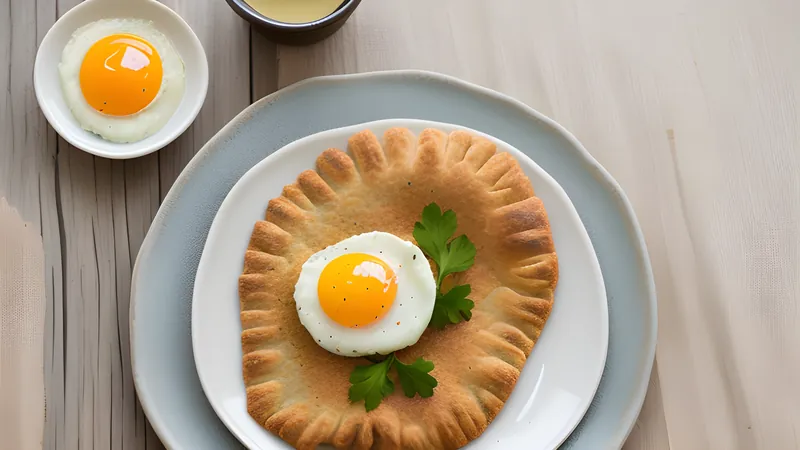
The crimp is the whole visual identity of the thing and it is easier than it looks. Wet thumb and forefinger, pinch the folded edge, push a small pleat towards yourself, move 5 mm along, repeat. Both sides.
Aim for a strip of rice visible down the centre about 3 cm wide. Fold too far over and you have a rye parcel; fold too little and the filling escapes.
The oven
As hot as it goes. 275°C is what a Finnish bakery uses; 250°C is what most domestic ovens manage, and it works with a few extra minutes. Preheat the trays — the underside needs to set instantly, and a cold tray gives you a soggy base.
You want the crimped edges blistered and dark in patches, almost burnt. That contrast between the scorched edge and the pale rice is correct, and pulling them out at an even golden brown means they are underdone.
The butter brush, and the reason for it
Straight out of the oven, the casing is brittle. Brushing it with the melted butter and milk mixture and then stacking the pasties under a cloth for ten minutes does something specific: the liquid soaks into the hot rye and the trapped steam from the stack softens it. A brushed, rested pasty is pliable and rich. An unbrushed one shatters into shards.
Be generous. All 120 ml goes on sixteen pasties.
Where it goes wrong
The dough tears constantly. Under-rested, or under-hydrated. Rye needs its full thirty minutes; if it is still fighting you after that, work another tablespoon of water in and rest it another ten.
The pasties dome up and split. Warm filling. There is no other cause. Cold porridge, every time.
The rice is dry and chalky on top. Over-baked, or the porridge was too thick going in. The visible strip of filling is exposed to direct oven heat for the whole bake, and it only survives because it goes in wet.
The base is pale and damp. Cold tray. Preheat them.
They are tough the next day. Under-brushed. The butter and milk wash is what keeps them pliable; a mean brushing gives you a rye biscuit by morning.
The edges are pale. Oven not hot enough. If 250°C is your ceiling, move the tray to the top third for the last four minutes.
A note on scale and rhythm
Sixteen is a small batch. Finnish households making these for Christmas make two hundred, and the entire process is built around a production line: one person rolls, one fills, one crimps, and the crimper is always the slowest.
Working alone, the order that keeps everything moving is this. Porridge the night before. Dough mixed and resting while the oven comes up to temperature — a domestic oven needs a good 25 minutes to genuinely reach 250°C with two heavy trays in it, and the dial lying to you is the norm. Then roll four ovals, fill and crimp those four, and put them on the tray while you roll the next four. Rolled dough dries out fast at that thinness, and an oval left sitting for ten minutes while you crimp its siblings will crack when you fold it.
Weighing the dough into 27 g pieces at the start feels fussy and saves you from the alternative, which is discovering at pasty fourteen that you have run out.
Egg butter, storage, variations
Munavoi is four hard-boiled eggs chopped fine and mashed into 120 g of softened butter with flaky salt. Nothing else. No mayonnaise, no mustard, no herbs. It goes on at the table, in a heap, on a warm pasty.
There is a Finnish convention worth knowing about the egg butter: the ratio is roughly one egg to 30 g of butter, and Finns will tell you that foreigners always get it wrong by using too little butter. They are right. It should be a butter dish with egg in it, spreadable and pale yellow, and if it looks like egg mayonnaise you have gone the wrong way.
Potato filling. Replace the porridge with 700 g of mashed floury potato loosened with 150 ml milk and seasoned well. Common in western Finland and quicker.
Barley filling. The oldest version. Pearl barley cooked as for the rice porridge, taking about 60 minutes. Nuttier and rougher; worth making once.
Carrot filling. Porkkanapiirakka, an eastern Karelian version. Grate 400 g of carrot, sweat it in 30 g butter for 15 minutes until it collapses, then fold it through half the rice porridge. Sweeter, and a good one for people who find the plain rice austere.
Rye and wheat casing. Pushing the white flour up to 100 g and dropping the rye to 130 g gives a casing that rolls far more easily and tastes noticeably less of anything. It is what a lot of supermarket versions in Finland do, and it is the compromise I would make for a first attempt and then stop making.
Baked pasties keep 2 days in a paper bag and reheat at 200°C for 5 minutes. They freeze extremely well: freeze after baking and brushing, then reheat from frozen at 200°C for 10 minutes. A Finnish freezer in November contains several hundred, and this is not an exaggeration.
Serve them with coffee, alongside lohikeitto, or on their own at four in the afternoon when the light has already gone.
Related Content