Karelian Hot Pot: Karjalanpaisti, Three Meats and Patience
Beef, pork and lamb, cold water, salt, allspice — and four hours where you do nothing
Contents
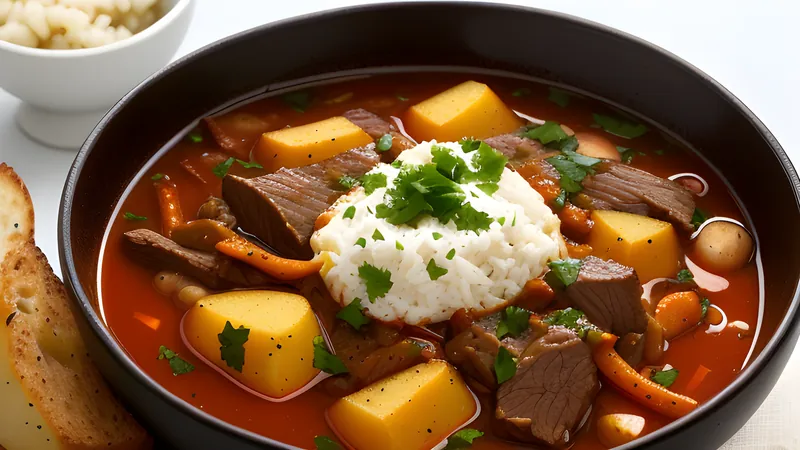
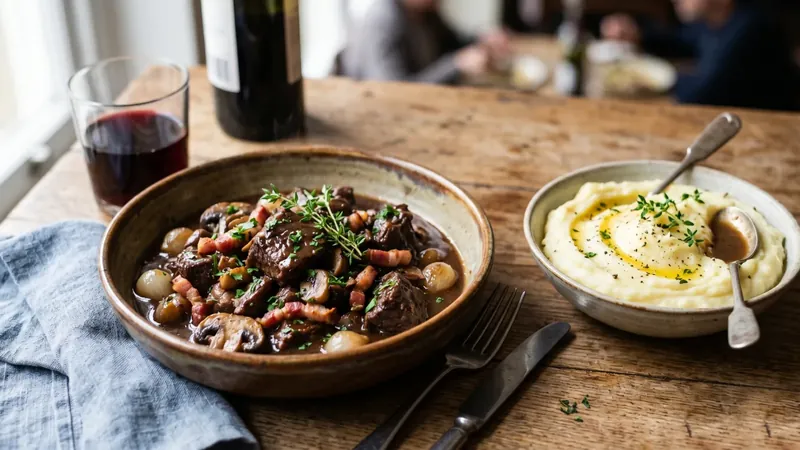
↓ Jump to recipeEvery cuisine has one dish that refuses to be improved. Karjalanpaisti is Finland’s. You put raw meat in a pot with cold water, salt and allspice, you close the lid, and four hours later you take out something that a French kitchen would need stock, wine, a bouquet garni and three separate reductions to approximate. It is the most efficient exchange of effort for flavour I know of, and the first three times I made it I ruined it by trying to help.
I browned the meat. I added stock. I put in a splash of red wine, because that is what you do. Each time the result was fine — a decent brown stew, indistinguishable from a hundred others. The fourth time I followed the method as written by a woman from Joensuu who told me, with some force, that the browning was the problem. She was right, and the reason why is genuinely interesting.
Karelian Hot Pot: Karjalanpaisti, Three Meats and Patience
Ingredients
- 600 g beef chuck or shin, cut into 4 cm cubes
- 500 g pork shoulder, cut into 4 cm cubes
- 400 g lamb shoulder, cut into 4 cm cubes
- 2 large onions (about 400 g), sliced into 1 cm half-moons
- 2 medium carrots (about 200 g), cut into 3 cm chunks
- 20 whole allspice berries
- 12 black peppercorns
- 3 bay leaves
- 2.5 tsp fine sea salt
- 600 ml cold water, or enough to barely cover
- 1 tbsp dark rye flour (optional, for thickening)
- 2 tbsp cold unsalted butter (optional, to finish)
Method
- Heat the oven to 150°C (130°C fan, gas mark 2). Do not preheat it any hotter — the whole method depends on the pot never reaching a hard boil.
- Pat all the meat dry with kitchen paper and cut it into even 4 cm cubes. Trim off hard gristle but leave the fat and any silverskin on — both dissolve over four hours.
- In a heavy casserole with a tight-fitting lid (4 litres or larger), build alternating layers: a third of the onions, then a mixed layer of the three meats, then a scattering of allspice, peppercorns, bay and salt. Repeat twice, tucking the carrot chunks in around the second layer.
- Pour in the cold water. It should come about two thirds of the way up the meat, leaving the top layer proud. Do not submerge everything — the exposed meat browns gently in the pot's own steam.
- Put the lid on. Transfer to the oven and cook for 4 hours. Do not open the door, do not stir, do not check on it before the three-hour mark.
- At 4 hours, test a cube of beef: it should collapse under the side of a fork with no resistance. If it still bites back, give it another 30 minutes.
- Lift the pot out and let it stand, lid on, for 20 minutes. Skim the clear fat from the surface with a spoon if there is a lot of it — expect 3 to 5 tablespoons.
- If you want a thicker sauce, mash 1 tbsp rye flour into 2 tbsp of the skimmed fat, stir it into the pot and simmer on the hob for 4 minutes. Otherwise, stir in the cold butter off the heat until it disappears.
- Taste and add salt in quarter-teaspoons until the broth tastes seasoned rather than salty. Serve with boiled floury potatoes and pickled cucumber.
Where the dish comes from
Karelia is the region straddling the Finnish-Russian border, and its recent history is one of displacement. When the Soviet Union took the Karelian Isthmus and Ladoga Karelia in 1940 and again in 1944, roughly 410,000 people — around eleven per cent of Finland’s entire population — were resettled westward. They arrived across Finland carrying their cooking with them.
This is why a dish from a specific eastern region became a national one within a single generation. Karjalanpaisti, along with Karelian rye pasties and their egg butter, spread through Finnish kitchens in the late 1940s and 1950s along resettlement lines. By the 1970s it was on restaurant menus in Helsinki as a national dish. In a 2016 poll run by the Finnish newspaper Ilta-Sanomat, readers voted it Finland’s national food.
The older version of the dish was cooked in a masonry bread oven, in the falling heat after the week’s rye bread came out. That is the key technical fact. A wood-fired bread oven bakes at 250°C or so, then drops slowly over the following twelve hours, passing through a long, gentle 120–150°C band. The pot went in, the door was sealed with a rag, and the household went to work. Nobody was stirring it or checking the temperature. The dish is designed around neglect, which is exactly why it works so well in a modern oven set low and left alone.
The three-meat rule has a practical origin too. Peasant Karelian households slaughtered rarely and used odds and ends: a bit of beef, a bit of pork, whatever mutton was hanging. The pot was a way of turning scraps of three animals into one meal. That accident of poverty turns out to be the whole flavour engine.
Why you must not brown the meat
Browning meat is the reflex of every cook trained in the French tradition, and here it actively costs you.
The Maillard reaction — the browning that gives seared beef its crust — needs surface temperatures above roughly 140°C and a dry surface. It produces intensely aromatic compounds, and it produces them fast. That is the appeal: five minutes of searing buys you a lot of flavour immediately.
But Maillard chemistry also runs slowly at low temperatures, over hours, in the presence of moisture. A closed pot at 150°C with meat sitting proud of the liquid is a slow Maillard reactor. The top layer of meat browns in its own steam over four hours, and the compounds produced by that slow route are different from the ones produced by a hot pan. They are rounder, less bitter, less aggressively “roasted”, and they diffuse into the broth as they form rather than sitting on a crust.
Sear first, and you saturate the dish with fast-Maillard flavours that dominate the finish. Everything ends up tasting of seared beef. That is a fine thing to taste of, and it belongs in a different pot. Skip the sear and the allspice, the lamb fat and the onion sugars all get room to be heard.
There is a second reason. A seared crust seals nothing — that Victorian myth died decades ago — but it does denature the surface proteins, and denatured protein is slower to release gelatine into the broth. Raw meat straight into the pot gives up its collagen more freely, and a karjalanpaisti’s sauce is nothing but dissolved collagen, fat and water. It is the reason the liquid sets to a wobble in the fridge.
The three meats and what each does
Beef chuck or shin provides the collagen. Shin is better if you can get it — the shank muscles work hardest and carry the most connective tissue, which means the most gelatine and the glossiest sauce. Chuck is the practical default.
Pork shoulder provides fat and sweetness. Pork fat renders at a lower temperature than beef fat and stays soft at eating temperature, so it coats the tongue instead of congealing. It is also the meat that goes stringy first, which is why 4 cm cubes matter; smaller pieces disintegrate entirely.
Lamb shoulder provides the smell. Lamb fat carries branched-chain fatty acids that beef and pork simply do not have, and they read as the distinct “lamb” aroma. In a four-hour braise these mellow into something warm and faintly gamey that runs underneath the whole dish. Use a fifth of the total weight in lamb and most people cannot name it; leave it out and everyone notices the pot is duller without being able to say why.
If you can only find two of the three, drop the lamb and add 150 g more pork. Two-meat karjalanpaisti is a real thing and it is still good.
Allspice is the other half of the dish
Twenty berries sounds absurd. It is correct.
Allspice — Pimenta dioica, the dried unripe berry of a Central American tree — became a Nordic staple through the Danish and Swedish colonial trade in the eighteenth century, and Finnish cooking absorbed it thoroughly. It turns up in Swedish kalops in similar quantities, and in Finnish meatballs, and in almost every Nordic preserved-meat recipe worth cooking.
Use whole berries. Ground allspice goes stale within weeks and turns muddy-bitter over a long cook. Whole berries release eugenol slowly and evenly, and eating one by accident is part of the experience.
Crack them lightly under the flat of a knife if you want more intensity — a bruised berry gives up its oil roughly twice as fast. I leave mine whole because four hours is plenty of time.
The layering, and why cold water
Layer rather than tip everything in. Onions on the bottom do two jobs: they release water in the first twenty minutes, which stops the meat catching before the pot comes up to temperature, and they collapse into a sweet sludge that thickens the broth without flour. A pot loaded with meat directly on the base will scorch in patches even at 150°C, and scorched onion sugar is bitter in a way you cannot season around.
Cold water, and only just enough of it. Starting cold means the pot takes forty minutes or so to reach temperature, and that slow climb is where a lot of the collagen conversion begins — collagen starts turning to gelatine at around 60°C and does its best work between 70°C and 90°C, so a long transit through that band is free tenderness. Pour boiling water in and you skip it.
The liquid level is the one measurement worth being fussy about. Two thirds of the way up the meat means the top layer sits in humid air at 150°C rather than in liquid at 95°C, and it is that top layer that browns. Submerge everything and you have made a boiled dinner. Add too little and the bottom scorches. If your casserole is wide and shallow rather than tall, use less water and check at three hours.
And keep the lid on. Every time you open the oven door you drop the cavity temperature by 20–30°C, and it takes ten minutes to recover. Three curious peeks cost you half an hour of cooking. There is nothing to see anyway — the pot looks identical at hour one and hour three, and only becomes interesting at four.
Serving, storage and what goes wrong
It is too watery. You added too much liquid at the start. The meat itself gives up around 20% of its weight in water over four hours, so 600 ml of added water becomes closer to a litre. If it happens, lift the meat out with a slotted spoon and boil the broth down by a third on the hob before returning it.
It is greasy. Skim properly, and skim cold if you can. Chill the pot overnight, lift the fat cap off in one disc, and reheat. The dish is genuinely better on day two, which is the standard Finnish position on it.
The meat is dry despite four hours. Your oven runs hot. A pot that has been at a rolling boil will produce meat that is simultaneously overcooked and tough, because the muscle fibres have squeezed out their water faster than the collagen has turned to gelatine. Check with an oven thermometer; domestic ovens are routinely 20°C out.
Everything collapsed into shreds. Your cubes were too small, or your meat was too lean. Karjalanpaisti needs pieces that start at 4 cm because they lose roughly a third of their volume; a 2 cm cube arrives at the table as a thread. Lean beef topside or pork loin will disintegrate no matter what size you cut them, because they have no intramuscular fat to hold the fibres apart once the collagen goes. Buy the cheap cuts. They are cheap because they need four hours, and you have four hours.
It tastes flat despite the salt. Two likely causes. Old allspice — sniff a berry, and if it smells of dust rather than cloves and pepper, replace the jar. Or you skimmed too aggressively; a karjalanpaisti wants some of its fat back, because the allspice and lamb aromatics are fat-soluble and pouring the fat away pours the smell away with it. Skim to a thin sheen rather than to nothing.
Serve it with plain boiled floury potatoes, pickled cucumber or beetroot, and a slice of dark rye — ruisleipä is the Finnish partner and its sourness works on the fat the way the pickles do. Some households serve mashed swede alongside. Nothing wants garlic, and nothing wants tomato.
It freezes for three months and reheats better than any stew I know, because the gelatine that makes the sauce also protects the meat fibres through a second heating. Make double. The pot does the work either way.
Related Content