Kare-Kare: Oxtail in a Peanut Sauce
Annatto, toasted rice and a three-hour simmer for Pampanga's feast-day stew
Contents
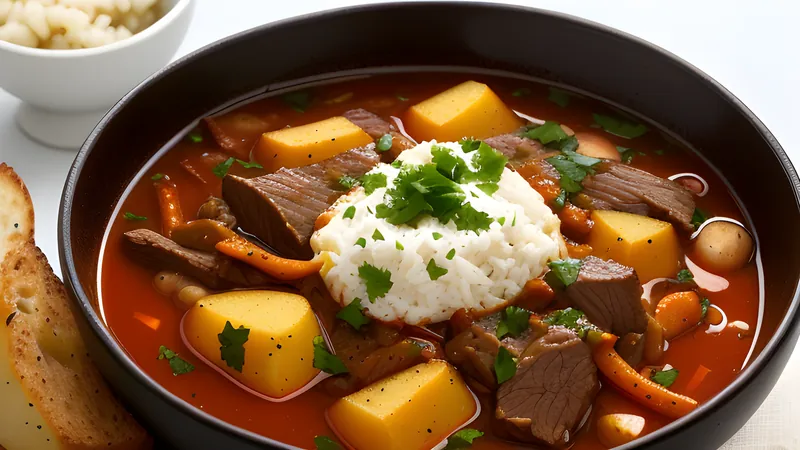
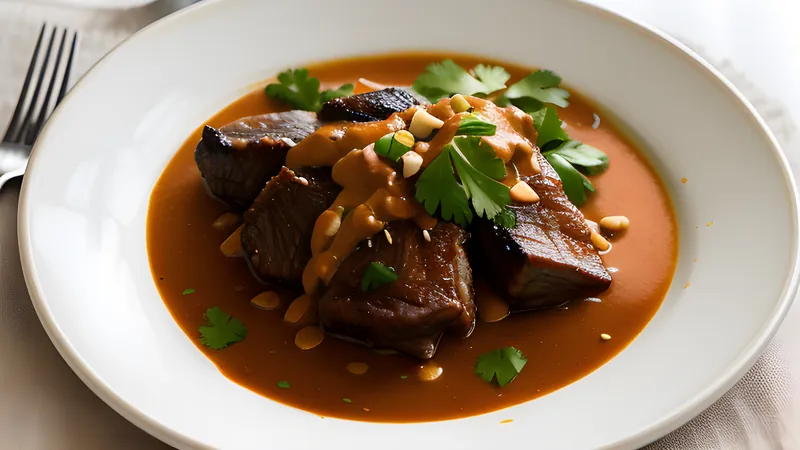
↓ Jump to recipeKare-kare is the dish Kapampangan cooks reach for when the point is to feed a crowd properly: oxtail and tripe simmered until they surrender, bathed in a peanut sauce coloured a deep orange-red by annatto seed, thickened not with flour alone but with toasted ground rice, the way it’s been done for generations. It arrives at the table looking almost too rich to be true, and then you taste the sharp, funky hit of bagoong alamang stirred in at the last second and the whole thing clicks into balance.
Kare-Kare: Oxtail in a Peanut Sauce
Ingredients
- 1.5kg oxtail, cut into 5cm pieces
- 500g beef tripe, cleaned and pre-boiled (optional)
- 2 litres water or beef stock
- 2 tbsp annatto (atsuete) seeds
- 4 tbsp vegetable oil
- 1 onion, chopped
- 6 garlic cloves, minced
- 4 tbsp toasted rice flour (galapong na bigas)
- 150g smooth unsweetened peanut butter
- 2 aubergines, cut into batons
- 200g string beans (sitaw), trimmed and cut into 5cm lengths
- 1 banana blossom heart, sliced (optional)
- 2 heads bok choy or pechay, halved lengthways
- 2 tbsp fish sauce, plus more to taste
- Salt, to taste
- 4 tbsp bagoong alamang (fermented shrimp paste), to serve
Method
- Simmer the oxtail and tripe in the water with half the onion, half the garlic and a pinch of salt for 2.5–3 hours, skimming scum, until the meat comes away from the bone easily.
- Lift the meat out and strain the broth; you need about 1.5 litres for the sauce, so top up with water if you've reduced below that.
- Warm the oil over low heat, add the annatto seeds and swirl for 3–4 minutes until the oil turns deep orange-red, then strain out and discard the seeds.
- Sauté the remaining onion and garlic in the annatto oil until soft, stir in the toasted rice flour and cook for a minute to lose its raw smell.
- Whisk in the reserved broth gradually so no lumps form, then stir in the peanut butter and simmer for 10 minutes until glossy and thick enough to coat the back of a spoon.
- Return the oxtail and tripe to the pot and simmer for 10 minutes to warm through and absorb the sauce.
- Add the aubergine and banana blossom first, cook for 4 minutes, then the string beans for 3 minutes, then the bok choy for a final 2 minutes so nothing turns to mush.
- Season with fish sauce and salt, then serve hot over steamed rice with a small dish of bagoong alamang alongside for spooning over each mouthful.
Where the name actually comes from
Pampanga calls itself the culinary capital of the Philippines without much argument from anyone who’s eaten there, and kare-kare is one of the province’s clearest arguments for the title. The most persistent origin story places it in the kitchens serving Spanish and, later, colonial officials stationed at Fort Santiago in Intramuros, Manila, who wanted a curry and got something else entirely: local cooks lacked the cumin, coriander and turmeric a Malay or Indian curry would call for, so they built a sauce from what Luzon actually had — peanuts, annatto for colour, rice for body — and served it back with a shrug that amounted to “kari-kari,” curry-curry, close enough. Whether or not that story is literally true, the name’s rhythm — the doubled syllable, the wink at an absent original — has stuck for long enough that most Kapampangan families tell some version of it themselves.
What’s better documented is the dish’s status as feast food. Oxtail and tripe were not throwaway cuts in the Philippines the way they sometimes are elsewhere; a whole ox slaughtered for a fiesta yields exactly one tail, so a pot of kare-kare signalled that a family had killed an animal rather than bought scraps. The dish shows up at baptisms, town fiestas and Sunday lunches for the same reason a British family might reach for a rib roast: it says the occasion matters. Older Kapampangan households still make the version with tripe and sometimes ox tongue alongside the tail, a nod to using the whole animal that the beef-only kare-kare served in most Manila restaurants has quietly dropped.
Some food historians push the trail further back, pointing to centuries of trade between the Visayas and Indian Ocean ports that predate Spanish colonisation entirely, arguing that spiced stews with ground nuts as a base arrived in the archipelago through Southeast Asian trading routes long before any Spanish official asked for a curry. The two stories aren’t in real competition — trade contact and colonial kitchen improvisation could both have shaped the dish over different centuries — but the Fort Santiago tale is the one told at family tables, which is its own kind of truth.
Building the sauce properly
The two ingredients that separate a convincing kare-kare from a beige approximation are the annatto oil and the toasted rice. Annatto seeds (atsuete) don’t taste of much on their own — they’re there purely for colour, releasing a rust-orange stain into warm oil within a few minutes — but without them the sauce goes a flat, unappetising brown no matter how good the peanut butter is. If you can’t find annatto seeds, a teaspoon of annatto powder stirred straight into the oil works, or in a pinch a small pinch of paprika will get you closer to the right colour, though it won’t taste the same.
Toasted rice flour is the traditional thickener, and it does something peanut butter alone can’t: it gives the sauce a slightly grainy, substantial texture rather than a purely smooth one, closer to a good satay sauce than to peanut soup. If you’re making your own, toast raw rice in a dry pan until it’s the colour of light hazelnuts, then grind it fine in a spice grinder — it keeps for months in a sealed jar and is worth making a double batch of. Skipping it and using cornflour instead will thicken the sauce fine but loses that texture entirely.
Peanut butter quality matters more than most recipes admit. A cheap, sweetened supermarket peanut butter will throw the whole sauce’s balance towards sweet, fighting against the savoury broth and the fish sauce. Reach for a natural, unsweetened variety with a short ingredient list — just peanuts and maybe salt — and you’ll get a rounder, more savoury result that reads as a proper stew rather than a dessert sauce gone wrong.
What goes wrong
The single biggest mistake is undercooking the oxtail and then trying to compensate by simmering it in the finished peanut sauce for an hour, which just breaks the sauce and leaves you with split oil pooling on top. Oxtail needs its own long simmer in plain, well-salted water first — two and a half to three hours, until a fork slides through the meat with no resistance — before it ever meets the peanut sauce. The sauce itself only needs ten minutes with the meat in it to marry the flavours; it isn’t a braising liquid.
The second common failure is vegetable timing. Aubergine, banana blossom, string beans and bok choy all cook at wildly different speeds, and if you dump them in together you get mushy aubergine sitting next to beans that still squeak. Stagger them by cook time, aubergine and banana blossom first since they take the longest to soften, beans next, bok choy last so it keeps some bite and colour.
A third, quieter failure is skimming too little fat off the initial oxtail broth. Oxtail renders a genuinely large amount of fat over three hours, and if you skip skimming, that fat floats into the finished sauce and sits as an oily sheen on top rather than emulsifying properly. Take five minutes partway through the simmer, and again once the meat is out, to spoon off the worst of it; the sauce will still be rich, just not greasy.
Bagoong alamang deserves a word of its own: it is fermented shrimp paste, sharply salty and pungent, and it is not optional garnish so much as the dish’s seasoning backbone served separately so each diner controls their own intensity. Some cooks stir a spoonful directly into the pot before serving instead, which mutes the funk but also mutes some of what makes kare-kare kare-kare. If bagoong alamang is genuinely unavailable, a small dish of good fish sauce cut with a little lime is a reasonable stand-in, though it won’t have the same body.
Serving customs worth knowing
Kare-kare is traditionally plated with the sauce ladled generously over the meat and vegetables rather than served on the side, so the rice underneath soaks it up properly. Diners then spoon bagoong alamang onto their own plate rather than into the communal pot, a small courtesy that keeps the shared dish from tipping too salty for guests who prefer it milder. At larger gatherings you’ll often see kare-kare served from a wide clay palayok set at the centre of the table, kept warm over a low flame or candle burner so the sauce doesn’t set as the meal stretches on.
It’s also common in Pampanga to serve kare-kare as the centrepiece of a much larger spread rather than alone, flanked by simpler vegetable dishes and a vinegar-based dip, precisely because the peanut sauce is rich enough that most cooks build the rest of the meal around cutting through it rather than adding to it.
Substitutions and variations
Ground roasted peanuts, pounded in a mortar until mostly smooth with a few coarser bits left, gives a rougher, more rustic sauce than smooth peanut butter and is closer to what many home cooks in Pampanga actually use — try it if you want more texture. Vegetarian versions swap the oxtail for extra vegetables and sometimes fried tofu, though the sauce loses the gelatinous richness the oxtail’s connective tissue contributes over its long simmer, so don’t expect an equivalent result, just a different one worth its own place at the table. Some coastal versions add a handful of blanched prawns alongside the meat, closer to the seafood kare-kare served in parts of the Visayas.
Banana blossom can be hard to source outside larger Asian supermarkets; if you can’t get it, simply increase the aubergine and add a head of extra bok choy rather than trying to substitute something unrelated in its place. Oxtail can also be swapped for beef shank or short rib if that’s what your butcher has, though the tail’s high collagen content gives the finished sauce a silkier body that shank alone won’t quite match.
A pressure cooker cuts the oxtail simmer dramatically, down to around 45 minutes at high pressure, if you’re working against the clock — the texture comes out nearly as good, though the broth will be slightly less concentrated since less liquid evaporates during cooking.
Storage and make-ahead
Kare-kare keeps well in the fridge for up to three days and, like most braises, tastes better the day after cooking once the sauce has had time to settle into the meat. Reheat gently on the hob rather than in the microwave, adding a splash of water or stock if the sauce has thickened too far on standing, since peanut sauces continue to firm up considerably once chilled. Freeze the meat and sauce together for up to two months, but add the fresh vegetables only after thawing and reheating, cooking them fresh into the reheated sauce rather than freezing them, since previously frozen aubergine and beans turn watery and grey.
If you’re cooking the oxtail portion ahead for a dinner party, you can prepare it up to the point of returning the meat to the finished sauce a full day in advance, then finish with the fresh vegetables just before serving so they keep their colour and bite. This also gives the fat in the broth time to set on top in the fridge overnight, making it far easier to lift off cleanly than trying to skim a hot liquid.
Serve kare-kare alongside other Kapampangan and wider Filipino dishes for a proper spread: the sharp vinegar note in lechon kawali’s blistered crackling cuts nicely through the peanut sauce’s richness, and a plate of chicken tinola with green papaya makes a lighter counterpoint if you’re feeding a crowd that wants variety across the table. For dessert after all that richness, something bright is welcome rather than another heavy plate.
Related Content