Kapustnica: Slovak Sauerkraut and Sausage Soup
Smoked meat, dried mushrooms, prunes and the sour cabbage that carries them
Contents
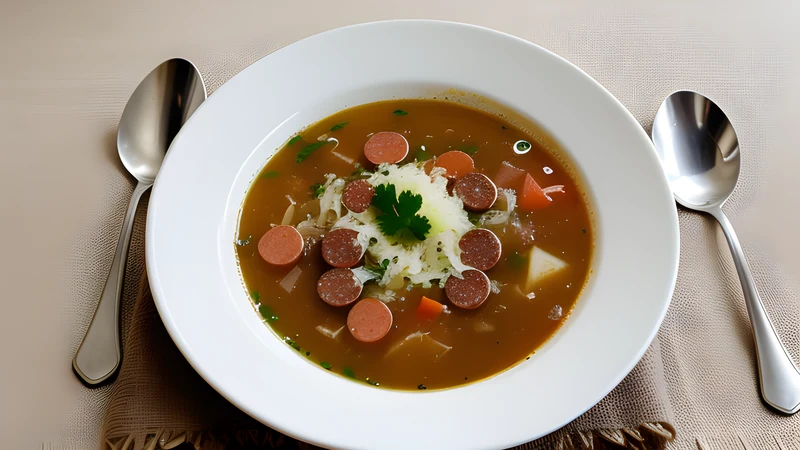
↓ Jump to recipeKapustnica is what a household eats on Christmas Eve in Slovakia, before the carp, in a room where the tree has just been lit and nobody is allowed to sit down until the youngest child spots the first star. It is also what that household eats on the twenty-eighth of December, and the second of January, because it makes six litres and gets better every day. Both facts are true and the second one is the reason the dish survived.
The soup is a sour, smoky, dark red-brown thing with sauerkraut suspended in it, sausage coins, shreds of hock meat, mushrooms and — the detail that makes people suspicious — prunes. It reads on paper as a collision. In the bowl it resolves into something very coherent, and the prunes turn out to be the hinge.
Kapustnica: Slovak Sauerkraut and Sausage Soup
Ingredients
- 20 g dried porcini
- 300 ml just-boiled water, for soaking
- 1 smoked pork hock or 300 g smoked pork ribs
- 1.8 litres cold water
- 600 g sauerkraut, drained, with 150 ml of its brine reserved
- 300 g Slovak klobása or other coarse smoked sausage, cut into 5 mm slices
- 2 tbsp lard or vegetable oil
- 2 medium onions, finely diced
- 4 garlic cloves, finely chopped
- 2 tbsp sweet Hungarian paprika
- 1 tsp caraway seeds
- 4 bay leaves
- 8 whole allspice berries
- 6 whole black peppercorns
- 6 pitted prunes, halved
- 1 tbsp plain flour
- 150 ml soured cream, at room temperature, plus more to serve
- 1 tsp caster sugar, or to taste
- Salt and freshly ground black pepper
Method
- Soak the dried porcini in the just-boiled water for 20 minutes. Lift them out, chop roughly, and reserve the liquid, leaving the gritty last tablespoon in the bowl.
- Put the smoked hock in a large pot with 1.8 litres cold water. Bring slowly to the boil, skim off the grey foam, then simmer, partly covered, for 60 minutes.
- Lift the hock out and let it cool enough to handle. Strip the meat from the bone, shred it, discard the skin and bone, and set the meat aside. Keep the stock in the pot.
- Melt the lard in a frying pan over a medium heat. Cook the onions for 8 minutes until soft and just golden. Add the garlic and caraway and cook 1 minute more.
- Take the pan off the heat, wait 20 seconds, then stir in the paprika. Cook in the residual heat for 30 seconds only — paprika burns fast and turns bitter.
- Scrape the onion mixture into the stock. Add the sauerkraut, the chopped porcini and their soaking liquid, the bay, allspice, peppercorns and prunes. Simmer, uncovered, for 30 minutes.
- Meanwhile, fry the sausage slices in the same frying pan for 4 minutes until the edges catch. Add them and the shredded hock meat to the pot for the last 15 minutes.
- Whisk the flour into the soured cream until smooth. Ladle in 200 ml of the hot soup, whisking, then stir the mixture back into the pot. Hold at a bare simmer for 5 minutes; do not boil.
- Taste. Add reserved sauerkraut brine 1 tbsp at a time if it needs more sourness, sugar if it is too sharp, and salt last — the smoked meat may have supplied enough.
- Rest the soup off the heat for 10 minutes, then serve in deep bowls with an extra spoon of soured cream and dark rye bread.
The Christmas Eve context
Slovak Christmas Eve — Štedrý večer, the generous evening — was historically a fast day, which meant no meat. This creates an obvious problem for a soup built on smoked pork, and the tradition solved it the way traditions always do: by splitting. There is a lean kapustnica made with dried mushrooms and no meat at all, eaten on the twenty-fourth in observant households, and a fat one loaded with klobása and hock, eaten on the twenty-fifth and every winter evening after. In much of the country the fast has quietly lapsed and the sausage version now appears on Christmas Eve regardless, which older relatives will mention.
Regional variation is intense. Eastern Slovakia leans on more sauerkraut and less meat. The area around Žilina adds more mushrooms. Some families put in a splash of red wine, others dried plums instead of prunes, others both. There are households where the recipe includes exactly one specific sausage from one specific butcher and the whole thing is considered ruined without it. This is a dish people argue about with real feeling.
What it shares with the wider region is the underlying logic: preserved cabbage plus preserved pork, simmered long, soured and enriched. The Polish bigos is the same instinct pushed towards a stew rather than a soup, with fresh cabbage alongside the sour. The Russian shchi strips the idea back to cabbage and broth. Kapustnica sits between them, wetter than bigos and richer than shchi.
Sauerkraut: the one ingredient to be fussy about
Get proper fermented sauerkraut, sold refrigerated, with nothing in the ingredients beyond cabbage and salt. The pasteurised jars on the ambient shelf have been heated to stability and taste of vinegar and cardboard, and no amount of simmering brings back what the heat took out. If you can find a Polish or Slovak shop, buy it loose from the barrel; it will be cheaper and better. If you want to know what actually happens inside the crock, making it yourself takes three weeks and a jar.
Drain the kraut and keep the brine — that liquid is your seasoning lever at the end. Whether to rinse depends on your kraut. A very sharp, very salty one benefits from a brief rinse under cold water; a mild one should go straight in. Taste it raw first. If it makes you flinch, rinse it.
Do not chop the sauerkraut finer. Its long strands are the textural spine of the soup and they should stay identifiable after ninety minutes. They will soften considerably and that is fine.
Why prunes belong in this soup
The prunes are the part guests query, and the answer is straightforward once you taste the soup without them.
Sauerkraut brings lactic acid. Smoked pork brings salt, fat and phenolic smoke compounds. Paprika brings a mild pepper sweetness and colour. Left alone, those three produce a soup that is sour and salty and smoky and has no bottom to it — everything hits at the same sharp register and the finish is short.
Prunes fix this two ways. They dissolve slowly over the simmer, releasing sugar that rounds the acid the way the pinch of sugar rounds a vinaigrette. And they contribute their own dried-fruit compounds, which sit in a deep, dark, faintly winey register that gives the soup a long tail. Six prunes across six litres is homeopathic in quantity and structural in effect. Nobody at the table identifies prune; everybody notices when they are gone.
The teaspoon of sugar at the end does a version of the same job, faster and cruder. Use it to adjust; use the prunes to build.
Choosing the smoked meat
The soup has two pork jobs and they want different animals. The hock builds the stock: an hour of simmering pulls gelatine out of the skin and connective tissue, which is what gives kapustnica its faint body on the lip, and the cure supplies the salt and the smoke that everything else is arranged around. A smoked ham hock from any decent butcher does this. Smoked pork ribs work too and give slightly less gelatine and slightly more meat.
The sausage is the other job, and it should be coarse-ground, smoked and firm enough to hold its shape in slices after fifteen minutes in liquid. Slovak klobása is ideal — a paprika-forward, garlicky, air-dried sausage. Polish kiełbasa wiejska is a very good stand-in and easier to find. A Spanish chorizo will work in the mechanical sense and will drag the soup somewhere else entirely, because pimentón and Hungarian paprika are different animals despite both being ground red pepper.
Avoid anything fine-textured and emulsified — a frankfurter or a bockwurst disintegrates into pale rings of nothing. Avoid fresh, unsmoked sausage: the smoke is doing real work here, and a fresh Cumberland contributes fat and pork and none of the phenolic depth the soup is built around.
Frying the sausage separately before it joins the pot is worth the extra pan. Cut faces meeting hot metal give you browning, and browning in a soup this dark is flavour you will never get from simmering alone. Four minutes, medium-high, until the edges curl and catch.
Mushrooms and the dried-versus-fresh question
Dried porcini here, always. This is one of the rare cases where dried genuinely outperforms fresh, and the reason is concentration. Drying a bolete concentrates its glutamates and its guanylates, and those two compounds together produce a savoury effect far larger than either alone. Twenty grams of dried porcini contributes more mushroom flavour to six litres of soup than 300 g of fresh chestnut mushrooms would, and it costs less than the fresh alternative once you account for water weight.
The soaking liquid goes in. This is where most of the extracted flavour ended up, and pouring it down the sink is the most expensive mistake in the recipe. Pour it in and stop before the last tablespoon, which holds the grit.
In Slovak households the mushrooms are often whatever the family dried themselves the previous autumn, threaded on string above the stove. Those tend to be a mix — boletes, a few chanterelles, sometimes something nobody can name any more — and the resulting soup is more complicated than mine.
The paprika rule
Paprika is ground sweet pepper, and it contains enough sugar to burn at frying temperature within seconds. Burnt paprika is unmistakably bitter and it does not cook out.
So: onions and garlic first, pan off the heat, count to twenty while it drops below the danger zone, then stir the paprika in and give it thirty seconds in the residual warmth before the liquid arrives. Those thirty seconds matter — paprika’s carotenoids are fat-soluble, and blooming them in the lard is what turns the soup the deep red-brown it should be rather than a muddy orange. Skip the bloom and add paprika to the water and you get colour without flavour.
Use sweet Hungarian paprika, and buy it from somewhere with turnover. Paprika stales badly; a tin that has been in the cupboard for two years is dust. If you like heat, add half a teaspoon of hot paprika alongside the two tablespoons of sweet, which is how it is done around Košice.
The soured cream, and how to keep it smooth
Same rules as every soured-cream soup in the region. The cream is 18–20% fat with a lot of casein, the soup is hot and acidic, and dropping one into the other guarantees curdling.
Whisk flour into the cold cream first — the starch physically obstructs the proteins clumping. Temper with 200 ml of hot soup, whisking hard. Return to the pot. Hold at a bare simmer for five minutes to cook out the flour and never let it boil after that point.
Some Slovak cooks add no cream to the pot at all and simply put a spoonful on each bowl at the table. That version is cleaner and lets each person decide, and it removes the curdling risk entirely. I like a little in the pot for body and more at the table, which is a compromise with no traditional authority behind it.
Failure modes
Bitter soup. Burnt paprika, almost every time. There is no fix; start the onion base again.
Thin, sharp, no depth. Not enough time. Ninety minutes is a minimum and this soup genuinely improves at two hours. Also check the prunes went in.
Aggressively salty. Smoked hocks vary enormously in cure strength. This is why salt is the last thing you add, and why the hock’s cooking water becomes the stock rather than being discarded — you need to taste it before you commit. If it is already too salty after the hour, dilute with 300 ml water and carry on.
Grey, curdled surface. The cream boiled. Blend a ladleful smooth and stir it back for a partial rescue.
Everything tastes of smoke and nothing else. Too much smoked sausage relative to kraut. The ratio here is roughly 1:2 sausage to sauerkraut by weight for a reason.
Making ahead, storing and the honest verdict
Kapustnica is better on day two and better still on day three. The acid softens, the smoke integrates, the prunes finish dissolving. Cool it quickly, refrigerate, and reheat gently — if you have added cream, keep it below a boil forever.
It freezes well for three months, though the cream version can go slightly grainy on thawing. If you plan to freeze, leave the cream out and add it to each reheated batch.
Here is my reservation. The traditional Christmas version often includes a large amount of fat — lard, fatty klobása, the hock’s rendered fat — and skimming is considered a failure of nerve. I skim. A tablespoon or two of fat off the surface after the hour costs the soup very little and makes a second bowl possible. Purists in Bratislava may disagree, and they are eating this once a year while I am eating it every fortnight from November to March.
Serve it with dense dark rye and nothing else. If you are building a Slovak table around it, bryndzové halušky afterwards is the canonical follow-up, though be aware that is roughly four thousand calories of dinner.
Related Content