Kanelbullar: Swedish Cinnamon Buns With Pearl Sugar
The knot, the syrup glaze, and a national day on 4 October
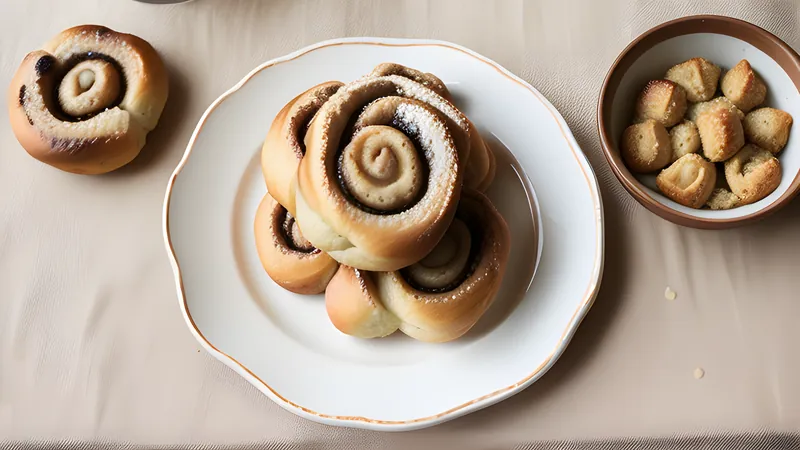
Contents
↓ Jump to recipeSweden has a national cinnamon bun day. It falls on 4 October, it was invented in 1999 by the Home Baking Council — an industry body representing flour and yeast manufacturers, which tells you something about how these things start — and it worked completely. Kanelbullens dag is now observed in offices, schools and bakeries across the country, and Swedes eat something like seven or eight kanelbullar per person per year, which is a low number until you consider that the same country also eats 40 million semlor in February.
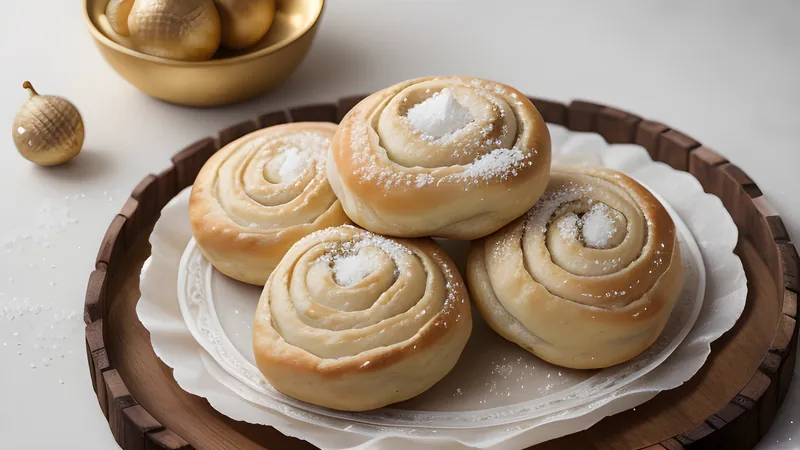
The Swedish bun is its own animal, and the American cinnamon roll is a different one. It is leaner, less sweet, scented with cardamom as well as cinnamon, baked hot and fast, glazed with a thin sugar syrup, and finished with pearl sugar. There is no cream cheese frosting anywhere near it. Understanding why is most of understanding the bun.
Kanelbullar: Swedish Cinnamon Buns With Pearl Sugar
Ingredients
- 300 ml whole milk, warmed to 37°C
- 50 g fresh yeast, or 17 g instant dried yeast
- 80 g caster sugar
- 1 tsp fine sea salt
- 2 tsp green cardamom pods (about 25 pods), seeds only
- 100 g unsalted butter, softened
- 580 g strong white bread flour
- 120 g unsalted butter, very soft, for the filling
- 100 g light brown soft sugar, for the filling
- 2 tbsp ground cinnamon
- 0.25 tsp fine sea salt, for the filling
- 1 medium egg, beaten, for glazing
- 50 g caster sugar, for the syrup
- 50 ml water, for the syrup
- 60 g Swedish pearl sugar (pärlsocker)
Method
- Crush the cardamom seeds coarsely in a mortar immediately before mixing.
- Dissolve the fresh yeast in the warm milk in a large bowl. For dried yeast, whisk it into the flour and simply warm the milk.
- Add the sugar, salt, crushed cardamom and 480 g of the flour. Mix to a shaggy dough and knead for 5 minutes.
- Add the 100 g softened butter in 4 pieces, kneading each in fully. Work in the remaining 100 g flour gradually. Knead 8–10 minutes more until smooth and glossy.
- Cover and prove for 60 minutes, until doubled.
- Beat the 120 g very soft butter with the brown sugar, cinnamon and 0.25 tsp salt to a smooth, spreadable paste.
- Roll the dough on a lightly floured surface to a rectangle roughly 50 x 35 cm and 4 mm thick, with a long edge facing you.
- Spread the filling evenly right to the edges. Fold the rectangle in half lengthways, bringing the bottom edge up to meet the top, giving a 50 x 17.5 cm strip.
- Cut the strip into 16 vertical strips, each about 3 cm wide.
- Take a strip, twist it 3 or 4 times along its length, then wind it around two fingers twice and tuck the loose end up through the centre of the coil. Place on a lined tray.
- Repeat with the remaining strips, spacing them well across two lined trays. Cover loosely and prove for 45 minutes until visibly puffed.
- Heat the oven to 225°C. Brush the buns with beaten egg.
- Bake for 8–10 minutes until deep golden brown.
- While they bake, boil the 50 g caster sugar with the 50 ml water for 2 minutes to make a thin syrup.
- Brush the hot buns with the hot syrup the moment they leave the oven, then scatter immediately with pearl sugar so it sticks.
- Cool on a wire rack for 15 minutes. Eat warm.
Fika, and the bun as social infrastructure
Fika is the Swedish institution of stopping for coffee and something sweet, and it is closer to a civic obligation than a habit. Workplaces schedule it. It happens twice a day in many offices. Sweden drinks more coffee per head than almost anywhere on earth — consistently top three or four globally — and the bun exists to be eaten alongside it.
That context explains the recipe. A pastry designed to be eaten twice a day, every day, with a strong black coffee, has to be restrained. It cannot be a dessert. American cinnamon rolls carry roughly twice the sugar and come loaded with a frosting that would make a second one unthinkable; you eat one and you are done for the day. A kanelbulle is engineered so you can have another one at three o’clock.
The bun’s ancestry is Central European — the wound, filled, sweet yeast dough travelled north through Germany, and the Swedish version emerges properly in the 1920s, once white flour, sugar and cinnamon were all cheap enough for ordinary households. That timing puts it a good deal later than most people assume. Kanelbullar are a twentieth-century industrial product that became a national symbol in about eighty years flat, which is a fast run for a folk food.
Cardamom, which is the actual point
If your kanelbullar taste only of cinnamon, you have made a cinnamon roll with a Swedish name.
The dough carries two teaspoons of cardamom seeds, crushed coarse, and it is the defining flavour. Cardamom arrived in Scandinavia via the Viking trade routes to Constantinople and the Arab world, and northern Europe has used it at volumes that baffle cooks from the spice’s native India ever since — Sweden and Norway between them consume a startling proportion of the world’s green cardamom relative to their populations.
Grind it yourself, immediately before mixing. Cardamom’s aroma sits in 1,8-cineole and α-terpinyl acetate, both volatile enough to escape a jar of pre-ground powder within weeks. An intact pod protects them for years; a mortar takes ninety seconds. Crush the seeds coarse — you want dark flecks visible in the crumb and the occasional small aromatic burst rather than a uniform background. This is the same argument I make about semlor, and it is the same answer.
The knot
The classic spiral is fine and every Swedish bakery makes them. The knot — kanelknut — is better, and it is what you will find in the good places.
Roll, fill, fold in half, cut into strips, twist each strip along its length, wrap it round two fingers, tuck the end through. It takes about fifteen seconds a bun once you have done three, and it looks like it took a professional.
The reason to bother is structural. A spiral bun has all its filling in concentric bands and its centre compressed by the winding; the middle stays underbaked and the outer layer unwinds on the plate. A knot has the filling folded through in a random tangle, more exposed surface for caramelisation, and a mechanical interlock that stops it opening up. It also bakes more evenly, because heat gets into the middle instead of having to conduct through six layers of dough.
The fold-in-half step is what makes the twist possible — you are creating a two-layer strip with filling inside, which twists without the filling squeezing out. This is the trick, and it is why Swedish recipes fold and most translated ones do not.
The dough
One hundred grams of butter to 580 g of flour puts this at around 17% butter, which is markedly leaner than a brioche and a shade leaner than the semla dough. That leanness is deliberate; the bun needs to be light and slightly bready so the coffee has something to do.
Add the butter after five minutes of plain kneading, in four goes. Fat added at the start coats the flour proteins and prevents the gluten network forming, and you will knead for twenty-five minutes to reach a structure that eight minutes would have given you. The dough will look curdled after each addition and will recover.
Roll thin — 4 mm — and large. A thick sheet gives you a doughy, underfilled bun. If the dough fights back and springs, cover it and wait ten minutes; the gluten needs to relax and it will roll out to size without an argument.
Hot and fast
225°C for eight to ten minutes. This is aggressive for an enriched dough and it is correct.
The mechanism is moisture. A kanelbulle is a small object with a high surface-to-volume ratio, and any time it spends in the oven beyond what is needed to set the crumb is time spent drying it out. A hot oven gives you rapid oven spring, fast Maillard browning on the surface, and a crumb that is set but still wet. Twenty minutes at 180°C produces a bun that is technically baked and tastes like a biscuit.
Watch them from minute seven. The gap between deep golden and burnt sugar is under ninety seconds, because the filling’s brown sugar is exposed on the knot’s surface and it will catch.
The syrup glaze, and why there is no icing
Boil 50 g of sugar with 50 ml of water for two minutes and brush it onto the buns the instant they come out. Two things happen. The hot syrup penetrates the crust and puts moisture back into the surface, which keeps the bun soft for a day longer than an unglazed one. And it dries to a thin tacky film that holds the pearl sugar.
This is the whole finishing system, and it explains the absence of frosting. A Swedish bun is finished while it is at 200°C, in about ten seconds, by a baker with a brush. Cream cheese icing requires a cooled bun, a piping bag, and roughly 200 calories a head of additional sugar and fat. It is a different food philosophy — the icing is the point of an American roll, and the bun is the point of a Swedish one.
Pearl sugar — pärlsocker — is compressed sugar in hard opaque nuggets that resist melting at oven and syrup temperatures. It gives you white specks that stay white and a crunch that survives. Crushed sugar cubes are a decent substitute; nib sugar from a German shop is the same product. Demerara will dissolve and disappear.
The filling, and the ratio that matters
One hundred and twenty grams of butter, 100 g of brown sugar, two tablespoons of cinnamon, a quarter-teaspoon of salt, beaten to a paste. Note what is absent: there is no flour in it, no egg, no cream.
The butter has to be very soft — the consistency of thick mayonnaise, spreadable with an offset palette knife without dragging the dough. Melted butter is the classic error. It soaks straight into the sheet, leaves nothing behind to hold the sugar, and then pours out of the buns in the oven and welds them to the tray. Take the butter out two hours ahead, or cube it and leave it somewhere warm for twenty minutes. Microwaving it in bursts almost always overshoots.
Two tablespoons of cinnamon in 16 buns is a lot of cinnamon, and it should be. Use cassia rather than true Ceylon cinnamon here — cassia is the coarser, hotter, more assertive bark that most supermarkets sell as “cinnamon”, and it is what the Swedish bun is calibrated for. Ceylon is more delicate and more floral and gets lost entirely under the cardamom.
The quarter-teaspoon of salt in the filling is the detail nobody writes down. Sugar and fat together read as flat without it; salt sharpens the cinnamon and makes the sweetness legible instead of merely present. Half a teaspoon is better if your butter is unsalted and your palate is like mine.
The case against
Kanelbullar are a four-hour project with a four-hour peak, and they are genuinely worse the next morning. Everything about them is calibrated for a bun eaten warm within sight of the oven, which makes them a poor thing to bake for a party the day before and an excellent reason to own a freezer.
They are also, by the standards of what most people expect from a cinnamon bun, underwhelming on first bite. If you have grown up on the American roll — the gooey centre, the frosting, the sheer sugar — a kanelbulle can read as dry and plain. That reaction is a fair description of the design brief rather than a failure. The bun is built to disappear alongside coffee and to leave you willing to have another one before lunch. Judged on its own terms it is one of the great pieces of bread engineering in Europe; judged as a dessert it will lose every time.
And the cardamom is not optional or negotiable. Without it, all the work above produces a competent enriched bun with cinnamon in it, which you can buy anywhere. The same distinction separates a proper Swedish cardamom bun from a supermarket approximation, and it separates a real kringle from a sweet plait.
Storage and troubleshooting
Kanelbullar are best within four hours and acceptable for a day. They freeze extremely well — cool completely, bag, freeze up to three months, and refresh straight from frozen at 180°C for five minutes, which brings them back almost entirely.
Filling leaked everywhere. The butter was melted rather than very soft, or the dough was warm. Chill the rolled sheet for ten minutes before cutting if your kitchen is hot.
Buns unwound in the oven. The tuck was not tucked. Push the loose end firmly up through the centre and press it against the tray.
Dry. Overbaked, or the syrup was skipped. Both are common and the syrup is thirty seconds of work.
Dense. Under-kneaded, or under-proved. The shaped buns should look inflated and hold a fingerprint halfway before they go in.
No cardamom. The jar. Always the jar.
Serve with black coffee, standing up, at ten in the morning. That is what they are for.
Related Content