Janssons Frestelse: Potato and Sprat Gratin
Matchstick potatoes, cured sprats, cream, and a name nobody can agree on
Contents
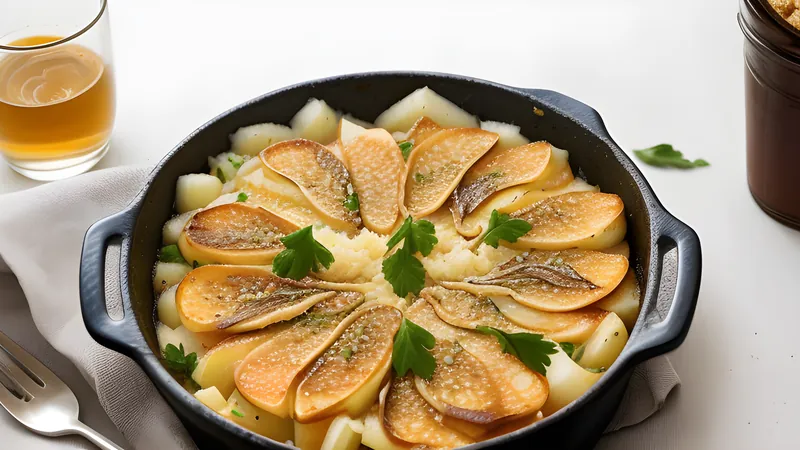
↓ Jump to recipeJansson’s frestelse — Jansson’s temptation — is the dish on the Swedish Christmas table that people go quiet for. It is potatoes, onions, cream and small cured fish, baked until the top browns and the cream underneath has thickened into something between a sauce and a custard. It costs about four pounds to make and it will outshine every expensive thing on the table.
My twist is three tablespoons of the brine from the tin, whisked into the cream. Most recipes tell you to drain the sprats and throw the liquid away. That liquid is a spiced, sweet, salty cure containing cinnamon, cloves, allspice, ginger and sandalwood, and it is the single most concentrated flavour in the entire dish. Pouring it down the sink is a decision, and I think it is the wrong one.
Janssons Frestelse: Potato and Sprat Gratin
Ingredients
- 900 g floury potatoes (King Edward or Maris Piper), peeled
- 2 large onions (about 300 g), halved and thinly sliced
- 50 g butter, plus extra for the dish
- 2 tins Swedish ansjovisfiléer (about 250 g total), drained, brine reserved
- 300 ml double cream
- 150 ml whole milk
- 0.5 tsp ground white pepper
- 0.25 tsp ground allspice
- 3 tbsp reserved sprat brine
- 40 g coarse dried breadcrumbs
- 15 g butter, melted, for the crumbs
Method
- Heat the oven to 200°C (180°C fan). Butter a 2-litre baking dish generously.
- Cut the potatoes into matchsticks 5 mm thick and 5 cm long. Do not rinse them — the surface starch thickens the cream.
- Melt 50 g butter in a frying pan over medium-low heat. Cook the onions for 12–15 minutes until soft, sweet and pale gold. Season with a pinch of salt.
- Cut each sprat fillet across into 3 pieces.
- Layer a third of the potatoes into the dish. Scatter over half the onions and half the sprats. Repeat, then finish with a final layer of potatoes.
- Whisk the cream, milk, white pepper, allspice and reserved brine together. Pour evenly over the dish — it should come about three-quarters of the way up.
- Bake uncovered for 35 minutes.
- Mix the breadcrumbs with the melted butter and scatter over the top. Return to the oven for 20 minutes until the top is deep gold and a knife slides into the centre with no resistance.
- Rest for 10 minutes before serving. The gratin firms up as it cools.
The name, the fish, and two separate arguments
Start with the fish, because this is where every English-language recipe for this dish goes wrong.
Swedish ansjovis means sprat — Sprattus sprattus — cured in a sweet spiced brine. The word is a false friend, and it has been catching English speakers out for a century. Mediterranean anchovy is Engraulis encrasicolus, cured in salt alone, and it tastes of salt and fish and very little else. Swedish sprats taste of cinnamon and clove and sugar. Substitute one for the other and you get a dish that tastes actively wrong, aggressively salty where it should be gently spiced.
The confusion is a nineteenth-century labelling accident. Swedish producers marketed sprats under the more prestigious anchovy name, the name stuck, and the country has been quietly confusing foreigners ever since. Abba and Grebbestads are the two brands you will find; both are widely available online and in Scandinavian grocers, and a tin keeps for years. If you genuinely cannot get them, cured Baltic herring in a spiced brine is the nearest thing. Mediterranean anchovies are not a substitute, and if they are all you have, make something else.
Now the name. There are at least four competing origin stories, and Swedish food historians have spent real energy on this.
The one most often repeated credits Pelle Janzon, an opera singer of the 1890s known as a spectacular gourmand. The problem is that the dish under this name does not appear in print until 1940, in Stina Lindqvist’s recipe collection, half a century later.
The second claims it is named for Janssons frestelse, a 1928 Swedish film starring Edvin Adolphson, on the grounds that a Christmas gratin taking the title of a popular melodrama is exactly the kind of joke a 1930s cook makes. The dates work considerably better.
The third, more prosaic, suggests Jansson is simply the most ordinary surname in Sweden — the equivalent of Smith — and that the dish is anyone’s temptation.
The fourth is a nineteenth-century religious sect: Erik Jansson led a puritan group who emigrated to Illinois in 1846, and the legend has him caught eating the gratin after preaching abstinence. It is a lovely story and there is no evidence for it at all.
What is documented is that the dish itself, under other names, predates all of these. A gratin of potato, onion and ansjovis appears in Swedish cookbooks from the 1910s as ansjovislåda or frestelse, without the Jansson. Somebody attached the name around 1940 and it never came off.
The potatoes
Matchsticks, cut by hand, 5 mm thick. This is the one job in the recipe that takes effort and it is not negotiable.
A mandoline gives you slices, and slices lie flat against each other and turn the middle of the gratin into a dense, wet layer that never cooks properly. Matchsticks stack loosely. Cream gets between them. Every strand cooks at the same rate, and the finished gratin has structure — you can see the individual pieces on the spoon.
If you own a mandoline with a julienne attachment, that is exactly right; it is the plain slicing blade that ruins the dish. Otherwise: cut the peeled potato into 5 mm planks, stack two or three planks, cut across into 5 mm sticks. Twenty minutes for 900 g, once you find the rhythm.
Floury potatoes. King Edward, Maris Piper, or a Swedish mjölig variety. The point of a floury potato here is that its cells separate as they cook and shed starch into the cream, thickening it from within. Waxy potatoes hold together and the cream stays thin and splits at the edges.
And do not rinse the cut potatoes. Every instinct from making chips says to wash the starch off. Here the starch is the thickener, and rinsing it away is the most common reason a Jansson’s comes out soupy.
Building it
Onions first: fifteen minutes over medium-low heat, to soft and pale gold. You want sweetness rather than colour. Onions added raw stay crunchy in the finished gratin, because there is not enough free water in a cream-bound dish to soften them properly in fifty-five minutes.
Cut the sprat fillets across into thirds. Whole fillets buried in the middle give you a mouthful of intense fish followed by three mouthfuls of nothing. Chopped, they distribute and dissolve — by the end of the bake most of them have broken down entirely into the cream, which is the intention.
Layer potato, onion and fish, potato, onion and fish, potato. The top layer is bare potato so it can brown.
The liquid — cream, milk, white pepper, allspice, brine — goes over last and should come three-quarters of the way up. Fully submerged potatoes steam rather than roast and the top never crisps. The exposed peaks are what turn deep gold.
The breadcrumbs question
Traditional Swedish recipes are split. Roughly half include a breadcrumb top, half consider it an adulteration. I am firmly in the crumb camp, and I add them for the last twenty minutes rather than at the start — thirty-five minutes of dry heat on buttered crumbs gives you charcoal.
Use coarse dried crumbs, ideally from a dark rye loaf like rugbrød or a broken-up sheet of knäckebröd. Panko is too uniform and reads as a schnitzel.
What happens in the dish over fifty-five minutes
It is worth knowing what you are waiting for, because the temptation to pull it out early is real and the last fifteen minutes are where the dish is made.
For the first ten minutes nothing much happens beyond the cream coming up to temperature. Around 60°C the potato starch granules begin absorbing water and swelling. By twenty minutes they have burst and started shedding amylose into the surrounding cream, which is the moment the liquid stops being pourable and starts being a sauce. This is why cutting the potatoes thin matters twice over: thin sticks reach 60°C fast, and they have proportionally more cut surface for starch to escape from.
Meanwhile the sprats are falling apart. The brine has already broken their proteins down substantially over months in the tin, and forty minutes at 200°C finishes the job. By the end you should struggle to find an intact fillet. Their spice — the cinnamon and clove that came out of the tin with them — has gone into the cream along with a large amount of glutamate, and that glutamate is what makes an otherwise plain potato gratin taste as savoury as it does.
The top browns last. Exposed potato dries, its surface sugars and the cream’s lactose caramelise, and the whole thing takes on the colour it needs. If your top is pale at fifty-five minutes, three minutes under a hot grill will fix it without touching the interior.
Substitutions and variations
Kalix löjrom Jansson’s. Fold 2 tbsp of bleak roe through the cream. Expensive, and extraordinary. If you are already buying roe for toast Skagen, a spoonful diverted here is well spent.
Vegetarian. There is no honest substitute for the sprats, so stop pretending. Make it with 200 g of sliced brown mushrooms fried hard in butter, a tablespoon of soy and a teaspoon of ground allspice instead, call it a potato and mushroom gratin, and let it stand on its own.
Leek instead of onion. Two large leeks, sliced and softened in butter, in place of the onions. Milder and slightly sweeter; a good version for people who find the standard dish too assertive.
Half-and-half with celeriac. Swap 300 g of the potato for celeriac cut the same way. It thickens less, so drop the milk to 100 ml.
Where it goes wrong
It is soupy. Waxy potatoes, or you rinsed them, or the potatoes were cut too thick to release starch in the time available. Give it another 15 minutes uncovered; some of it will reduce.
It is too salty. Two tins is right for 900 g of potato. If you scaled the fish up without scaling the potato, that is the answer. There is no rescue.
The centre is raw and the top is black. Oven too hot, or the dish too deep. A 2-litre dish spreading the gratin to about 5 cm deep is the target. Foil over the top and 15 more minutes at 170°C will save it.
It splits and goes greasy. Single cream or milk alone. Double cream has enough fat and enough stability to hold at 200°C for the best part of an hour; lower-fat dairy breaks.
Serving and storage
It belongs on a julbord next to gravlax, inlagd sill and cold meats, and it is traditionally the last thing served — hot, near midnight, after everything else has been picked over. It is also the standard Swedish 2 a.m. dish at parties, which tells you something about how it eats after drinking.
As a weeknight main it needs nothing beyond a sharp green salad and a beer.
Rest it for a full ten minutes. Straight from the oven the cream has not set and it slumps on the plate; ten minutes later it holds a clean edge.
It keeps 3 days covered in the fridge and reheats well at 180°C for 20 minutes, covered for the first 15. It does not freeze — the potato goes grainy and the cream separates on thawing. Make it the size you will eat.
Related Content