Jägerschnitzel With Mushroom Cream Sauce
The pork cutlet built to be drowned
Contents
↓ Jump to recipeA Jägerschnitzel is what happens when you take a schnitzel and decide, deliberately and with full knowledge of the consequences, to pour sauce on it. In Vienna this is close to a moral offence. In most of Germany it is Tuesday.
The two dishes have opposite goals, and the confusion between them is the reason so many home versions disappoint. A Wiener Schnitzel is engineered so the crumb lifts away from the meat in a dry, blistered, souffléd shell — a thing that survives about ninety seconds of contact with liquid before it turns to porridge. A Jägerschnitzel is engineered the other way: a thicker cut, a coat pressed hard so it bonds to the pork, a crumb dense enough to take sauce and stay crunchy underneath. Every technique in this recipe follows from that.
Which means the mistake to avoid is making a delicate schnitzel and then ruining it. Make a sturdy one instead.
Jägerschnitzel With Mushroom Cream Sauce
Ingredients
- 4 pork loin steaks, boneless, 150 g each
- 1.5 tsp fine sea salt
- 0.5 tsp freshly ground black pepper
- 80 g plain flour
- 2 large eggs, beaten with 1 tbsp whole milk
- 150 g dry white breadcrumbs
- 300 ml neutral oil, for frying
- 300 g chestnut mushrooms, quartered
- 150 g mixed wild or dried mushrooms (or a further 150 g chestnut)
- 50 g unsalted butter
- 1 banana shallot, finely diced
- 2 fat garlic cloves, finely sliced
- 1 tsp fresh thyme leaves
- 3 tbsp brandy or Weinbrand
- 150 ml dry white wine
- 400 ml well-flavoured beef or veal stock
- 150 ml double cream
- 1 tsp Dijon mustard
- 1 tsp red wine vinegar
- 3 tbsp flat-leaf parsley, chopped
Method
- If using dried mushrooms, cover 20 g of them with 150 ml boiling water and leave for 20 minutes. Lift them out, chop, and reserve the soaking liquid, discarding the gritty last tablespoon.
- Start the sauce. Melt 25 g of the butter in a wide frying pan over a high heat. When it foams, add the mushrooms in a single layer and leave them undisturbed for 3 minutes. They will release water; keep the heat high and let it boil off completely, which takes 6–8 minutes, then stir until they are properly browned at the edges.
- Add the shallot and the remaining 25 g butter, lower the heat to medium, and cook for 4 minutes until soft. Add the garlic and thyme and cook for 1 minute more.
- Pour in the brandy and let it bubble away almost entirely, scraping the base of the pan. Add the wine and reduce by half, about 4 minutes.
- Add the stock and any reserved mushroom soaking liquid and simmer briskly for 10–12 minutes until reduced by roughly a third and slightly syrupy on a spoon.
- Stir in the cream, mustard and vinegar and simmer for a further 4 minutes. Season with 0.5 tsp salt and a good grind of pepper. Keep warm over the lowest heat while you fry.
- Beat the pork steaks between clingfilm to an even 6–7 mm — thicker than a Wiener Schnitzel. Season both sides with the remaining salt and pepper.
- Set out flour, egg-and-milk, and breadcrumbs in three dishes. Coat one steak at a time: flour and shake off the excess, egg, then crumbs, pressing firmly with the flat of your hand this time so the coat compacts.
- Heat the oil in a heavy pan to 175°C, to a depth of about 1 cm. Fry each schnitzel for 3 minutes on the first side and 2–3 on the second, until deep gold and firm. An instant-read probe should show 63°C in the centre.
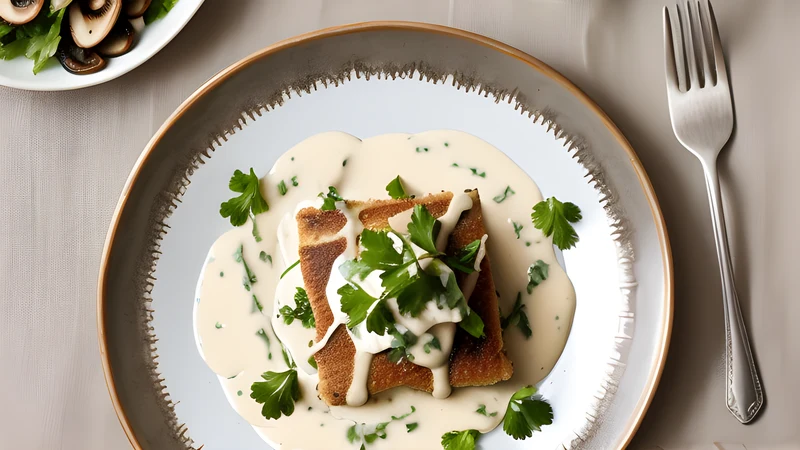
- Drain on kitchen paper for 30 seconds. Plate, spoon the mushroom sauce over half of each schnitzel, and scatter with parsley. Serve immediately with Spätzle or boiled potatoes.
The hunter and the mushroom
Jäger means hunter, and the received story is that hunters returning from the forest cooked their kill with the mushrooms they had picked on the way home. It is a pleasant image and probably backwards. In German cooking, Jägerart — hunter’s style — is a nineteenth-century restaurant term for a garnish of mushrooms, shallots and wine, applied to whatever protein was on hand: venison, beef, chicken, veal, eventually pork. The name describes the sauce, and the sauce travelled to the meat.
The Schnitzel half of it is a later marriage. Breaded pork cutlets became a German staple in the twentieth century as pork got cheap and veal did not, and the Jäger sauce was one of a small set of standard toppings that turned a plain cutlet into a menu item. Its siblings are Zigeunerschnitzel (a paprika and pepper sauce, now generally renamed Paprikaschnitzel for reasons that are entirely defensible), Rahmschnitzel (plain cream) and Zwiebelschnitzel (fried onions). Together they were the backbone of the West German Gasthaus menu from about 1955 onwards.
The dish also has a peculiar political afterlife. In the DDR, “Jägerschnitzel” meant something else entirely: a slice of Jagdwurst — a smooth pork sausage — breaded, fried and served with tomato sauce and pasta. It had no mushrooms and no cutlet. East German children ate it at school; West German adults ate the pork and mushroom version at inns. Thirty-five years after reunification, ordering Jägerschnitzel in Leipzig and in Stuttgart can still produce two unrelated plates, and people from each side will tell you the other one is fake. Both are real. They just have the same name.
Making the mushrooms taste of something
The sauce is where this dish is won, and the failure is nearly always the same: mushrooms that have been stewed instead of browned.
Mushrooms are around 90% water. Put them in a pan with butter over a medium heat and they immediately release that water, the pan temperature drops to 100°C, and they poach in their own liquid. Poached mushrooms are grey, squeaky and taste of very little. What you want is for that water to boil off entirely, so the pan can climb back above 140°C and the Maillard reaction can start on the mushroom surface, generating the roasted, meaty, savoury compounds that give the sauce its backbone.
So: high heat, a wide pan, and patience through the wet phase. There will be a moment, six or seven minutes in, when the pan is full of grey liquid and it looks like it has gone wrong. Hold your nerve and keep the heat up. The liquid boils off, the sizzle changes pitch from a hiss to a crackle, and within ninety seconds the mushrooms go gold. That pitch change is the cue. If you crowd the pan, this never happens — the mushrooms sit in a permanent puddle. Use the widest pan you own, or do it in two batches.
Dried mushrooms are a genuine upgrade here. Twenty grams of dried porcini contribute more glutamate than 200 g of fresh chestnuts, and their soaking liquid is free stock. Pour it in carefully and stop before the last tablespoon, where the grit settles.
The brandy is doing real work. Several of the aromatic compounds in browned mushrooms and thyme are alcohol-soluble and only weakly water-soluble, so a splash of spirit pulls flavour off the fond that stock alone leaves stuck to the pan. The mustard and the teaspoon of vinegar at the end are there to cut the cream — a cream sauce without an acid reads as flat and greasy on the third mouthful, and most home versions are missing exactly this.
Which mushrooms, and in what proportion
Chestnut mushrooms are the workhorse and they are better than white buttons for one measurable reason: they are a slightly older harvest of the same species, Agaricus bisporus, picked with the cap closed but the flesh further developed, and the extra days on the farm concentrate both the flavour compounds and the dry matter. They also brown more readily because they hold marginally less water.
Beyond that, a proportion of something wilder pays for itself. Fresh chanterelles in season are the Jäger ideal and are priced accordingly. Dried porcini are the cheap and reliable route: the drying process concentrates guanosine monophosphate, a nucleotide that acts synergistically with the glutamate already in the mushrooms and the stock, and the combination reads on the tongue as several times more savoury than either alone. This is the same synergy that makes dashi work, and it is why 20 g of dried porcini transforms a pan of ordinary chestnuts.
Slice thickly. Four to five millimetres. Thin slices lose all their structure once the water has gone and end up as leathery flecks; thick ones keep a bite that survives fifteen minutes in the sauce.
Pork, and why thicker is correct
Use loin steaks, boneless, around 150 g. Beat them to 6–7 mm, roughly double the thickness of a veal schnitzel. There are two reasons. Pork loin at 3 mm is dry and papery by the time the crumb colours — the muscle is leaner and has less intramuscular fat to buffer it. And a thicker cutlet gives you a substantial slab under the sauce, which is the texture the dish is asking for.
Press the crumbs on firmly. Where the Viennese technique is a fingertip touch designed to keep the coat loose, here you want the flat of your hand and real pressure, so the crumb layer compacts into a shell that bonds to the meat and resists moisture. Fry at 175°C, slightly cooler and slightly longer than veal, and take it to 63°C internal — pork loin at 63°C is faintly pink at the centre and juicy, and the old advice to cook it to 71°C is a holdover from a trichinosis risk that European pork has not carried in decades.
Sauce only half of it. Every good German kitchen does this: a ladle over one half, the other half left bare and crisp, so you can alternate. It is a small thing and it doubles the pleasure.
What to serve alongside
Spätzle is the default, and the cheese-laden version — Käsespätzle — is arguably too much alongside a cream sauce, so plain buttered Spätzle wins. Boiled waxy potatoes are the honest alternative. If you want a vegetable, German Rotkohl braised with apple and clove brings the sweet-sour note that the plate is otherwise missing, and its acidity does the same job as the vinegar in the sauce, only louder.
For the wider German-Austrian repertoire, Semmelknödel made from yesterday’s rolls are excellent mops for the leftover sauce, and Sauerbraten is the weekend project when you have four days to spare.
Troubleshooting and variations
The sauce is thin. You under-reduced the stock before adding the cream. Cream will not rescue a watery base; it dilutes it. Reduce the stock until a spoon drawn through the pan leaves a track that closes slowly.
The sauce split. Double cream at 48% fat is stable at a simmer, but single cream or crème fraîche will break if it boils. If it does split, take it off the heat and whisk in a tablespoon of cold water.
The crumb went soggy under the sauce. You sauced the whole cutlet and let it sit. Sauce at the table, or sauce half.
It tastes flat. The vinegar. Almost always the vinegar.
A version worth trying: replace 100 ml of the stock with the same amount of dark beer and add a teaspoon of tomato purée with the shallot. It pushes the sauce towards the Rhineland, deeper and slightly bitter, and it is very good with the pork.
Make-ahead and storage
The sauce is genuinely better made a day ahead — the mushroom flavours round out overnight and the cream loses its raw edge. Make it up to the point before the cream goes in, cool, and refrigerate for up to three days; add the cream, mustard and vinegar when you reheat. It also freezes well in the pre-cream state for three months.
The schnitzels themselves must be fried and eaten. Breaded pork can sit coated in the fridge for an hour if you are timing a dinner, which is a liberty a Wiener Schnitzel would never permit — the compacted crumb is more forgiving. Beyond an hour it goes damp. Leftovers reheat acceptably on a wire rack in a 190°C oven for 8 minutes, dry, with the sauce warmed separately and poured at the table.
Related Content