İskender Kebab: The Bursa Original
Sliced lamb over toasted pide, thin tomato sauce, cool yoghurt and foaming butter poured at the table
Contents
↓ Jump to recipeİskender kebab is a stack of four plain things that only work when they hit the plate hot, cold, sharp and rich all at once: dry toasted bread, thin lamb, a thin tomato sauce, and cool strained yoghurt, with foaming butter poured over the top in front of you. Every element is simple enough to describe in a sentence. The dish lives entirely in the temperature contrast and the timing, which is why so many versions outside Turkey feel like a beige plate of döner and gravy. Get the sequence right and it is one of the great assemblies in Turkish cooking.
İskender Kebab: The Bursa Original
Ingredients
- 800g lamb mince, around 20% fat (shoulder is ideal)
- 1 medium onion (about 150g), coarsely grated
- 2 garlic cloves, crushed to a paste
- 2 tsp fine salt
- 1 tsp ground cumin
- 1 tsp dried oregano
- 1 tsp pul biber (Turkish red pepper flakes)
- 1/2 tsp freshly ground black pepper
- 1 tbsp full-fat milk
- 500g passata (sieved tomatoes)
- 30g unsalted butter, for the sauce
- 1/2 tsp fine salt, for the sauce
- 1/2 tsp caster sugar, for the sauce
- 2 large pide or thick flatbreads (about 300g total), at least a day old
- 300g strained or thick Greek yoghurt, at room temperature
- 100g unsalted butter or sadeyağ (clarified butter), to finish
- 4 long green (sivri) peppers
- 2 tomatoes, halved
- Pul biber, to serve
Method
- Squeeze the grated onion hard in a clean tea towel over a bowl and keep the juice; discard the pulp. Put the lamb mince in a large bowl with the onion juice, garlic, 2 tsp salt, cumin, oregano, 1 tsp pul biber, black pepper and the milk.
- Knead the mince firmly with one hand for a full 5 minutes, slapping it back into the bowl every so often, until it turns sticky, pale and tacky enough to cling to your palm when you turn your hand over. This is what makes it sliceable.
- Press the mixture into a 900g (2lb) loaf tin lined with baking paper, pushing it into the corners so there are no air pockets. Level the top, cover, and chill for 30 minutes.
- Heat the oven to 180C fan / 200C conventional / gas 6. Bake the loaf for 45-50 minutes, until a probe pushed into the centre reads 70C. Pour off the rendered fat and reserve it. Cool the loaf, then wrap and chill for at least 4 hours, ideally overnight — a cold loaf slices thinly, a warm one crumbles.
- For the sauce, put the passata, 30g butter, 1/2 tsp salt and the sugar in a small pan. Simmer gently for 12-15 minutes, stirring now and then, until it coats the back of a spoon and has lost its raw edge. Keep it hot.
- Cut the pide into rough 2cm squares. Spread on a tray and toast at 180C fan for 8-10 minutes, until dry and lightly golden but still pale in the middle.
- Turn the cold lamb loaf out and slice it as thinly as you can manage, ideally 2-3mm, then cut the slices into strips about 3cm wide.
- Heat a large frying pan over a high heat with 1 tbsp of the reserved lamb fat. Fry the lamb strips in two batches for 2-3 minutes each, tossing, until the edges frizzle and brown. Char the peppers and tomato halves in the same pan for 3-4 minutes.
- Divide the toasted bread between four warm plates. Spoon a ladle of hot tomato sauce over the bread, then pile the lamb on top and spoon over a little more sauce.
- Melt the 100g butter in a small pan over a medium-high heat until it foams and smells nutty, about 3 minutes. Carry it to the table and pour it, still sizzling, over each plate.
- Add a generous spoonful of room-temperature yoghurt to the side of each plate, add a charred pepper and half a tomato, dust with pul biber and eat at once.
Bursa, 1867, and a man called İskender
Bursa sits at the foot of Uludağ in north-west Anatolia and was the first Ottoman capital, from 1326 until the court moved to Edirne. It made its money on silk and its reputation on food, and the kebab that carries the city’s name — Bursa kebabı is the other thing to call it — is dated by the family who serve it to 1867 and to İskender Efendi, known as Mehmetoğlu İskender.
The family’s claim is that İskender turned the kebab spit upright. Meat had been grilled horizontally over embers for centuries; standing the spit vertically next to the fire lets the fat baste the meat as it renders and lets the cook shave off the cooked outer layer while the inside carries on roasting. Every döner, gyro and shawarma stack works on that principle, including the chicken shawarma most of us actually eat on a Friday night.
Whether İskender got there first is genuinely disputed. Other accounts credit Hamdi Usta of Kastamonu with the vertical spit around the same period, and the honest position is that the idea was in the air in mid-nineteenth-century Anatolia and Bursa is where it acquired a plate, a sauce and a name. What is beyond argument is that the İskenderoğlu family are still in Bursa, still cooking, and have been fierce about the name — İskender is a registered trademark in Turkey, and the family have gone after restaurants using it without permission. The generic workaround you see on menus across the country, yoğurtlu kebap, exists because of those lawyers.
The setting matters to how the dish is eaten. The family’s shop sits in the old bazaar quarter of Bursa, the commercial heart of a city that grew rich as the western terminus of the silk trade, and İskender was invented as trade food — a plate for merchants with an hour to spare, served in portions (porsiyon) you order by the half. Ask for bir buçuk, a portion and a half, and nobody blinks. That commercial origin explains the economy of the thing: one cut of lamb, yesterday’s bread, tomatoes, yoghurt and butter, assembled in ninety seconds by someone who has done it ten thousand times.
It also explains the lamb. Bursa’s kebab houses talk about sheep grazed on the thyme and wild herbs of Uludağ, the mountain above the city, and whether or not you believe the pasture makes the difference, the preference it encodes is real: this dish wants lamb with character and enough fat to baste itself. Anything lean and mild disappears under the sauce.
The old-school Bursa detail worth stealing is the butter. Sadeyağ — clarified butter, traditionally from sheep’s milk in this part of the country — is heated until it foams and carried to the table, then poured over the plate in one theatrical arc. It looks like showmanship. It is doing work: the fat re-heats the bread that the cold yoghurt is about to hit, and it carries the tomato sauce down into the toasted cubes.
What actually makes it work
Four components, four jobs.
The bread. Pide, at least a day old, cut into rough cubes and toasted until dry. Fresh bread turns to paste under the sauce within a minute. Dry bread drinks the sauce and the butter and keeps a chew in the middle. This is the same logic as panzanella — stale bread is a structural ingredient with a job to do.
The sauce. Plain. Passata, butter, salt, a pinch of sugar if the tomatoes are sharp. No garlic, no onion, no herbs, no paprika. It is there to be sour and hot and thin enough to soak, and every seasoning you add crowds out the lamb.
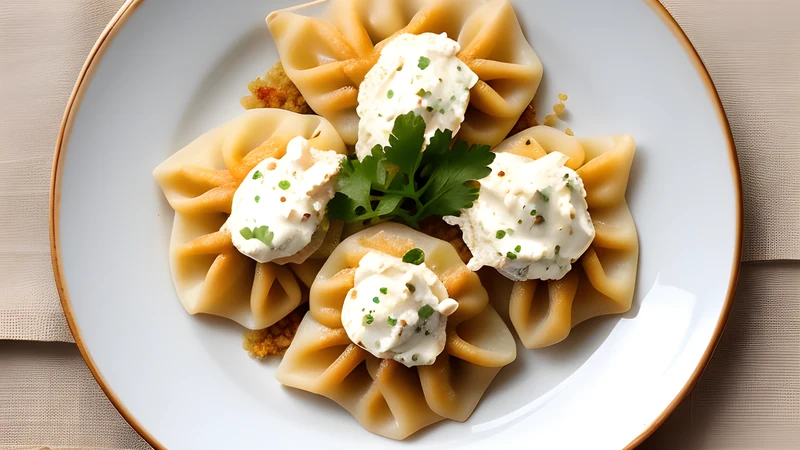
The yoghurt. Süzme, strained, thick, and at room temperature. Fridge-cold yoghurt kills the plate. It also stays unseasoned here, which is the fork in the road between this dish and manti, where the garlic goes into the yoghurt and drives the whole thing.
The lamb. Fatty, thin, and crisped at the edges. This is the part a home kitchen has to solve laterally.
Four things worth sourcing properly
Pul biber. Turkish red pepper flakes are coarse, slightly oily, sun-dried and mild-to-medium with a raisiny depth. Standard supermarket chilli flakes are a different plant doing a different job — hotter, drier, one-dimensional. Aleppo pepper is the closest easy substitute. A Turkish grocer will sell you a bag for less than the little supermarket jar costs.
Pide. The flat, thick, slightly chewy Turkish bread, ideally the plain round ramazan pidesi shape. A good thick pitta or a torn-up focaccia crust will stand in. What matters is that it has a soft open crumb to soak and enough body to survive it — thin, crisp flatbreads dissolve, and a dense sourdough goes gluey. If you are making your own, the puffy charred pita dough baked a little thicker and left a day is very close.
Yoghurt. Süzme means strained. Full-fat Greek yoghurt works as-is; ordinary natural yoghurt needs an hour in a muslin-lined sieve to lose its whey, or it slides off the plate. Homemade labneh taken off the strain early, at the thick-cream stage, is the best version of this you can put on a plate.
The butter. Sadeyağ is clarified, and clarified butter matters here for a practical reason: milk solids burn at the temperature you need to get the foam and the nutty smell, and burnt solids taste acrid over lamb. If you are using ordinary unsalted butter — which I usually do — watch it closely and take it off the heat the moment it smells of hazelnuts, about three minutes.
Building the döner without a rotisserie
You do not have a vertical spit, and stacking marinated lamb slices on a skewer in a domestic oven produces something grey and sad. The workaround that gets closest to the real texture is a pressed lamb loaf, sliced cold and crisped in a pan.
Fatty lamb mince gets kneaded with salt, onion juice and spices until it becomes tacky. That stickiness is myosin, the protein that dissolves out of muscle in the presence of salt and mechanical work, and it is the same mechanism behind a springy kofta or a good sausage. Five minutes of proper kneading gives you a loaf that slices like charcuterie. Two minutes of half-hearted stirring gives you a meatloaf that shatters.
Use the onion’s juice and throw the pulp away. Grated onion pulp holds a lot of water, and water in the loaf means steam pockets and a crumbly slice. The juice carries the flavour and the enzymes that tenderise, without the wet.
Then chill it. Overnight is best, four hours is the minimum, and this is the step people skip and regret. A cold, set loaf can be cut at 2-3mm with a sharp knife. A warm one tears no matter how good your knife is.
The 70C internal temperature is deliberate and slightly lower than you might bake a meatloaf to. Lamb mince at 70C is set, safe, and still juicy; carry on to 80C and the fat has largely fled the loaf and the slices fry up dry. Use a probe. The visual cues that work for a roast are useless inside a compacted loaf.
Pour off the rendered fat and keep it — that is a small jar of seasoned lamb dripping, and it is the correct fat for frying the slices, for the peppers, and for roast potatoes for the rest of the week.
The final fry is quick and the pan must be genuinely hot. You want the frizzled brown edges that a shaved döner gets from the fire, and 2-3 minutes in a crowded pan gives you steamed grey lamb instead. Two batches, high heat, and a spoonful of the fat you poured off the loaf.
Where it goes wrong
Cold plates. Everything about this dish is thermal. Warm the plates in the oven while the bread toasts.
Too much sauce. A ladle per plate, then a spoonful more over the meat. Drown the bread and you get soup with lamb in it.
Slicing the loaf warm. Covered above, and worth repeating because it is the one failure that ruins the plate.
Sweet sauce. Half a teaspoon of sugar exists to correct sharp passata. Taste first; a good ripe passata often needs none at all.
Garlic in the yoghurt. Tempting, wrong here, and it makes the plate taste like a different dish entirely.
A thick sauce. The passata wants to reduce enough to coat a spoon and no further. A jammy, concentrated sauce sits on top of the bread instead of sinking into it, and the whole architecture of the plate depends on the soak.
The version debate, and a shortcut
Purists in Bursa will tell you the meat should be hand-stacked slices of leg and shoulder, layered on the spit with sheets of fat-tail sheep fat between them, seasoned lightly and left overnight. That is the original, and it is genuinely better — the texture of separate muscle fibres is something no mince loaf reproduces. It also needs a vertical rotisserie and about four kilos of lamb before the stack is deep enough to cook evenly, which is why nobody does it at home.
The mince loaf is the honest compromise and it gets you perhaps eighty-five per cent of the way. If you want to close some of the gap, there is a middle route: mince half the lamb and hand-cut the other half into 3mm slices from a piece of shoulder, marinate the slices in the same spice mix for four hours, then layer them through the loaf as you press it in. You get pockets of proper sliced meat suspended in a binder that holds it all together, and it slices just as cleanly.
The name to look for on Turkish menus, incidentally, is yoğurtlu kebap — yoghurt kebab. It is the same plate under a name that does not attract a trademark letter.
Serving, and what to do with the leftovers
In Bursa the plate arrives with a charred long green pepper and a grilled tomato half tucked at the edge, and that bitter, blistered pepper against the butter is the reason to bother. A shepherd’s salad or shirazi-style chop of cucumber, tomato and onion on the side does the same job with less effort.
The loaf keeps, wrapped, for three days in the fridge and freezes well sliced, with baking paper between the layers — pull out a handful and crisp it straight from frozen. Cold slices in flatbread with yoghurt and pul biber is a lunch worth planning for.
Finish with Turkish coffee and, if you have been to Bursa, you will know that a piece of baklava after all that butter is somehow entirely reasonable.
Related Content