Hutspot: The Dutch Mash Born From a Siege
Carrot, onion and potato beaten together, eaten every October in Leiden
Contents
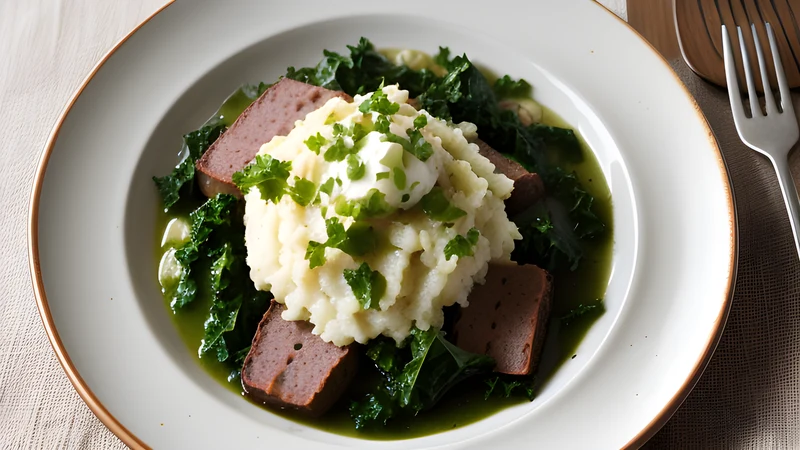
↓ Jump to recipeHutspot is orange, sweet and slightly rough, and it arrives with a piece of beef that has been simmering since the middle of the afternoon. It is one of two great Dutch mashes, and where boerenkool stamppot tastes of iron and smoke, this one tastes of caramelised carrot and long-cooked onion. Both are made with the same masher and the same wrist action. They belong to entirely different moods.
It also has the best origin story in Dutch cooking, and unusually for a food origin story, most of it holds up.
Hutspot: The Dutch Mash Born From a Siege
Ingredients
- 800 g beef brisket or short rib (klapstuk), in one piece
- 1 tbsp beef dripping or vegetable oil
- 1 bay leaf
- 4 whole cloves
- 6 black peppercorns
- 1.2 litres beef stock or water
- 800 g floury potatoes (Bintje, Maris Piper), peeled and cut into 4 cm chunks
- 600 g carrots, peeled and cut into 2 cm rounds
- 400 g onions, peeled and roughly chopped
- 1 tsp fine salt, for the pan
- 60 g unsalted butter
- 100 ml whole milk
- 1 tsp Dijon mustard
- 1/4 tsp freshly grated nutmeg
- 1/2 tsp freshly ground black pepper
- 1 tbsp cider vinegar
- 1 tbsp plain flour, for the gravy
Method
- Pat the brisket dry and season it with 1 tsp salt. Heat the dripping in a heavy casserole over high heat and brown the meat hard on all sides, about 10 minutes total, until it is deeply coloured.
- Add the bay leaf, cloves, peppercorns and enough stock to come three-quarters of the way up the meat. Bring to a bare simmer, cover, and cook over the lowest heat for 2 hours 30 minutes, turning once, until a fork twists freely in the meat.
- Lift the beef out, cover it loosely with foil, and strain the cooking liquid into a jug. Skim the fat from the surface and reserve 2 tbsp of it.
- Put the potatoes, carrots and onions in a large pan, cover with cold water by 2 cm, add 1 tsp fine salt and bring to a boil. Simmer for 22 minutes, until the carrot is soft enough to crush against the side of the pan with a spoon.
- Drain thoroughly in a colander and leave to stand for 3 minutes so the steam escapes.
- Warm the milk and butter together until the butter melts. Return the drained vegetables to the dry pan over low heat for 30 seconds, then pour in the hot milk and butter.
- Mash with a stiff masher until the potato is smooth and the carrot and onion are broken down into an orange-flecked, slightly rough purée. Leave some texture.
- Beat in the mustard, nutmeg, pepper and cider vinegar. Taste and add salt, usually about 1 tsp.
- For the gravy, heat the reserved 2 tbsp beef fat in a small pan, stir in 1 tbsp flour and cook for 1 minute. Whisk in 400 ml of the strained braising liquid and simmer for 4 minutes until it coats a spoon.
- Slice or shred the beef. Pile the hutspot into warm bowls, press a well into the top of each, fill it with gravy and lay the beef alongside. Serve immediately.
The siege of Leiden, and a pot left behind
In 1574 Leiden was under siege by Spanish forces for the second time in a year. The city had been cut off since May, the grain had run out by August, and by the end of September people were eating dogs, cats and boiled leather. Contemporary accounts put the death toll from starvation and plague at around six thousand out of a population of roughly eighteen thousand — a third of the city.
The relief came by water. William of Orange ordered the dykes cut, flooding the polders around the city so that a fleet of shallow-draught barges, the Watergeuzen, could sail across drowned farmland to reach the walls. The Spanish, camped on ground that was rapidly becoming a lake, abandoned their positions on the night of 2 October. According to the tradition, an orphan boy named Cornelis Joppensz climbed over the earthworks at Lammenschans the next morning and found a cooking pot still warm on a fire, containing a stew of carrots, onions and parsnips. He carried it back into the city and the citizens ate it.
The historian’s caveats are worth stating plainly. The Cornelis Joppensz story first appears in print well over a century after the event, the pot is a folk motif that attaches to sieges across Europe, and the potato was not in the Netherlands in 1574 at all — the modern hutspot only became possible around 1750. What is documented is the date, the flooding, the Spanish withdrawal and the herring and white bread that William’s fleet distributed to the survivors on 3 October.
That date is still a public holiday in Leiden. Every year on 3 October the city hands out free herring and white bread, the bells ring, and the restaurants and households eat hutspot met klapstuk. The pot itself — an object claimed to be the original — sits in the Museum De Lakenhal. The story may be embroidered. The commemoration is real and continuous, which is a stranger and better fact than any of the folklore.
Klapstuk, and why the beef takes three hours
Klapstuk is the Dutch butcher’s name for the flat rib or brisket end — a muscle threaded with connective tissue and worked hard during the animal’s life. This is the cut the dish requires, and substituting something leaner and more expensive makes it worse.
The reason is collagen. Klapstuk is packed with it, and collagen is tough and rubbery at low temperatures. Held between roughly 70°C and 85°C for two to three hours, it hydrolyses into gelatin, which dissolves into the surrounding liquid and gives the braise its body and the meat its yielding texture. This conversion is slow and time-dependent; there is no way to hurry it with higher heat, because above about 90°C the muscle fibres contract hard and squeeze out their moisture faster than the gelatin can compensate. A hard boil gives you dry, stringy beef sitting in a thin liquid — the classic failure.
So keep it at a bare simmer. You want a bubble breaking the surface every two or three seconds, no more. A heavy casserole with a tight lid on the smallest burner, or the oven at 140°C, both work. The fork test is the only reliable doneness check: a fork pushed into the thickest part should twist without resistance. Time is a guide; collagen conversion varies with the animal.
Brown the meat properly first. Ten minutes over high heat, turning only when each face releases, builds the Maillard compounds that make the braising liquid taste of beef rather than of wet meat. This is the flavour that ends up in your gravy, so it is the least skippable step in the recipe.
Building the mash
The vegetable ratio traditionally runs about equal parts potato and carrot with half as much onion, and the proportions matter more than they look. Carrot brings sugar and colour; onion brings sulphurous depth that turns sweet as it cooks; potato brings starch and the structural ability to hold a well of gravy. Push the carrot too high and the mash slumps and tastes like baby food. Push the potato too high and you have lost the point.
Everything goes into one pan together, which surprises people who expect staged timings. It works because 4 cm potato chunks and 2 cm carrot rounds finish within a couple of minutes of each other, and the chopped onion is fully collapsed by then anyway. Twenty-two minutes is the mark; test the carrot, since it is the slowest.
Floury potatoes only. High dry-matter varieties like Bintje have large starch granules that swell and separate cleanly, so the mash comes out fluffy and takes butter. Waxy potatoes have tight cells that shear open under the masher and release free starch into a gluey suspension. Mash by hand, straight up and down — a food processor ruptures every cell in the pan and produces wallpaper paste in about four seconds.
Warm the milk and butter before they go in. Cold dairy on hot potato starts the starch retrograding, and the mash turns tacky and dull. Leave the finished mash slightly rough: hutspot is meant to show flecks of carrot and shreds of onion rather than being a uniform purée.
Carrots, and the argument for buying them with tops on
Hutspot is a carrot dish wearing potato as a disguise, so the carrots decide how good it is. Supermarket carrots sold loose in a bag have usually been in cold storage for months, and cold storage is not kind to them: the plant continues to respire slowly, converting sugars back into energy, and the volatile terpenes that give a fresh carrot its perfume dissipate steadily. What is left is fibre and a flat, faintly soapy sweetness.
Carrots sold with their tops still attached are almost always more recently lifted, because the greens wilt within days and give the game away. That is the whole trick — the foliage is a freshness indicator the retailer cannot fake. If you can only get bagged carrots, choose the ones that snap cleanly rather than bending, and taste one raw before committing 600 g of them to a pan.
Size matters in the other direction from what people assume. Very large carrots develop a woody core with a bitter, resinous edge, because the xylem tissue at the centre lignifies as the root ages. Medium carrots, about 150 g each, give the best ratio of sweet outer phloem to woody core. If you are stuck with monsters, quarter them lengthways and cut out the pale central wedge.
Cut them into 2 cm rounds rather than dice. Rounds have less surface area for their volume, so they leach less sugar into the boiling water, and they collapse under the masher into short flecks rather than dissolving into a uniform orange slurry. The visible fleck is part of what hutspot is supposed to look like.
One optional step that changes the dish considerably: roast half the carrots instead of boiling them. Toss 300 g of rounds in a tablespoon of the reserved beef fat and roast at 200°C for 25 minutes until the edges are properly browned, then mash them in with the rest. The Maillard browning and the caramelised sugars give the mash a darker, more savoury bass note that the boiled version never reaches. Purists in Leiden will tell you this is wrong. They are not entirely mistaken about tradition, and they are missing a good supper.
Where it goes wrong
The mash is wet and sloppy. Carrots hold a lot of water and release it as they cook. Drain hard, rest the colander for three full minutes, and return the vegetables to the dry pan for thirty seconds before adding any liquid.
It tastes cloying. All that carrot sugar with nothing against it. The cider vinegar and the Dijon are doing real work; if it still reads sweet, add another teaspoon of vinegar and a serious amount of black pepper.
The beef is dry and stringy. The pot was above a simmer. Nothing recovers it, though shredding the meat and stirring it through the gravy hides a lot.
The gravy tastes thin. Not enough browning at the start, or the braising liquid was too dilute. Reduce the strained liquid by a third before making the roux.
It went grey. Old carrots, or you blitzed it.
Variations, and the day after
The Leiden orthodoxy is hutspot with klapstuk and nothing else. Elsewhere in the country people serve it with a rookworst steamed on top in the stamppot manner, or with plain fried bacon, or with the leftovers of a stoofvlees from the day before, which is entirely defensible and arguably better than the original.
Some Dutch cooks include parsnip, which is what the siege legend actually specifies and which the potato displaced. A 200 g parsnip swapped for 200 g of the potato takes the dish somewhere earthier and more medieval. Others brown the onions separately in butter before adding them, which costs ten minutes and buys a noticeable depth. A spoonful of the beef braising liquid beaten into the mash itself, rather than left for the gravy, is a trick worth stealing.
The mash keeps four days covered in the fridge and reheats in a pan with a splash of milk over low heat. Cold hutspot fries beautifully into patties — flour them, fry in butter for four minutes a side, top with a fried egg. The beef is better on day two, kept whole in its liquid so it does not dry out, and it shreds into a sandwich with mustard in the way that all good braises do. As with erwtensoep, Dutch winter cooking assumes there will be a second act.
Related Content