Horta Vrasta: Greece's Boiled Wild Greens With Lemon
Four ingredients, one pot, and a dressing built on the cooking water
Contents
↓ Jump to recipeThere is a dish in Greece that is a plate of boiled leaves with oil and lemon on it, that costs nothing, that takes twenty minutes, and that Greeks abroad describe missing more than they miss anything else. It is called horta vrasta — boiled greens — and it is on the table at almost every meal in the villages, sitting there in its ordinariness while the interesting food gets talked about.
The reason it works is that it takes four ingredients seriously, and one of them is water. My addition below concerns that water: instead of pouring the pot away, I reduce a cupful of it down with garlic and fennel seed and build the dressing on top of it.
Horta Vrasta: Greece's Boiled Wild Greens With Lemon
Ingredients
- 800 g mixed leafy greens (dandelion, chicory, kale, chard, beet tops, or a mix)
- 2 tbsp fine sea salt, for the cooking water
- 3 litres water
- 80 ml Greek extra virgin olive oil
- 1 large garlic clove, peeled and left whole
- 1 tsp fennel seeds
- Juice of 1 large lemon (about 40 ml)
- 1/4 tsp flaky sea salt, to finish
- Black pepper
- 1 lemon, cut into wedges, to serve
Method
- Fill a sink with cold water. Plunge the greens in, agitate hard, and lift them out into a colander leaving the grit behind. Repeat with fresh water until no sand settles. Wild greens need three changes; supermarket kale needs one.
- Trim any stems thicker than a pencil and set them aside separately. Leave the leaves whole.
- Bring 3 litres of water to a rolling boil in a wide pot with the 2 tbsp salt. It should taste aggressively of the sea.
- Drop in the thick stems first and boil for 4 minutes, uncovered.
- Add the leaves, push them under with tongs, and boil uncovered for 8-12 minutes, until a stem crushes flat between finger and thumb with no resistance. Bitter greens need the longer end.
- Lift the greens out with tongs into a colander. Do not tip the pot away. Let the greens drain for 5 minutes without pressing them.
- Measure 200 ml of the green cooking water into a small pan. Add the whole garlic clove and the fennel seeds and boil hard for 6-8 minutes, until reduced to about 3 tbsp of syrupy, dark liquid. Discard the garlic.
- Take the pan off the heat, let it stop bubbling, then whisk in the olive oil and the lemon juice. It will thicken and go cloudy.
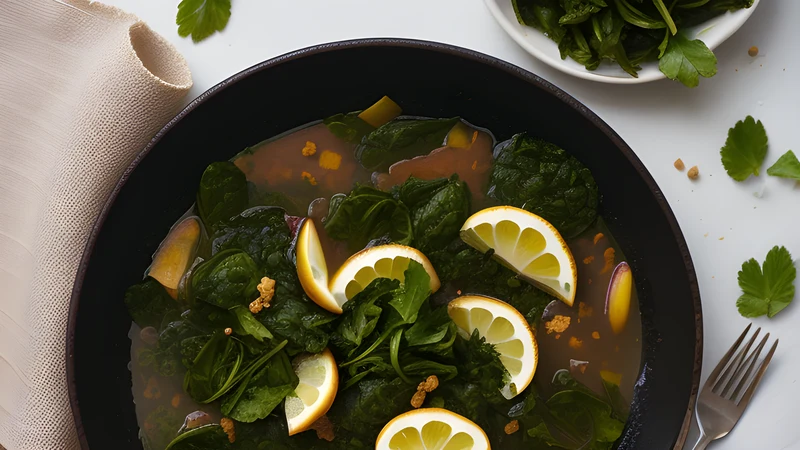
- Pile the warm greens on a wide plate, chopping them roughly if the leaves are unwieldy. Pour the dressing over, turn once, and finish with flaky salt and black pepper.
- Serve warm or at room temperature, with lemon wedges for people who want more.
What “horta” means
Horta is a category rather than a plant — anything leafy that grows without being planted, gathered from the roadside, the olive terrace, the edge of a field. The ethnobotanists who have gone out with Greek grandmothers with notebooks have recorded well over a hundred species in regular use on Crete alone. Dandelion (radikia), sow thistle (zochoi), wild chicory, wild fennel, mustard greens, mallow, poppy leaves, vine tendrils in spring, amaranth (vlita) in high summer when everything else has bolted.
The gathering is called hortopsarema, roughly “green-fishing”, and it is still a real activity rather than a heritage exercise. Go for a walk on Crete in February and you will pass people of retirement age with plastic bags and a small knife, working an embankment.
That biodiversity has been studied hard, because Crete kept appearing in mid-century epidemiology as a place where people with almost no meat and almost no money had strikingly low rates of heart disease. The Seven Countries Study started in the late 1950s and the finding held up. When later researchers analysed the actual greens, they found levels of alpha-linolenic acid, glutathione and various polyphenols far above cultivated spinach. Purslane, one of the commonest horta, has more omega-3 than any other leafy plant measured. Nobody in the village was eating it for that reason. They ate it because it was free and it was there.
In a British kitchen the honest substitution is a mix. Dandelion leaves from a good greengrocer if you can, otherwise cavolo nero, chard with its stems, beetroot tops, and a bunch of watercress or rocket stirred in at the end for pepperiness. The one rule is that a portion of it should be genuinely bitter, because bitterness is the flavour the lemon and oil are answering.
Why you boil it hard, uncovered, in a lot of salted water
Every instinct trained on modern vegetable cookery says to steam these, or wilt them in a pan with garlic, and keep them squeaky. Every instinct is wrong here. Horta is boiled properly soft — the test is a stem crushed flat between finger and thumb — and this is deliberate.
Two things are going on. Bitter greens contain sesquiterpene lactones, the compounds that make chicory and dandelion taste of chicory and dandelion. They are water-soluble, and a hard uncovered boil in a large volume leaches them out until the bitterness sits at a level a human wants to eat. Underboil, and the plate is punishing. The second thing is oxalic acid, high in chard, beet tops and amaranth: boiling in plenty of water and discarding most of it removes a real fraction of it, which is why the technique persisted in cultures eating a lot of these leaves.
Uncovered matters too. Volatile plant acids escape as steam from an open pot; trap them under a lid and they condense straight back onto the leaves, which is the mechanism behind grey, sour, sulphurous boiled greens. The salt in the water is at pasta levels, around 2 per cent, because the leaves are in there long enough to season through, and it is your only chance to salt them from the inside.
Cook the thick stems first. A chard stem takes twice as long as its own leaf, and putting everything in together gives you either raw stems or dissolved leaves.
The pot liquor
The water the greens boiled in — Greeks call it zoumi and drink it warm with lemon, straight, as a tonic — is dark green, mineral, and tastes overwhelmingly of the plant. Reducing 200 ml of it to three tablespoons concentrates that fifteenfold, and the concentrate is the base of my dressing.
There is a mechanical bonus. The reduced liquor carries dissolved pectins and plant polysaccharides which act as weak emulsifiers, so oil and lemon whisked into it hold together for several minutes instead of splitting on contact with the plate. A standard oil-and-lemon ladolemono slides straight off boiled leaves and pools at the bottom. This one clings.
The garlic goes into the reduction whole and comes out again. Its sulphur compounds infuse and its texture never appears, which suits a dish this quiet. The fennel seed is a nod to wild fennel, which grows all over the Greek roadside and would be in the horta bundle anyway if you were picking it there. Toast them in the dry pan for thirty seconds first if you want them louder.
Add the oil off the heat and after the bubbling stops. Extra virgin olive oil that is boiled loses precisely the peppery, grassy polyphenols you bought it for.
Picking your own, and the one real caution
If you are tempted to gather rather than buy — and it is the better version of this dish — the rules are simple and worth stating plainly.
Learn each plant individually and eat nothing you cannot name. The Asteraceae family, which contains dandelion, sow thistle and wild chicory and therefore most of what a Greek would gather, is broadly benign, but the countryside also contains hemlock, which is in the carrot family and has killed people who mistook it for wild fennel or wild parsley. The distinguishing features are real and learnable — hemlock has purple-blotched hollow stems and smells unpleasantly of mice when crushed, and wild fennel smells overwhelmingly of aniseed — and the correct posture for a beginner is still to leave anything umbelliferous alone until someone who knows has shown you in person.
Beyond identification: avoid roadside verges within a few metres of traffic, where lead and other exhaust residues accumulate in leaves; avoid field margins in arable country, which are routinely sprayed; avoid anywhere dogs are walked, for reasons that need no elaboration. Take the young growth and leave the crown, so the plant produces again. And wash it far harder than you think — three changes of standing water, agitated, lifted out rather than tipped out, because grit sinks and tipping pours it straight back over your leaves. Sand in horta is the one fault the dish cannot survive.
Dandelion is the easiest starting point in Britain: unmistakable, ubiquitous, and best in early spring before the flower stalks appear, after which the leaves turn savagely bitter. Nettle tops, blanched, work in the mix. Wild garlic in April is a fine and very un-Greek addition.
The oil is an ingredient in its own right
Eighty millilitres of extra virgin olive oil across 800 g of greens is a genuinely large amount, and if you use a bland oil you will have wasted the dish.
Greek olive oil is dominated by the Koroneiki cultivar, a small, high-phenol olive grown mostly in the Peloponnese and Crete, and the peppery catch at the back of the throat that a fresh one gives you is oleocanthal — a compound that binds the same receptor as ibuprofen, which is why the sensation is a sting rather than a taste. That pepperiness is the counterweight to the bitterness of the leaves and the sourness of the lemon, and a mild, sweet, late-harvest oil brings nothing to the argument.
Which is also why it goes in off the heat. The polyphenols in good oil degrade steadily above about 80C, and the volatile grassy aldehydes — hexanal and its relatives, the green-tomato-leaf smell — evaporate well below that. Whisk the oil into the reduced liquor once it has stopped bubbling, and you keep almost all of it.
Buy oil with a harvest date on the bottle, and treat the date seriously: the phenol content of an olive oil falls measurably over its first year in the bottle, and an oil three years past harvest is a cooking fat rather than a seasoning. Store it dark and away from the hob.
The lemon, and when it goes in
Lemon juice into the dressing, off the heat, at the very end. There is a chemistry reason for the timing and it is visible on the plate.
Chlorophyll is the pigment making these leaves green, and it holds a magnesium ion at the centre of its molecule. Acid displaces that magnesium and replaces it with hydrogen, converting chlorophyll to pheophytin, which is olive-brown. Boiled greens sitting in lemon juice turn drab within about fifteen minutes, and the process accelerates with heat. Dress them at the last moment and they stay green long enough to reach the table; dress them an hour early and you have a khaki plate.
This is also why the boiling water is never acidulated, and why Greek cooks put the lemon wedges on the table rather than in the pot. The squeeze belongs to the eater.
Roughly 40 ml — one large lemon — against 80 ml of oil gives a dressing at about one part acid to two parts fat, which is sharper than a standard vinaigrette and correct against bitter leaves and a mineral reduction. Taste it in the pan before it goes on. If the lemons were tired, add the zest of half of one to compensate; zest carries the aroma the juice has lost.
Notes, faults and what to do with the leftovers
It tastes of nothing. Underboiled, or undersalted water. There is no way to season leaves adequately after the fact.
It went khaki and slimy. Overboiled past the crush test by a wide margin, or the lid went on.
Too bitter. Boil the bitter fraction two minutes longer next time, and change the water once if you are using pure dandelion.
Squeezing. Drain, do not wring. Compacted greens turn into a wet brick and the dressing never gets in.
Leftovers are arguably the point. Cold horta, chopped, is the filling half of a spanakopita with charred spring onion and dill — a hortopita is exactly this with wild greens instead of spinach. Chopped fine and folded through fried eggs, or stirred into Greek white bean soup at the last minute, both work. They keep 3 days refrigerated, undressed.
The traditional plate is horta, a wedge of feta, bread, and a fried or grilled fish. In Greece the greens arrive at room temperature almost always, which is worth knowing before you decide yours have gone cold.
Related Content