Honey and Ricotta Phyllo Cups with Walnuts
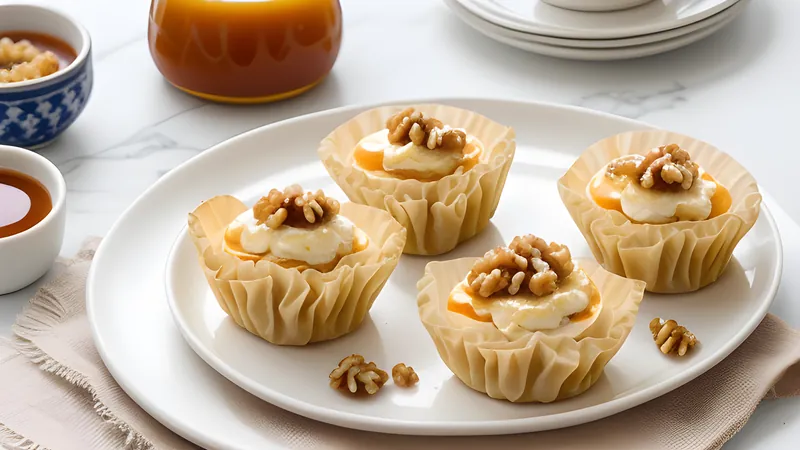
Crisp, golden filo shells filled with whipped ricotta and walnuts
Contents
↓ Jump to recipeThese little cups are the answer to the question of how to make a dessert that looks like real effort while taking barely twenty minutes of hands-on work. Crisp, ruffled shells of filo hold a cloud of whipped ricotta sweetened with honey and brightened with lemon, all crowned with honey-glossed walnuts. They are light, elegant and endlessly poppable, the sort of thing to set out after dinner with coffee or pile onto a platter for a party. The small twist is treating the ricotta like a savoury cheese given a sweet turn, whipping it smooth and perfuming it with cinnamon, lemon and a whisper of orange blossom water.
Honey and Ricotta Phyllo Cups with Walnuts
Ingredients
- 6 sheets of filo pastry
- 60g unsalted butter, melted
- 250g ricotta, well drained
- 3 tbsp honey, plus 1 tbsp to finish
- Finely grated zest of 1 lemon
- 0.25 tsp ground cinnamon
- 1 pinch fine salt
- 60g walnuts, roughly chopped and lightly toasted
- 3 to 4 drops orange blossom water (optional)
Method
- Heat the oven to 180C fan and lightly butter a 12-hole muffin tin.
- Lay one sheet of filo on the work surface, brush lightly with melted butter and top with a second sheet; repeat to make a stack of three buttered sheets, then make a second stack with the remaining three.
- Cut each stack into six squares, giving twelve squares in total.
- Gently press one square into each muffin hole, ruffling the corners upwards to form a cup.
- Bake the empty shells for 8 to 10 minutes until deep golden and crisp, then cool completely.
- Beat the drained ricotta with two tablespoons of the honey, the lemon zest, cinnamon, salt and the orange blossom water until smooth and light.
- Toast the walnuts in a dry pan over a medium heat for 3 to 4 minutes until fragrant, then toss with the remaining tablespoon of honey.
- Spoon or pipe the ricotta into the cooled filo cups just before serving.
- Top with the honeyed walnuts and a final drizzle of honey.
A dessert from the crossroads of the Mediterranean
Filo, ricotta, honey and nuts are the founding ingredients of an enormous family of sweets that stretches across the eastern and southern Mediterranean. Wherever the Ottoman Empire once reached, from Greece and the Balkans through Turkey and into the Levant, you find paper-thin pastry layered with butter, stuffed with cheese or nuts, and bathed in honey or sugar syrup. Baklava is the most famous of these, and if you want the full syrup-soaked version I have written it up separately in my pistachio baklava. The same quartet of ingredients turns up in Greek galaktoboureko, in Turkish künefe, and in dozens of regional pastries besides.
Ricotta itself belongs to the Italian side of this story. Its name comes from the Latin recocta, meaning recooked, because it is traditionally made by reheating the whey left over from cheesemaking and coaxing the last of the milk solids into soft, mild curds. That thrift made it the backbone of southern Italian sweets, most gloriously in Sicilian cannoli and cassata, where sweetened ricotta meets candied fruit and nuts. Sicily’s sweet-making was itself shaped by Arab rule over the island from the ninth to the eleventh centuries, which introduced sugar cane, citrus and almonds. These cups borrow freely from both halves of the map: the honey-and-walnut sweetness of the Levant married to the soft ricotta of Italy, in a format that needs no syrup and stays crisp. If you have never made your own ricotta, it is genuinely worth trying, and my homemade ricotta recipe gives you the cleaner, drier curd that works best here.
Working with filo, and keeping it crisp
Filo intimidates people, but it is friendlier than it looks once you accept its one rule: keep it from drying out. Work with one stack at a time and cover the rest with a barely damp tea towel, because exposed filo turns brittle and shatters within a few minutes. Brush each sheet lightly with melted butter as you layer; this is what crisps and golds the pastry and glues the sheets together into a shell that holds its shape. You do not need to drench it, just a thin, even film over the whole sheet.
The single most important technical point is to bake the shells empty and let them cool completely before filling. Filo is only crisp when it is dry, and any moisture, including the wet ricotta, softens it almost immediately. So bake the cups to a deep golden crisp, cool them fully on a rack, and fill them as close to serving as you can manage. A soggy filo cup is the one thing that can go wrong here, and this timing is the entire cure. If your shells come out pale in the centre, they will not hold up; give them the full ten minutes and colour is your guide.
The filling and the finish
Drain the ricotta well before you start. Supermarket tubs can be surprisingly wet, and excess liquid gives you a slack, weeping filling that slides out of the cups. Tip it into a sieve lined with muslin or kitchen paper and leave it for twenty minutes, or press it gently with the back of a spoon. Then beat it with two tablespoons of honey, the lemon zest, a quarter teaspoon of cinnamon and a pinch of salt until smooth and aerated, light enough to spoon or pipe. Taste and adjust the honey; ricotta varies in sweetness from brand to brand. A few drops of orange blossom water lift the filling into something quietly special, but go gently, adding three or four drops at most, because it is potent and tips easily into soapiness.
Toast the walnuts before you chop them. Three to four minutes in a dry pan over a medium heat wakes up their oils and chases off the faint bitterness that raw walnuts can carry. Watch them closely, because the line between fragrant and scorched is a matter of thirty seconds, and burnt nuts taste acrid rather than sweet. Tossing them in the reserved tablespoon of honey while still warm gives a glossy, sticky topping that contrasts beautifully with the cool, soft cheese and the shattering pastry beneath.
A word on honey, since it does so much of the flavouring here. A mild wildflower or acacia honey keeps the filling delicate and lets the ricotta and lemon lead, while a stronger honey such as orange blossom or thyme honey stamps its own character on the dish. Choose deliberately: this is a recipe where the honey is not a background sweetener but a headline ingredient, so a good jar earns its keep. Whatever you use, add it gradually and taste, because honeys vary widely in sweetness and intensity.
Filo, phyllo, and getting good pastry
Filo and phyllo are the same thing, the word simply meaning “leaf” in Greek, a nod to how thin the sheets are rolled. Making it from scratch is a craft that takes practice, stretching the dough by hand over a floured cloth until it is almost transparent, and for a recipe like this the shop-bought chilled or frozen sheets are entirely sensible and what most cooks across the region reach for. If using frozen filo, thaw it slowly in the fridge overnight rather than at speed on the counter, where the outer sheets thaw and dry while the middle stays frozen, leaving you with a brittle, unusable block. Bring it to room temperature in its wrapping before you unroll it, so the sheets stay supple.
The sheets vary in size by brand, so treat the “six sheets, two stacks of three” as a guide rather than gospel; what matters is that each cup is built from three buttered layers, thick enough to hold its shape and stay crisp but not so thick it turns leathery. If your sheets are small, use more of them; if large, trim to fit. Any offcuts can be layered, buttered, sprinkled with sugar and cinnamon and baked into crisp shards to crumble over yoghurt.
Make-ahead, storage and variations
Every element here can be made in advance, which is exactly why these earn their place at a party. Bake the shells up to two days ahead and keep them airtight at room temperature; if they soften in humid weather, five minutes in a 150C oven crisps them again. Make the filling a day ahead and keep it covered in the fridge. Toast and honey the walnuts whenever suits you and store them in a jar. Then assemble only just before serving, so the pastry keeps its crunch. Filled cups do not keep; they turn soft within an hour.
For variations, swap the walnuts for toasted pistachios or pecans, or scatter over a few pomegranate seeds for a jewel-bright, tart finish. A drizzle of dark, bitter chestnut honey is wonderful against the sweet cheese. Fold a spoonful of mascarpone into the ricotta for extra richness, or add a little finely chopped candied orange peel for a more cannoli-like result. A whisper of vanilla, or the seeds of a cardamom pod crushed fine, takes the filling in a warmer, more fragrant direction. For a summer version, fold in a little chopped fresh fig or a few crushed raspberries and skip the cinnamon, letting the fruit and honey carry the flavour.
Serving and scaling
These cups are built for a crowd, and the beauty of the format is that they scale cleanly: double the quantities for two tins and twenty-four cups, or halve everything for six. A piping bag with a plain or star nozzle gives the neatest, most bakery-like finish, but two teaspoons work perfectly well if you do not mind a rustic look. Arrange them on a single flat platter rather than stacking, so the pastry stays crisp and the toppings stay put, and finish the final drizzle of honey only once they are plated so it does not have time to slide off.
Serve them with strong coffee or a small glass of dessert wine, a chilled Vin Santo or a Muscat, whose sweetness and slight nuttiness echo the walnuts and honey. They sit happily on a mixed dessert table too. For a fuller spread, pair them with something citrus-sharp to balance the richness, or set them alongside the syrup-soaked layers of my pistachio baklava for a Mediterranean sweet platter that plays crisp against sticky, light against dense. Made carefully and assembled at the last moment, they punch far above the effort they take.
Related Content