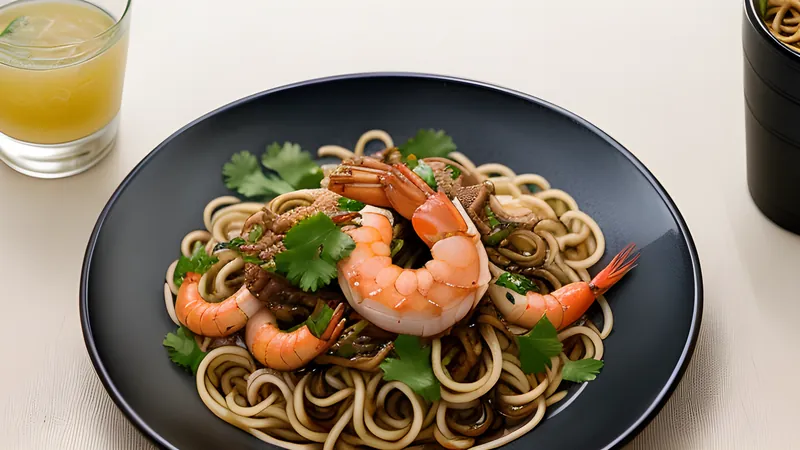
Hokkien Mee: Prawn Noodles in a Dark Braise
A stock built from shells and reduced hard, clinging to two noodles at once
Contents
↓ Jump to recipeEvery good hokkien mee starts with a decision that has nothing to do with noodles: what to do with the shells. Most home cooks throw them out with the peelings. The stall owners along Geylang and the older kopitiam kitchens in Penang know better — the shells hold more flavour than the meat, and a proper hokkien mee lives or dies on how hard you’re willing to work that stock down before a single noodle goes in the pan.
This is not the same dish everywhere it’s cooked, which causes genuine arguments among people who care about it. In Singapore, hokkien mee (sometimes written Hokkien fried prawn mee) is a dry, dark-glazed noodle dish, the yellow noodles and rice vermicelli braised in reduced prawn stock until the liquid has all but disappeared into the strands. In Penang, “Hokkien mee” refers to something else entirely — a soupy pork-rib and prawn-shell broth eaten with the same noodles but ladled generously rather than reduced dry. Both trace back to Hokkien (Minnan) immigrants from Fujian province who arrived in the Straits Settlements through the nineteenth century, and both use the same shellfish-forward stock logic. This recipe is the Singapore dry-braised version, the one you’ll find at hawker stalls with a queue that doesn’t move much faster at 9pm than at noon. The naming confusion runs deep enough that Singaporean food writers still argue about it in print: what Singapore calls hokkien mee, Kuala Lumpur calls Hokkien char mee and cooks with a much darker, almost black soy glaze and no stock reduction at all, closer to a dry noodle stir-fry than a braise. Ask for “hokkien mee” in three different Malaysian and Singaporean cities and you risk three different dishes arriving at the table, which is part of why hawker menus increasingly specify “Singapore style” or “KL style” alongside the name.
Hokkien Mee: Prawn Noodles in a Dark Braise
Ingredients
- 500g whole raw prawns, shell-on, heads on if you can get them
- 2 tbsp neutral oil
- 6 cloves garlic, finely chopped, divided
- 1.2 litres water
- 200g pork belly, skin removed, cut into 1cm lardons
- 200g fresh yellow egg noodles (mee kia or thick hokkien noodles)
- 150g dried rice vermicelli (beehoon), soaked in warm water 15 minutes
- 3 tbsp dark soy sauce
- 1 tbsp light soy sauce
- 1 tsp white pepper
- 150g squid, cleaned and sliced into rings
- 2 eggs, lightly beaten
- 100g bean sprouts, tails trimmed
- 4 fish cakes, sliced (optional)
- 6 garlic chives, cut into 4cm lengths
- 3 tbsp rendered pork lard, plus the crisp bits left from rendering it
- 2 calamansi or 1 lime, halved
- 3 tbsp sambal belacan, to serve
Method
- Peel the prawns, keeping the shells and heads. Refrigerate the peeled prawns.
- Heat 1 tbsp oil in a heavy pot over medium-high heat. Add the prawn shells and heads and fry, pressing them with a spatula to crush the heads and release the orange fat, for 4-5 minutes until deep red.
- Add half the chopped garlic to the shells, fry 30 seconds, then pour in the 1.2 litres water. Bring to the boil, then simmer uncovered for 25 minutes. Strain firmly through a sieve, pushing the solids to extract every drop, and discard the shells. You want roughly 700ml of concentrated stock.
- In a clean pot or wide wok, render the pork belly lardons over medium heat for 6-8 minutes until they release fat and turn golden at the edges. Remove the crisp pieces with a slotted spoon and set aside; leave the fat in the pan.
- Add the remaining chopped garlic to the pork fat and fry 30 seconds until fragrant, then pour in the strained prawn stock. Stir in the dark soy sauce, light soy sauce and white pepper. Bring to a rolling simmer.
- Add the fresh yellow noodles and drained vermicelli to the simmering stock. Push them under the liquid with tongs and let them braise, turning occasionally, for 6-8 minutes, until the vermicelli has swollen and the stock has reduced by roughly half and coats the strands rather than pooling underneath them.
- Push the noodles to one side of the pan. Add the peeled prawns and squid to the exposed stock and poach for 90 seconds until the prawns turn pink, then fold them through the noodles.
- Drizzle the beaten egg over the noodles in a thin stream, wait 15 seconds for it to set into ribbons, then toss everything together so the egg breaks up through the strands rather than forming a separate omelette.
- Add the bean sprouts, sliced fish cakes if using, and garlic chives. Toss for one final minute over high heat until the sprouts just wilt and still have bite.
- Divide between bowls, scatter over the crisp pork bits and a final teaspoon of pork lard per bowl, and serve immediately with calamansi halves to squeeze over and a spoon of sambal belacan on the side.
Why the shells matter more than the prawns
Prawn heads contain tomalley — the soft, orange-brown substance that’s part liver, part digestive gland — and when you fry the heads hard enough to crush them, that tomalley renders out into the oil and turns it a deep coral colour. This is the single most important step in the whole recipe and the one most home versions skip, using pre-made stock or bouillon cubes instead. A bouillon cube gives you salt. Crushed, fried prawn heads give you an entire register of savoury depth that no other ingredient replicates, because the compounds responsible — glutamates concentrated in the hepatopancreas — simply aren’t present anywhere else in the animal at that density.
Buy prawns with heads on if your fishmonger stocks them; frozen whole prawns from an Asian supermarket are usually the easiest source outside a coastal town. If you can only get headless shell-on prawns, the dish still works, just with a slightly lighter stock — compensate by using a full 3 tablespoons of dark soy rather than easing back, and don’t skip the pork fat rendering, which does real work here too.
The reduction is the technique
Once you have concentrated stock, the entire method is about controlled reduction. The noodles go in raw-ish (fresh yellow noodles need barely any cooking; dried vermicelli needs the soak but still absorbs actively once it hits hot liquid) and you let them braise directly in the stock rather than boiling them separately and saucing them afterwards. This does two things: the noodles pull in the flavour of the stock as they finish cooking, swelling and turning glossy, and the stock itself reduces down around them into a coating rather than a broth. You’re aiming for the point where, if you tilted the wok, there’d be a spoonful of dark liquid at most — not a puddle.
Dark soy sauce isn’t just a stronger version of light soy. It’s brewed longer and often has molasses or caramel added, giving it a viscosity and sweetness that light soy doesn’t have, plus a colour that goes almost black on reduction. Light soy carries the salt; dark soy carries the colour and a rounder sweetness. Using only one or the other gets you either a pale, under-seasoned braise or an over-sweet one — you need both, in the roughly 3:1 ratio in the ingredient list.
Reading the noodles
Fresh hokkien yellow noodles (sometimes labelled mee kia or just “yellow noodles”) are pre-steamed and alkalised with kansui, giving them their yellow tint and springy bite — they need only a couple of minutes in hot liquid to finish. Dried beehoon vermicelli needs the warm soak first to rehydrate, then a longer simmer in the stock to actually cook through; skip the soak and you’ll get noodles that are stodgy on the outside and brittle in the centre no matter how long you braise them. Using both noodle types together, rather than picking one, is the actual Singapore convention, and it’s not just tradition for its own sake — the springy yellow noodle and the softer, more absorbent vermicelli behave differently in the sauce, one carrying bite and one carrying flavour, and a forkful with both textures reads as more complete than either alone.
The lard is not optional
Pork lard croutons — the crisp, golden bits left over from rendering pork fat — are a finishing garnish at almost every hokkien mee stall in Singapore, and skipping them changes the dish more than any other substitution on this list. They add a crunch that nothing else in the bowl provides, since everything else is soft-braised, and a note of clean pork fat that plain vegetable oil can’t replicate. Render your own belly fat in the pan before you start the stock — it takes eight minutes and gives you both the crisp bits and the fat you’ll fry the garlic in for the braise, so nothing is wasted.
Squid, timing, and overcooking
Squid turns from tender to rubbery in the space of about 45 seconds once it hits a hot pan, and prawns go from translucent to tight and dry not much slower. Both go in near the very end here, poached in the reduced stock for 90 seconds rather than braised alongside the noodles from the start — if you add them at the same time as the noodles, by the time the braise has reduced down, they’ll have been cooking for eight minutes and turned to rubber. Pull the prawns the moment they turn pink all the way through; residual heat finishes them off the stove.
Wok hei and why a flat pan falls short
A proper hokkien mee stall cooks this over a gas ring putting out far more heat than a domestic hob manages, and that heat difference matters more here than in a simple stir-fry, because you’re not just searing ingredients — you’re actively reducing a liquid while keeping the noodles moving so nothing catches and burns on the bottom. A carbon steel wok holds and distributes that heat far better than a flat non-stick pan, letting you keep the braise at a hard simmer across the whole surface rather than just the centre. If a wok isn’t an option, use the widest, heaviest pan you own and resist the urge to turn the heat down when the reduction looks fierce — a gentler heat just means a longer, wetter braise and noodles that never quite achieve the clinging, glossy finish the dish is known for.
What can go wrong
The single most common failure is stock that never properly concentrates, which usually traces back to skipping the initial reduction step or not frying the shells hard enough to release their fat in the first place. If your finished stock tastes thin and mostly of salt rather than deep and savoury, the shells didn’t fry long enough — you want them properly red and fragrant, with the fat visibly tinted orange, before any water goes in.
A watery finished dish, even with good stock, usually means too much liquid went in relative to noodles, or the braise was pulled off the heat before the reduction finished. Judge doneness by texture rather than the clock: the noodles should look glazed and slightly sticky to the spoon, with barely any free liquid pooling underneath when you push them aside. If it still looks soupy after eight minutes, keep going rather than plating early — an extra two or three minutes of hard reduction makes a bigger difference here than almost anywhere else in the recipe.
Overcrowding the pan is the other frequent mistake, especially if you’re doubling the recipe for a crowd. A wok or pot that’s too full can’t reduce evenly, and the noodles at the bottom stew in a way that separates them from the glaze forming higher up. Cook in two batches rather than one oversized one if you’re feeding more than four.
What to serve alongside
Sambal belacan — a raw or lightly cooked paste of chillies, shrimp paste and lime — is the standard hawker-stall condiment, sold in a small dish on the side rather than mixed in, because the fermented punch of belacan is meant to be dosed to taste rather than baked into the whole braise. Calamansi, the small sour Southeast Asian citrus, is traditional; ordinary lime is the honest substitute outside the region and works nearly as well, just use a slightly heavier squeeze since lime is less aromatic.
If you’re building a wider hawker-style spread at home, hokkien mee sits comfortably alongside two other Singapore stalwarts covered on this site: chai tow kway, the fried radish cake that shares the same wok-hei instinct for a hard sear, and hainanese chicken rice, which uses its own version of shallow poaching logic to keep protein tender rather than tough.
Storage and reheating
Hokkien mee doesn’t keep especially well — the noodles keep absorbing residual moisture in the fridge and turn gluey within a day, and the prawns toughen further on reheating. If you do have leftovers, reheat gently in a dry non-stick pan with a tablespoon of water to loosen the sauce rather than in the microwave, which cooks the seafood a second time and turns it chewy. The stock itself, if you have any concentrated prawn stock left over before the noodle stage, freezes well for up to two months and makes an excellent base for a quick prawn noodle soup another night — just don’t reduce it as hard the second time round, since a thinner soup base benefits from more body rather than less.
Variations worth trying
Some Singapore stalls add a few slices of Chinese sausage (lap cheong) rendered alongside the pork belly for extra savoury sweetness, or swap squid for sliced fish cake exclusively if squid isn’t to hand — both are legitimate substitutions rather than compromises. A handful of chopped garlic chives at the very end, rather than folded through earlier, keeps their sharper raw bite intact against the soft-braised noodles, which is worth doing if you like a little green heat cutting through all that reduced fat and soy.
Related Content