Harees: The Slow Wheat-and-Meat Porridge
Wheat and meat beaten to silk, the dish that marks Ramadan nights
Contents
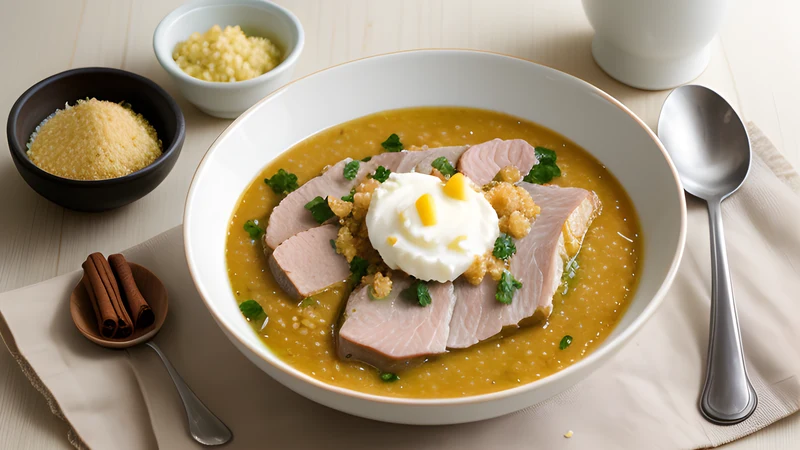
↓ Jump to recipeSome dishes announce themselves loudly. Harees stays quiet. It arrives at the table the colour of old ivory, smooth as wet plaster, and if you have never eaten it you would be forgiven for looking at it and wondering what the fuss is about. Then you take a spoonful, and the fuss becomes obvious. Wheat and meat, cooked so long and beaten so thoroughly that they stop being two ingredients and become one, carry a savoury depth that no amount of spice could fake. This is a dish built on time and elbow grease, and it tastes like both.
Harees: The Slow Wheat-and-Meat Porridge
Ingredients
- 300g whole wheat berries (hard wheat, not cracked bulgur)
- 700g bone-in lamb shoulder or chicken thighs on the bone
- 1.8 litres water, plus more as needed
- 1 cinnamon stick
- 3 green cardamom pods, lightly crushed
- 2 tsp fine salt, plus more to taste
- 60g ghee
- 1 tsp ground cinnamon
- 1/2 tsp ground cumin (optional)
- Sea salt flakes and extra ghee, to serve
Method
- Rinse the wheat berries and soak them in cold water overnight, or for at least 4 hours. Drain.
- Put the drained wheat, meat, cinnamon stick, cardamom and 1.8 litres water in a large heavy pot. Bring to a boil, skim the grey foam, then cover and simmer very gently for 2 hours until the wheat is bursting and the meat falls off the bone.
- Lift out the meat. Discard bones, skin and the whole spices. Shred the meat finely and return it to the pot with the salt.
- Simmer uncovered another 45-60 minutes, stirring often, until the mixture is thick. Now beat it hard with a wooden spoon, a whisk or a stick blender pulsed in short bursts, until the grain breaks down and the harees turns pale, stretchy and smooth. Add hot water if it stiffens past a spoonable porridge.
- Melt the ghee in a small pan until it smells nutty and just turns gold. Off the heat, stir in the ground cinnamon and cumin.
- Spread the harees in bowls, make a well, and pour the spiced ghee into it. Finish with sea salt flakes.
What harees actually is
Harees is a porridge of whole wheat and meat, simmered for hours and then pounded or beaten until the two collapse into a single silky mass. It belongs to a wide family of grain-and-meat pottages that stretch across the Arabian Peninsula, the Levant, Armenia and as far as the Horn of Africa, going by names like harissa (no relation to the North African chilli paste), keshkeg and boko. In the United Arab Emirates, Qatar, Bahrain and Kuwait, harees is the food of Ramadan and of weddings, cooked in vast quantities in oil-drum-sized pots and stirred with what looks like a canoe paddle.
That communal scale is part of what harees means. Through Ramadan, mosques, majlis gatherings and charitable kitchens across the Gulf cook it in enormous vats to feed whole neighbourhoods at iftar, and the stirring is often a shared job, men taking turns at the paddle as the pot thickens. At weddings and on National Day it is cooked by the hundredweight. Because it demands hours of attention and muscle, harees has always been food that brings people together to make as much as to eat. Neighbours send bowls of it to each other’s homes during Ramadan, and a family’s harees becomes a small point of pride, judged on its smoothness and the perfume of its browned ghee.
The dish is old, and its distribution tells you something. A recipe for a wheat-and-meat pottage appears in the tenth-century Baghdad cookbook Kitab al-Tabikh, and versions of it spread with trade and with faith. In Armenia the same idea became harissa, tied to the feast day of the saint Gregory the Illuminator. The genius of the format is that it takes cheap, storable ingredients — wheat that keeps for years, a tough cut of meat, water — and through patience alone turns them into something rich enough for a celebration. In desert and mountain economies where you could not waste a scrap, that mattered.
The dish also travels under the banner of remembrance. In parts of the Levant and South Asia a close relative is cooked for the Islamic month of Muharram and shared during Ashura, and in India and Pakistan the same wheat-and-meat logic became the spiced, longer-cooked haleem sold from Hyderabadi stalls at Ramadan. The Emirati version stays deliberately plain by comparison, letting the wheat and lamb speak, yet these are all unmistakably branches of one very old tree, carried along the trade routes that linked Baghdad to the coast.
The word most people reach for to describe good harees is stretchy. When it is beaten properly, the gluten in the wheat develops and the porridge takes on a faint elasticity, so that a spoonful pulls slightly before it breaks. Get that texture and you have made it correctly. Miss it, and you have made a bowl of bland wheat soup.
Getting the grain right
The single most important choice is the wheat. You want whole wheat berries, sometimes sold as hard wheat, wheat grain or Arabian jireesh if unbroken. What you do not want is bulgur or cracked wheat, which is precooked and will turn to mush without ever developing that characteristic chew. Whole berries are stubborn: they need an overnight soak and a long simmer before they will even think about breaking down. That stubbornness is the point. It is what lets you cook them for three hours until they burst and still hold enough structure to be beaten smooth.
Soaking matters more than people admit. Skip it and you can add an hour to the cooking time and still end up with hard flecks in the middle of an otherwise soft porridge. I soak mine overnight in plenty of cold water, and I have never regretted the forethought.
The meat is more forgiving. Lamb shoulder on the bone is traditional and gives the deepest flavour, the connective tissue melting into the pot and adding body. Bone-in chicken thighs make a lighter, quicker harees that many Emirati families prefer for everyday cooking. Either way, cook the meat on the bone and shred it back in — the bones give the broth the gelatine that makes the finished dish feel luxurious rather than thin.
The beating
Traditionally harees is pounded with a wooden pestle called a midfa’a until the cook’s arms give out. You can skip the traditional tool, but you must commit to the beating, because this is where the texture comes from. Once the wheat is soft and the mixture has thickened, you break the grains down by force. A sturdy wooden spoon and ten minutes of determined mashing against the side of the pot will do it. A balloon whisk is faster. A stick blender is fastest of all, but use it in short pulses and stop while there is still some texture — blitz it to complete smoothness and it goes gluey and lifeless.
You are aiming for a consistency somewhere between mashed potato and thick custard: it should fall slowly off a spoon and settle back into itself. If it stiffens too far, and it will as it cools, loosen it with a splash of hot water and beat again. Harees waits for no one; serve it hot.
The finish that makes it
A bowl of plain beaten wheat and meat is honest but austere. The finish is what lifts it into something you want to eat again. Across the Gulf that finish is samn — ghee — browned until nutty and poured into a well in the centre of the porridge, so that each spoonful carries a little of the fragrant fat. I bloom ground cinnamon in the ghee off the heat, which is the classic Emirati touch and gives harees its faint sweetness and warmth. Some cooks add a dusting of sugar alongside for the sweet-savoury contrast that defines a lot of Gulf cooking; a pinch of cumin pulls it the other way, towards the savoury. Both are correct. Choose your mood.
Do not skip the salt at the table. Harees is under-seasoned by design during cooking, because the wheat absorbs so much, and a scatter of flaky salt on top wakes the whole bowl up.
Method, step by step
Soak your rinsed wheat overnight. The next day, drain it and tip it into a heavy pot with the meat, a cinnamon stick, a few crushed cardamom pods and 1.8 litres of water. Bring it up to a boil, skim off the grey scum that rises, then drop it to the gentlest simmer, cover, and leave it for two hours. Check it once or twice; if the water drops below the level of the grain, top it up with boiling water.
After two hours the meat should be falling off the bone and the wheat should be split and soft. Fish out the meat, strip it off the bones, discard the skin and the whole spices, and shred the meat finely with two forks. Return it to the pot with the salt and simmer uncovered for another 45 minutes to an hour, stirring more and more often as it thickens and threatens to catch.
Now beat it. Really beat it, until the grains give up and the porridge turns pale and slightly stretchy. Taste, and correct the salt. Brown your ghee in a small pan until it smells like toasted nuts, stir the ground cinnamon into it off the heat, and pour it into a well in the middle of the served harees. Sea salt on top, and eat it while it steams.
Tips, storage and variations
The most common mistake is impatience with the wheat. If your harees has hard grains in it, it simply has not cooked long enough — put it back on the heat with more water and keep going. You cannot overcook it in the way you can overcook rice; it only gets smoother.
Harees thickens dramatically in the fridge, setting almost solid overnight, which is normal. Reheat it gently with plenty of added water or milk, beating it back to a porridge over low heat. It freezes well in portions for up to three months. A well-known Emirati trick is to fry leftover harees the next day in a little ghee until the underside crisps — a completely different, deeply good thing.
For a richer version, stir a knob of butter through at the end as well as the ghee on top. Some Kuwaiti cooks add a little ground loomi (dried lime) for a sour note that cuts the richness, which works beautifully. If you want to serve harees as part of a bigger table, it sits well next to the spiced rice of machboos or a saffron-scented zurbian, and it makes a gentle foil for the fenugreek froth of Yemen’s saltah. If layered rice is your thing, the same slow-cooked patience pays off in a pot of maqluba.
Make it once and you will understand why families across the Gulf will queue for it at sunset through the whole of Ramadan. It is the least flashy thing you can cook, and one of the most quietly satisfying.
Related Content