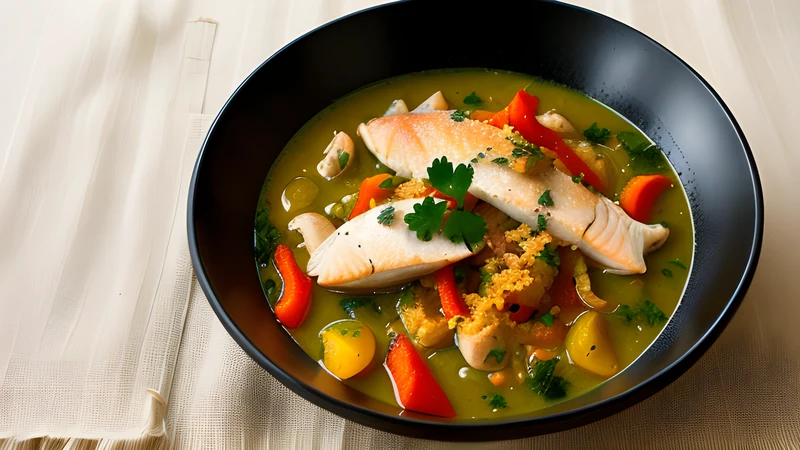
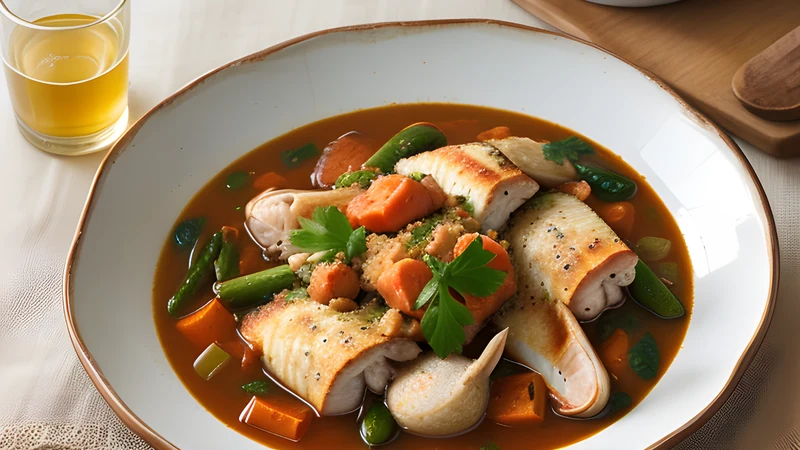
Halászlé: Hungarian River Fish Soup With Paprika
A carp broth built from the bones up, stained red, and cooked over fire in a kettle
Contents
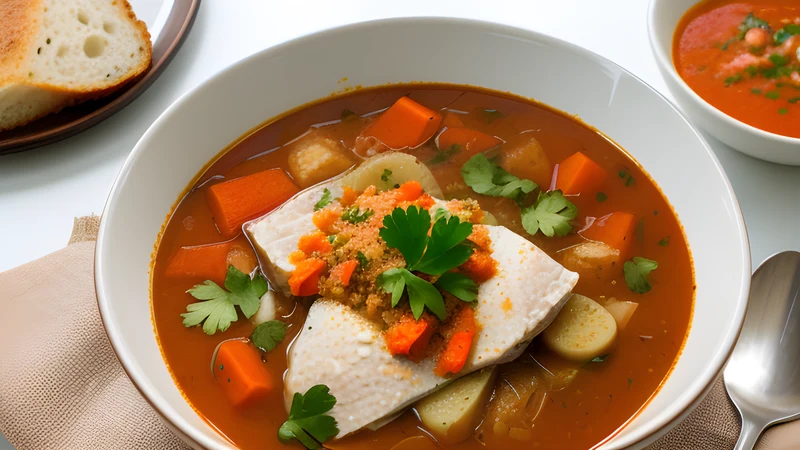
↓ Jump to recipeHalászlé is one of the loudest soups in Europe. It arrives the colour of a brick, it smells of paprika and onion and river, and it contains a quantity of ground pepper that looks like an error until you taste it. It is the food of the fishermen of the Tisza and the Danube, cooked in a bogrács — a cast-iron kettle on a tripod over a wood fire, outdoors, in November, with someone standing over it who will not let you stir it.
The prohibition on stirring is real and it is the first thing anyone tells you. Carp flesh at simmer is fragile, and a spoon through the pot turns clean chunks into shreds suspended in red liquid. You move the whole kettle in a slow circle instead. This is a soup with rules.
Halászlé: Hungarian River Fish Soup With Paprika
Ingredients
- 1 whole carp, about 2 kg, scaled and gutted, or 1 kg carp fillet plus 1 kg fish heads, bones and trimmings
- 700 g onions, roughly chopped
- 2 litres cold water
- 4 tbsp sweet Hungarian paprika
- 1 tsp hot Hungarian paprika, or to taste
- 1 green Hungarian wax pepper (or 1 green pointed pepper), sliced into rings
- 1 medium tomato, quartered
- 2 tsp fine salt, plus more to finish
- 1 tbsp lard
Method
- If using a whole carp, fillet it. Cut the fillets into 4 cm chunks, leaving the skin on. Salt the chunks with 1 tsp salt and refrigerate while you make the broth. Keep the head, backbone, fins and belly trim.
- Put the head (gills removed), bones and trimmings in a large pot with the chopped onions, the tomato, half the pepper rings and 2 litres cold water. Add 1 tsp salt.
- Bring slowly to the boil and skim off every trace of grey foam. Simmer, uncovered, for 60 minutes — the onions should be collapsing.
- Melt the lard in a small pan, take it off the heat, count to twenty, then stir in the sweet and hot paprika. Swirl for 30 seconds in the residual heat and scrape it into the pot. Simmer 5 minutes more.
- Pass the whole lot through a sieve set over a clean pot, pressing the solids hard with a ladle to push through the onion and fish flesh. Discard the bones and skin. You should have about 1.4 litres of thick, opaque, deep red broth.
- Bring the broth back to a bare simmer and taste for salt. It should be assertively seasoned — the fish will absorb some.
- Slide in the salted carp chunks in a single layer and the remaining pepper rings. Simmer, uncovered, for 10–12 minutes without stirring. Move the pot in a circle if you need to redistribute.
- Take off the heat and rest 5 minutes. Serve in deep bowls, fish on top, with white bread and more hot paprika at the table.
Two rivers, two soups
There is no single halászlé and Hungarians will tell you so at length.
The Szeged version, from the Tisza in the south, is the one this recipe follows. Everything goes through a sieve. The bones, heads and onions are simmered for an hour and then pushed through a fine mesh, which pulps the onion and the scraps of fish flesh into the liquid itself. The result is thick, opaque, almost velvety — a broth with body that comes from vegetable pulp and fish gelatine rather than any flour. The fish chunks are then poached in that finished broth for barely twelve minutes.
The Baja version, from the Danube, is looser and the broth stays clearer, and — this is the significant part — it is served with a nest of thin matchstick pasta in the bowl. The Baja people consider the Szeged sieve step fussy. The Szeged people consider the Baja pasta an admission that the broth lacks body. This argument has been running for well over a century and neither side is going to concede.
There is also a Danube version around Paks that uses a much hotter hand with the paprika, and a version from Lake Balaton that quietly includes other fish. Every fishing town has its own.
What unites them is the ingredient list, which is startlingly short: carp, onion, paprika, water, salt. No stock cube, no herbs, no wine, no butter, no cream. A tomato and a green pepper if you are being generous. That austerity is the point — it is a soup made from what a fisherman had in the boat and what grew behind his house.
Paprika, and the reason there is so much of it
Four tablespoons of paprika for six servings sounds absurd. It is correct, and here is why.
Paprika in halászlé is doing three jobs at once. It is the colour, obviously. It is the only spice, so it carries the entire aromatic burden that herbs would carry in a French soup. And — the part people miss — it is a thickener. Ground paprika is milled dried pepper flesh, which is mostly cell wall and fibre, and four tablespoons suspended in 1.4 litres contributes real viscosity.
Buy proper Hungarian paprika. The distinction between édesnemes (noble sweet), csípős (hot) and the rest is meaningful, and a supermarket tin of unspecified “paprika” that has been open since last spring is powder with no smell. Open the tin and put your nose in it: it should smell sweet, fruity and faintly of dried tomato. If it smells of nothing, it will do nothing.
And then there is the burning. Paprika contains enough sugar to scorch within seconds at frying temperature, and burnt paprika is irredeemably bitter. So the lard comes off the heat, drops for twenty seconds, and only then does the powder go in — thirty seconds in residual warmth to bloom the fat-soluble carotenoids, then straight into the liquid. This bloom is what produces the deep red rather than a muddy orange, and it is the same discipline that governs pörkölt and gulyásleves.
The broth is the entire dish
Everything that makes halászlé good happens in the first hour, before any edible fish goes near the pot.
Carp heads are extraordinary stock material. The head and the collar carry a lot of collagen, and an hour of gentle simmering converts it to gelatine that gives the finished soup a weight on the lip you cannot fake. Remove the gills — they are bitter and they hold blood — and use everything else. If your fishmonger will sell you a bag of carp frames for very little money, buy two.
Seven hundred grams of onion to two litres of water is another quantity that looks wrong. After an hour they have collapsed entirely, and after the sieve they are simply gone — dissolved into the broth as pulp. They provide sweetness against the paprika and the bulk of the body. Chop them roughly; they are not going to survive to be seen.
Skim relentlessly in the first ten minutes. The grey foam is coagulated blood protein and it tastes muddy. Once it is gone, the pot can look after itself.
The sieve step is physical work. Press hard with the back of a ladle, keep going after you think it is done, and scrape the underside of the mesh. You are extracting onion pulp and fish flesh, and what you leave behind is body you paid an hour for. Expect to lose about 30% of your volume to solids — 2 litres of water becomes roughly 1.4 litres of finished broth, which is exactly the concentration you want.
The fish, and twelve minutes
Salt the fish chunks and refrigerate them while the broth simmers. This is a light dry-brine: the salt draws out a little water, dissolves in it, and diffuses back in, seasoning the flesh through rather than just its surface. It also firms the exterior slightly, which helps the chunks survive the poach.
Skin on. The skin holds the chunk together and contributes more gelatine.
Twelve minutes at a bare simmer, maximum. Carp is lean and its muscle fibres shorten and squeeze out moisture fast above about 65°C internal. Overcooked carp is dry, cottony and vaguely woolly, and there is no way back. Pull the pot off at ten minutes and rest it for five — carryover finishes the job.
And do not stir. Lift the whole pot and rotate it in a slow circle if the chunks need redistributing.
The kettle, the fire, and doing it on a hob
A bogrács is a bulbous cast-iron kettle that hangs from a tripod over an open fire, and it is not decorative. Its shape matters: the wide belly and narrow-ish mouth give a large surface for evaporation while the round base distributes heat from a flame that is inherently uneven. The lack of a flat bottom means nothing catches, which is useful when you have four tablespoons of sugar-bearing paprika in suspension and no intention of stirring.
The fire matters too. A wood fire delivers radiant heat up the sides of the kettle rather than conducted heat through a base plate, so the whole volume comes to temperature together and the simmer is gentler than any hob gives you. Some of the smoke gets into the soup. Hungarians will tell you this is the difference between halászlé and a fish soup, and having eaten both, I think they have a point I cannot fully defend.
Indoors, use the widest, heaviest pot you own — a cast-iron casserole is closest in behaviour. Keep the heat low enough that you see a bubble every second or two and no more. The reduction over the hour is part of the recipe, so leave the lid off and let it work. If your hob runs hot on its lowest setting, a heat diffuser under the pot solves it for a few pounds.
Serving, storage and the Baja question
Serve immediately in deep, warm bowls, with the fish chunks lifted in with a slotted spoon and the broth ladled around them so nothing breaks. A slice of green pepper on top is the standard garnish and it is there for the raw, grassy bite against all that cooked sweetness.
The broth alone keeps three days refrigerated and freezes for three months, and this is the best way to plan the dish: make a big batch of base broth on a Sunday, freeze it in 700 ml portions, and you are twelve minutes from halászlé on a weeknight. The finished soup with fish in it does not keep — reheating turns the carp to wool.
If you want the Baja version, make the same broth, skip nothing, and cook 200 g of thin dried pasta — gyufatészta, matchstick noodles — separately in salted water. Put a nest in each bowl and ladle the soup over. It is a genuinely different eating experience: the pasta absorbs broth and the whole thing becomes closer to a stew. I make the Szeged version because I prefer the texture of a broth that got its body honestly. That is a preference and the Baja people would say something rude about it.
Getting carp, and what else works
Carp is farmed extensively across central Europe and is genuinely cheap; in Britain, Polish and Turkish shops sell it whole, often live, especially around Christmas. Ask them to scale it — carp scales are large and armour-like and it is a miserable job at home.
Carp has a reputation for muddiness. That flavour is geosmin, produced by bacteria and algae, and it concentrates in the fat and skin of fish from warm, still water. Farmed carp is usually purged in clean water before sale and is fine. If yours does smell of pond, the paprika and onion will bury most of it.
If you cannot get carp: pike, perch, zander and catfish all belong in the Danube tradition and any of them works. The essential thing is a firm-fleshed freshwater fish plus a kilo of bones and heads for the broth. Sea fish is the wrong dish — cod or salmon here produces something that is not halászlé, and the flavour of a saltwater fish against this much paprika is jarring. For a fish soup at the other end of the spectrum, lohikeitto shows what happens when the same fisherman’s logic goes north into cream and dill.
What goes wrong
Bitter. Burnt paprika, or gills left in the head. Both are unrecoverable.
Thin and watery. You under-reduced, or under-pressed the sieve, or used too little onion. The broth should coat a spoon faintly.
Shredded fish. You stirred. Or you boiled hard rather than simmered.
Dry, chalky fish. Over twelve minutes.
Muddy orange rather than red. Paprika went into water instead of fat. The bloom is not optional.
Serve it with plain white bread to mop, and nothing else. There is no wine that survives this much paprika comfortably; Hungarians drink a dry white or a beer, and the traditional answer at the kettle is pálinka before and after.
Related Content