Haemul Pajeon: Seafood and Spring Onion Pancake
The crackling-edged pancake that turns rain into an excuse to fry
Contents
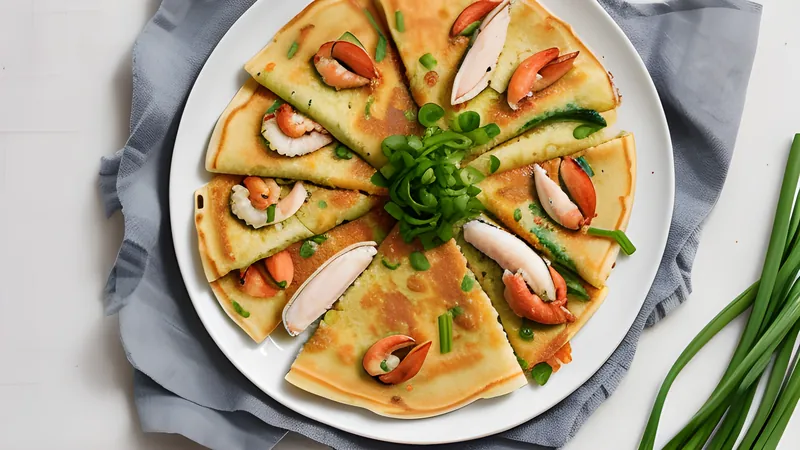
↓ Jump to recipeHaemul pajeon is a seafood pancake built the wrong way round from how most people picture a pancake: the spring onions go down first, laid side by side like a raft, and the batter is poured over them rather than mixed with them. That distinction matters more than it sounds. A pajeon where the onions are stirred through a bowl of batter cooks up soggy and uneven; laying them flat across the base of the pan first means the batter only has to bind them into a sheet, and the onions themselves get direct contact with the hot oil, which is where the char and sweetness come from.
The dish has strong ties to Busan and the southern coastal cities, where seafood pancakes are a fixture of the pojangmacha — the orange tented street stalls that serve drinking food after dark. Busan’s version, sometimes called dongnae pajeon after a district of the city, is thicker and more generously loaded with seafood than pancakes found further inland, reflecting straightforward proximity to the fish market. Coastal cooks had squid, mussels and prawns on hand daily in a way that inland Korean kitchens didn’t, and the pancake absorbed whatever the morning catch offered.
Pajeon itself predates the seafood version by a wide margin — plain spring onion pancakes appear in Korean cookery going back centuries as an everyday farmhouse food, built from whatever grain flour was on hand and whatever onions were growing. The addition of seafood, and specifically the haemul designation, is a later regional development tied directly to coastal access rather than a single dateable invention. What’s consistent across every version and every century is the same underlying logic: a starchy binder, a vegetable base laid flat rather than mixed in, and enough oil to fry rather than merely cook the batter.
Haemul Pajeon: Seafood and Spring Onion Pancake
Ingredients
- 150g plain flour
- 50g rice flour
- 1 egg
- 250ml cold water
- 1/2 tsp salt
- 1 bunch spring onions (about 10-12), trimmed to pan length
- 100g squid, cleaned and sliced into thin rings
- 100g raw peeled prawns, halved lengthways
- 80g mussels, cooked and shelled
- 1 red chilli, sliced into thin rounds
- 4 tbsp neutral oil, divided
- 3 tbsp soy sauce
- 1 tbsp rice vinegar
- 1 tsp gochugaru
- 1/2 tsp sesame oil
- 1/2 tsp toasted sesame seeds
Method
- Whisk the plain flour, rice flour, egg, cold water and salt into a thin, lump-free batter and rest it for 10 minutes.
- Lay the spring onions side by side across a hot, well-oiled pan so they form a solid base layer roughly the size of the pan.
- Ladle the batter evenly over the spring onions, letting it fill the gaps and bind them into one sheet.
- Scatter the squid, prawns and mussels over the batter while it is still wet, pressing them in gently so they sit flush with the surface.
- Scatter the chilli rounds over the top and cook over medium heat for 5-6 minutes until the underside is deep golden and set.
- Flip the pancake in one motion using a large plate or a second pan, then drizzle a tablespoon of oil around the edges and cook the second side for 5-6 minutes, pressing down occasionally with a spatula for even crisping.
- Mix the soy sauce, rice vinegar, gochugaru, sesame oil and sesame seeds for the dipping sauce.
- Slide the pancake onto a board, cut into wedges, and serve immediately with the dipping sauce.
The rain association, and why it’s not just folklore
Korean food culture has long paired pajeon with rainy days, and with makgeolli, the milky, lightly fizzy rice wine traditionally drunk alongside it. Part of the story is genuinely acoustic: the sound of batter hitting hot oil in a pan is said to resemble rain on a roof, and on a wet day when farm work stopped, frying pancakes was one of the few things left to do with the afternoon. It’s a folk explanation rather than a documented one, but the practical logic behind it holds up — rain kept people indoors and off the fields, and pancake batter made from cheap flour and whatever vegetables and scraps of seafood were around was a sensible way to feed a household without much planning.
The makgeolli pairing is not incidental either. Makgeolli’s slight sourness and low, gentle carbonation cut through pajeon’s oil in a way that stronger spirits don’t, and the two are sold together at nearly every pojangmacha stall for a reason that’s more physiological than cultural: the low alcohol content and slight sweetness of the wine make it forgiving to drink alongside food this rich, rather than fighting it the way soju’s higher proof often does.
Getting the crisp edge right
The single biggest mistake home cooks make with pajeon is using a batter that’s too thick. A pancake batter built to be spread with a spoon, the way you might treat Western-style savoury pancakes, comes out doughy and heavy. Haemul pajeon batter should be genuinely thin — closer to a crepe batter than a Yorkshire pudding one — so it crisps rather than puffs. The rice flour in the mix, alongside the plain flour, is what gives the finished pancake its shatter rather than a soft chew; rice flour absorbs less oil and sets up crisper than wheat flour alone, which is why nearly every proper Korean pancake batter includes some proportion of it.
Oil quantity is the second lever. Korean pancake cooking uses noticeably more oil than most Western pancake or omelette technique — the base of the pan should have a visible shimmering layer, not a thin film, because the crisp lace-edged texture pajeon is known for comes from the batter’s edges essentially shallow-frying against the pan while the centre stays tender. Skimp on the oil and you get a pale, chewy pancake instead of the deep gold, faintly crackling one this dish is supposed to be.
Do not press the pancake down while the first side is cooking — let it set fully before you even think about flipping. Pressing early breaks the structure the spring onions are providing and can cause the whole sheet to tear when you try to turn it. Once it’s set and you can see the edges crisping and pulling slightly from the pan, it’s ready to flip.
The flip, properly
This is the moment that intimidates people, and it shouldn’t. Slide the pancake onto a large flat plate — one at least as wide as the pan — then invert the pan over the plate and turn the whole thing over in one confident motion so the pancake drops back in raw-side down. A second pan of the same size works even better if you have one: slide the pancake from the first pan onto the second, inverted, so you never have to juggle a hot plate. Either way, the key is committing to one smooth motion rather than a hesitant half-turn, which is what tends to fold or tear the pancake.
Seafood choices and substitutions
Squid, prawn and mussel is the classic haemul (meaning “seafood”) combination, but the dish is genuinely flexible about proportions and even about which seafood shows up, as long as everything is cut or prepared so it cooks through in the same five or six minutes the pancake needs per side. Squid rings should be thin — a few millimetres — so they don’t need longer than the batter to cook. Prawns should be halved lengthways rather than left whole if they’re a decent size, again purely so they cook through in time. Pre-cooked mussels are there mostly for their briny flavour and don’t need much heat at all, which is why they go in raw-cooked rather than fresh.
Oysters are a common addition along the south coast in season, and baby octopus turns up in some Busan versions, sliced small. If you’re working with what’s available rather than a fixed ingredient list, weight the seafood towards whatever is freshest that day — the dish was never built around a fixed recipe so much as a technique applied to the morning’s catch.
Dipping sauce and what it’s for
The soy-vinegar-gochugaru dipping sauce isn’t decorative. Pajeon on its own, cooked in a good amount of oil, needs the sauce’s acidity to balance it — without the vinegar cutting through, the richness of the oil and the seafood together gets heavy fast. Make the sauce fresh each time rather than keeping a batch on hand; the gochugaru settles and loses its bite if the sauce sits for more than an hour or two before serving.
Common mistakes worth naming
Overcrowding the seafood is the most frequent error — piling on too much squid and prawn so the batter can’t bind it into a cohesive sheet leaves you with something closer to a seafood fritter falling apart at the seams rather than a pancake that holds together when cut. A single, even layer is the goal; you should be able to see batter between pieces of seafood before it cooks, not a solid mat of shellfish.
Cooking over heat that’s too low is the second common problem. Because the batter is thin, a pan that isn’t hot enough lets it spread too far and soak into itself rather than setting quickly against the pan’s surface, and the result is pale and greasy instead of crisp and golden. Get the oil properly shimmering before the batter goes anywhere near it, and don’t turn the heat down out of nervousness partway through — medium-high the whole way is correct, not medium-high then a retreat to medium-low.
Skipping the rest period on the batter also shows up in the finished texture. Ten minutes lets the flour hydrate fully, which reduces the raw, floury edge a freshly mixed batter can have and gives a slightly better crisp once it hits the oil.
Storage and reheating
Pajeon is a poor candidate for making ahead — the crisp edges that define it soften within an hour of cooking as residual steam works its way out through the crust, so cook it as close to serving time as you can manage. If you do have leftovers, keep them in the fridge for up to two days and reheat in a dry, hot pan rather than a microwave: a few minutes per side over medium heat drives moisture back out and restores a reasonable amount of the original crispness, whereas a microwave just steams the pancake into something limp and rubbery. Leftover portions also reheat better cut into wedges than left whole, since more surface area contacts the hot pan and crisps back up evenly rather than one thick centre staying soft while the edges scorch.
If you’re prepping ahead of guests, the batter itself holds in the fridge for several hours once rested, and the seafood can be portioned and ready to go — but don’t assemble and cook the pancake itself until close to when people are eating.
Serving and pairing
Cut the pancake into wedges with a sharp knife or kitchen scissors rather than trying to tear it — a clean cut keeps the crisp edges intact rather than crushing them. Pajeon is a shared dish by nature, meant to sit in the middle of a table alongside other small plates rather than served as an individual portion, and it holds its crispness for only a short window after cooking, so serve it as soon as it’s cut.
If you’re building a wider Korean spread, bindaetteok makes a natural pairing — another savoury pancake built on a completely different base, mung beans rather than wheat and rice flour, which makes for an interesting side-by-side comparison of technique. A pot of budae jjigae on the same table balances the pancake’s oil with a spicy, brothy contrast, and the meal reads as a proper spread rather than two disconnected dishes.
Related Content