Gudeg: Young Jackfruit Stewed Overnight
unripe jackfruit simmered for hours in coconut milk and palm sugar until it turns deep brown and falls apart
Contents
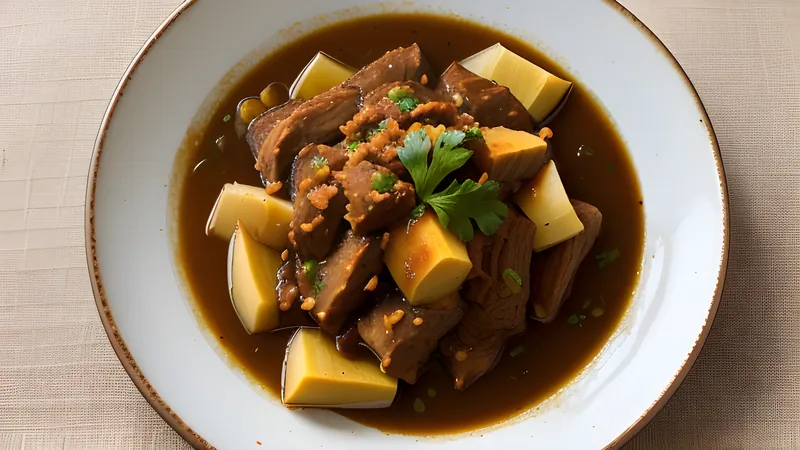
↓ Jump to recipeGudeg takes four hours to make something that, on paper, sounds unpromising: an unripe jackfruit, simmered until it collapses into soft, stringy shreds the colour of dark treacle, sweetened with palm sugar and enriched with coconut milk until it barely resembles the pale, starchy fruit it started as. It’s Yogyakarta’s defining dish, sold from dawn at market stalls that have sometimes kept the same pot going, topped up and reheated, for decades, and it’s built entirely around the idea that patience is the main ingredient rather than a garnish on top of everything else.
Gudeg: Young Jackfruit Stewed Overnight
Ingredients
- 1.5kg young, unripe jackfruit, peeled and cut into large chunks (tinned young jackfruit in brine works as a substitute, drained)
- 6 fresh or dried teak leaves (daun jati), optional, for colour
- 800ml coconut milk
- 300ml water
- 150g palm sugar, grated
- 8 shallots, peeled
- 6 cloves garlic, peeled
- 4 candlenuts, toasted
- 3 Indonesian bay leaves (daun salam)
- 2cm piece galangal, bruised
- 1 tbsp coriander seeds, toasted and ground
- 2 tsp salt, plus more to taste
- 4 hard-boiled eggs, peeled
- 500g chicken thighs, bone-in, skin-on
- 2 tbsp vegetable oil
- steamed rice, to serve
- krecek (spicy beef skin or tempeh sambal) and fried shallots, to serve
Method
- If using fresh teak leaves, line the base of a large, heavy pot with them — traditionally this is what turns the finished gudeg reddish brown, though the dish will still work and simply stay paler without them.
- Blend the shallots, garlic, candlenuts, galangal and ground coriander to a smooth paste.
- Fry the paste in the oil over medium heat for 5 minutes until fragrant, then transfer to the pot (or straight into the pot if not using leaves).
- Add the jackfruit chunks, bay leaves, coconut milk, water, palm sugar and salt to the pot and stir to combine.
- Nestle the chicken thighs and whole peeled eggs into the pot among the jackfruit.
- Bring to a bare simmer, then cover and cook on the lowest possible heat for 3.5-4 hours, stirring gently every 45 minutes to prevent catching, until the jackfruit has broken down to a soft, fibrous mass and the sauce has reduced and darkened.
- Check halfway through and top up with a splash of water if the pot looks dry before the jackfruit has fully softened.
- In the final 30 minutes, uncover and let the sauce reduce further until it clings thickly to the jackfruit rather than pooling around it.
- Taste and adjust salt and sugar; the finished gudeg should taste sweet first, with a deep savoury base underneath rather than a flat sugariness.
- Serve hot with steamed rice, the chicken and eggs from the pot, krecek and fried shallots.
Young jackfruit is not the same fruit as the one sold ripe
Ripe jackfruit — the version most people outside Southeast Asia recognise, with its sweet, custardy yellow flesh — has almost nothing in common with the young, unripe fruit gudeg is built on. Young jackfruit is harvested while the flesh is still pale, dense and starchy, well before the seeds have developed sweetness or the flesh has softened into the fragrant ripe version. On its own, raw and unseasoned, young jackfruit tastes of very little beyond a faint vegetal note, closer to a very starchy, fibrous vegetable than to any kind of fruit — which is exactly why it can absorb four hours of coconut milk, palm sugar and spice without ever tasting cloying. If your only access to jackfruit is tinned, buy the variety packed in brine or water specifically labelled “young” rather than in syrup, since the syrup-packed tins are ripe fruit and will turn the dish unpleasantly sweet and mushy rather than giving the fibrous texture gudeg depends on.
Teak leaves and the mystery of gudeg’s colour
Traditional gudeg gets its distinctive reddish-brown colour from daun jati — teak leaves — lining the bottom of the cooking pot, a technique with no fully agreed scientific explanation even among Javanese cooks who’ve used it for generations. The leading theory is that tannins and other compounds in the teak leaf react with the jackfruit’s own sap and the reducing sugars in the palm sugar over the many hours of slow cooking, gradually darkening the whole pot from pale yellow-green to a deep reddish-brown. Some cooks are sceptical the leaves do much beyond adding a very faint bitterness, and plenty of good gudeg is made without them at all, coloured instead simply by the depth of reduction and the natural darkening of palm sugar over a long cook. Teak leaves are essentially impossible to find outside Indonesia and parts of Southeast Asia, so this recipe treats them as optional; the dish will be a shade paler without them but otherwise unaffected in flavour.
Why the cook time is measured in hours, not minutes
Young jackfruit’s flesh is dense and fibrous enough that a short simmer leaves it merely softened rather than truly broken down — the texture gudeg is known for, where the fruit has separated into loose, tender shreds rather than firm chunks, only comes from three to four hours of gentle, continuous heat. This is not a dish where a pressure cooker shortcut gives an equivalent result: gudeg’s character depends on the slow reduction of coconut milk and palm sugar around the fruit over that long stretch, thickening gradually into a sauce that clings rather than one that’s been artificially concentrated in twenty minutes. A pressure cooker will soften the jackfruit fast, but the sauce won’t have had time to develop the same depth, and you’ll likely need to finish it with an extended uncovered reduction anyway to get the right consistency.
Traditional versions are cooked overnight over a low charcoal fire that needs almost no attention once it’s set, which is part of why gudeg became a market and street-stall dish rather than exclusively a home one — a vendor could start a pot the evening before and have it ready, deeply flavoured and unattended through most of the cook, by the next morning’s breakfast trade. At home, the stove-top version in this recipe compresses that into a single afternoon, with a check-in every forty-five minutes rather than none at all, and gets remarkably close to the same result.
Balancing sweet against savoury, and why gudeg isn’t a dessert
Palm sugar is the dominant flavour in gudeg, more so than in almost any other savoury Indonesian dish, and the temptation for a cook unfamiliar with the dish is to pull back on it, assuming a savoury main course shouldn’t taste this sweet. Resist that instinct — gudeg’s whole identity rests on genuine, pronounced sweetness balanced against the savoury base of shallot, garlic, candlenut and salt, plus the counterpoint of krecek, the sharp, chilli-forward beef skin or tempeh sambal traditionally served alongside. Krecek is not optional in the way rice might be adjustable to taste; without something spicy and savoury on the plate to balance gudeg’s sugar, the dish reads as unbalanced and overly sweet in a way it was never meant to. If you can’t find krecek or don’t want to make it from scratch, a simple, hot sambal with a good vinegar kick does a similar balancing job, though it won’t have krecek’s specific chewy-crispy texture.
Gudeg kering versus gudeg basah — the two textures you’ll find
Yogyakarta serves two distinct styles of gudeg, and it’s worth knowing which one you’re aiming for before you start reducing the sauce. Gudeg kering, the “dry” style, is cooked down until almost no liquid remains, leaving jackfruit that’s dark, sticky and coated rather than sitting in sauce — this is the style that travels well and is often what’s sold packed for visitors to take home from Yogyakarta by train, since it keeps for days without spoiling the way a wetter dish would. Gudeg basah, the “wet” style, stops reducing earlier and is served with more of its coconut sauce still pooling around the jackfruit, a looser, saucier plate more typical of what’s eaten fresh at a market stall the same morning it’s made. The method in this recipe leans towards gudeg kering by reducing uncovered at the end, but you can stop ten to fifteen minutes earlier, before the sauce has fully clung to the fruit, if you’d rather serve the wetter version.
A dish tied to a specific city more than any other in Java
Yogyakarta’s relationship with gudeg goes well beyond simply being where it’s most commonly eaten — the city is sometimes nicknamed “Kota Gudeg,” gudeg city, and it’s one of the few regional Indonesian dishes with an entire street, Jalan Wijilan, historically lined with gudeg vendors operating side by side, each with a version passed down through a specific family. Some of the best-known stalls have been run by the same family for three or four generations, cooking in the same large pots and, according to several long-running vendors, never fully cleaning them between batches — a slow, continuous seasoning of the cookware that regular customers claim they can taste, whether or not it’s strictly true in any way you could measure. It’s the kind of claim that’s impossible to verify and repeated constantly regardless, which says something about how tightly gudeg is bound up with specific places and specific pots rather than existing as a portable recipe detached from where it’s made.
The chicken and egg cooked directly in the pot
Chicken thighs and whole hard-boiled eggs go into the same pot as the jackfruit, absorbing the coconut milk and palm sugar as everything reduces together rather than being cooked separately and added at the end. The eggs, in particular, take on a deep brown colour and a faintly sweet, savoury flavour right through to the yolk after four hours in the pot — they end up bearing little resemblance to a plain boiled egg by the time they’re served, closer to a soy-marinated egg in richness though built on an entirely different base. Bone-in, skin-on chicken thighs hold up far better than breast meat over the long simmer, keeping some texture and flavour rather than disintegrating into the sauce the way a leaner cut would by hour three.
Serving gudeg properly
A full plate of gudeg — the version served at Yogyakarta’s dawn markets — includes rice, the jackfruit itself, a portion of the chicken, half an egg, a spoonful of krecek and often a ladle of thick, white coconut sauce called areh, made by reducing coconut milk separately until it turns almost custard-thick. Areh isn’t included in the base recipe here since it requires a second pot and a close eye to stop it splitting, but it’s worth making on a second attempt once the base dish is familiar — reduce 400ml coconut milk with a pinch of salt over low heat, stirring constantly, until it thickens to the texture of double cream, then spoon it over the finished plate just before serving.
Working with tinned jackfruit if fresh isn’t available
Fresh young jackfruit is a genuine challenge to find outside Southeast Asia and specialist South and Southeast Asian grocers, and it’s a difficult fruit to prepare even when you can source it — the raw pod exudes a sticky, rubber-like sap that’s best handled with oiled hands and a well-oiled knife. Tinned young jackfruit in brine is a perfectly good substitute and what most cooks outside the region will end up using; drain and rinse it well before it goes into the pot, since the brine itself carries a flat, slightly metallic taste that the long cooking time won’t fully mask if it’s left clinging to the fruit. Tinned jackfruit is also generally pre-cut into smaller, more uniform pieces than you’d get hand-cutting a fresh pod, which shortens the time needed for it to break down completely — start checking for that soft, shreddable texture from around the two-and-a-half-hour mark rather than waiting the full four hours the fresh version needs.
Storage and why gudeg keeps unusually well
Gudeg keeps for up to five days refrigerated and is, by design, a dish that improves with reheating — market versions are often a day or more old by the time they’re sold, continually warmed through and reduced a little further each time. Refrigerate the jackfruit, chicken and eggs together in their sauce, and reheat gently on the stove with a splash of water if the sauce has thickened too much overnight. Freeze for up to two months; the texture holds up better than most stews thanks to how thoroughly broken-down the jackfruit already is by the time it’s finished cooking.
For another dish built on the same patient, hours-long approach but landing somewhere entirely different in flavour, rawon applies several hours of low, slow simmering to beef shin and a black keluak-based paste rather than jackfruit and palm sugar. And if you want a milder, faster coconut dish from the same part of Java to serve gudeg’s chicken alongside, opor ayam uses a related spice base in a fraction of the cooking time.
Related Content