Grünkohl mit Pinkel: North Germany's Kale and Smoked Sausage
The winter pot that Bremen walks three miles to eat
Contents
↓ Jump to recipeThe first hard frost in Lower Saxony sets off a chain of events that looks, from outside, like a regional mania. Kale that has stood in the field since September gets cut. Village pubs start taking bookings they will not honour in July. Groups of adults between twenty and seventy assemble on a Saturday morning, drag a handcart loaded with schnapps and a portable stereo across three miles of flat farmland in horizontal drizzle, and finish the afternoon in a back room eating dark green kale out of a bowl the size of a hubcap. That is a Kohlfahrt, and it has been the organising principle of winter around Bremen and Oldenburg for well over a century.
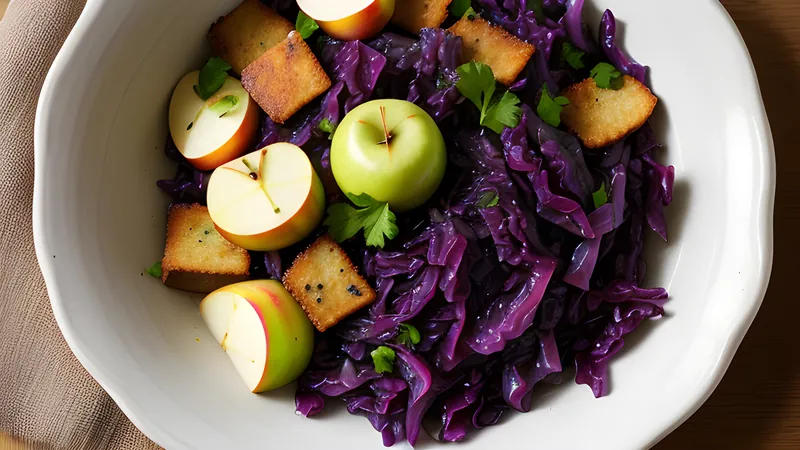
The prize at the end is Grünkohl mit Pinkel. It is one of the few German dishes where the vegetable is the headline and the meat is the seasoning, and the version most British cooks imagine — kale wilted for four minutes, bright green, a squeeze of lemon — bears no relationship to it whatsoever. This kale cooks for an hour and a half. It goes almost black. It collapses into something closer to a savoury jam than a side salad, and that collapse is the entire point.
Grünkohl mit Pinkel: North Germany's Kale and Smoked Sausage
Ingredients
- 1 kg curly kale, thick stems stripped out (about 600 g leaf once trimmed)
- 50 g lard or 50 g unsalted butter
- 2 large onions (about 300 g), finely chopped
- 600 ml unsalted chicken or ham stock
- 500 g Kassler (smoked pork loin) in one piece
- 4 Pinkel sausages (about 120 g each), or 4 smoked Mettwurst
- 60 g pinhead oatmeal (omit if using true Pinkel)
- 1 tbsp dark miso
- 2 tsp coarse German mustard, plus more to serve
- 1 tsp caster sugar
- 1/2 tsp ground allspice
- 1/4 tsp ground cloves
- 1 tbsp cider vinegar
- Black pepper
- Salt, only at the very end
Method
- Strip the kale leaves from their stems and wash them in two changes of cold water. Boil a large pan of unsalted water, drop the leaves in for 3 minutes, then drain and press out the water. Chop coarsely.
- Melt the lard in a large heavy pot over medium heat. Cook the onions for 12 minutes until soft and pale gold, stirring often.
- Add the chopped kale and turn it in the fat for 2 minutes. Pour in the stock, add the allspice, cloves and sugar, and bring to a simmer.
- Bury the Kassler in the kale, cover the pot, and simmer gently for 45 minutes. Keep the heat low enough that the surface barely moves.
- Lift the Kassler out and set it aside. Stir the oatmeal into the kale if you are using it. Lay the Pinkel sausages on top, pricking each one once with a needle. Cover and cook for a further 30 minutes.
- Lift the sausages out. Stir the miso and mustard into the kale until dissolved, then simmer uncovered for 10 minutes to thicken.
- Stir in the cider vinegar and plenty of black pepper. Taste, and add salt only now — the Kassler and sausage will have salted the pot already.
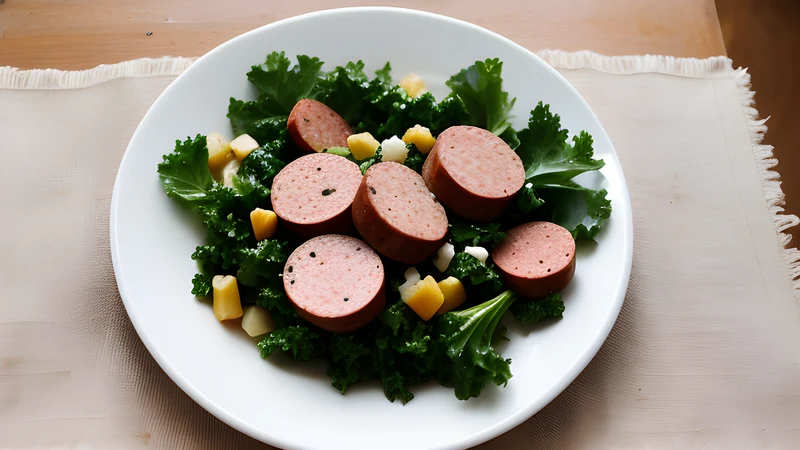
- Slice the Kassler thickly and return it to the pot to warm through for 5 minutes. Serve the kale in deep bowls with the sausage split open on top and extra mustard on the side.
Why the frost actually matters
The tradition says you wait for the first frost before cutting kale, and for once the folk rule and the plant physiology agree. Kale exposed to sustained cold below about 4°C converts stored starch into soluble sugars — mostly glucose, fructose and sucrose — because dissolved sugar lowers the freezing point inside the plant’s cells and stops ice crystals rupturing them from within. The kale is protecting itself. The cook gets the benefit: measurable sweetness, and a reduction in the harsher glucosinolate bitterness that makes summer kale taste like a punishment.
Modern varieties bred around Oldenburg reach that sugar level faster and hold it longer, which is why commercial growers now often chill cut kale rather than gamble on the weather. If you are cooking this in a country where frost is theoretical, buy the toughest, darkest, most stubbornly curly kale you can find and give it a night in the coldest part of the fridge, spread out rather than bagged. It is a partial substitute. It is enough.
What Pinkel actually is
Pinkel is where most people outside Germany stall, because there is nothing quite like it on a British counter. It is a smoked sausage built around groats — oats or barley — bound with pork fat, onion, salt, allspice and cloves, then cold-smoked. When it heats through, the groats swell and the fat renders, and the sausage functions as a slow-release seasoning device: everything inside it leaks into the kale over half an hour. Split one open at the table and the interior is a soft, spiced, oatmealy paste. It is much better than that sentence makes it sound.
The name has spawned an entire genre of pub etymology, most of it revolving around the sausage being stuffed into the pig’s rectum. The more credible reading traces it to the Low German Pinkel for the little finger, describing the sausage’s size. Either story gets told with total confidence by whoever is buying the round.
If you cannot source Pinkel — and outside northern Germany you probably cannot — use a good smoked Mettwurst and stir 60 g of pinhead oatmeal into the pot at the same point. The oatmeal does the thickening and the starchy body that Pinkel would have contributed. It is a genuine reconstruction rather than a compromise; the groats were always the functional half of the sausage.
The miso, and why it earns its place
Here is my one departure from Oldenburg orthodoxy: a tablespoon of dark miso, stirred in near the end.
Traditional Grünkohl gets its savoury depth from volume of pork — Kassler, Pinkel, Kochwurst, sometimes Bregenwurst, sometimes bacon on top of all that. Four meats in one pot. Cook it that way and it is superb, and you will need to be walked three miles afterwards. Miso delivers a large part of the same effect through free glutamates and the browned, fermented notes of a long koji ferment, and it does it with 18 g of paste instead of another 300 g of fat. Stirred in off the boil, it disappears completely — nobody has ever identified it in a blind bowl, and I have tried this on a Bremen-born guest who was actively suspicious.
Add it after the sausages come out, and never let it boil hard. Prolonged high heat drives off the aromatic compounds that make it worth adding and leaves you with plain salt.
Method notes that matter
Blanch, then squeeze. The three-minute blanch pulls out the roughest bitterness and, more usefully, wilts the kale so 1 kg of leaf fits in a pot at all. Press the drained kale hard between your palms. Wet kale dilutes the stock and you will spend an extra twenty minutes boiling that water back off.
Salt at the end, always. This is the single failure mode I see. Kassler is brine-cured and Pinkel is heavily salted, and both give up salt to the pot for ninety minutes. Season at the start and you will produce something inedible with no route back. Add the stock unsalted, taste at the end, adjust then.
Keep the simmer lazy. A hard boil emulsifies the rendered pork fat into the liquid and turns the pot greasy and cloudy. A bare simmer lets the fat sit on the surface, where it stays glossy and where you can spoon some off if you want to.
Prick the sausage once. Once. Enough to stop the casing bursting and dumping the groats into the pot; not so much that the sausage empties itself and arrives at the table as an empty skin.
The kale should look wrong. After 90 minutes it will be olive-black and structureless, and every instinct trained on modern vegetable cookery will tell you it is ruined. It is not. Kale has enough cellulose and enough sturdy cell wall to survive a treatment that would reduce spinach to green water, and the long cook is what converts it from fibrous to velvety.
Storage, and the second day
Grünkohl is better reheated, unambiguously. Overnight in the fridge, the fat sets on top and the spicing settles into the leaf; the allspice in particular stops reading as a separate note and folds into the background. It keeps for four days covered, and freezes well for three months — freeze the kale and the meat separately, because the sausage casing turns rubbery on a slow thaw.
Northern Germans reheat it in a wide pan with a spoonful of lard until the bottom catches slightly, then scrape the caught bit back through. The scorched fragments are the best part of the whole dish and there is no polite way to distribute them fairly.
Regional arguments worth knowing about
Grünkohl is cooked across a band of northern Germany roughly 300 km wide, and every stretch of it disagrees with the next about something.
Bremen and Oldenburg chop the kale fine, cook it to blackness and serve it with Pinkel and sugar-browned potatoes; this is the version I have given you, and the one the Kohlfahrt was built around. Around Hanover the kale is left in coarser pieces and gets a spoonful of oats or a slice of bread stirred in to thicken. In Schleswig-Holstein it turns up beside smoked pork with the sugar left out entirely, which the Oldenburgers regard as a wasted opportunity. Frisian cooks add a peeled, whole potato to the pot to collapse into the leaf and bind it. And in Kassel — home of the Kassler, or so the pub story goes, though the sausage historian Johann Cassel of 1880s Berlin has a better claim — they will tell you the smoked loin is the dish and the kale is the garnish.
The one thing nobody argues about is the length of the cook. Ninety minutes is the floor everywhere.
The case against, honestly
This dish has real limits and it is fairer to name them than to pretend otherwise.
It is heavy in a way that is difficult to moderate. Even with my miso swap you are eating cured pork, smoked sausage and rendered lard in a single bowl, and the traditional four-meat version is closer to 1,200 calories a serving before the potatoes arrive. The Kohlfahrt exists partly because three miles of walking makes the bowl survivable.
It is also monochrome. There is one flavour direction here — smoke, salt, sweet, fat — and it is pushed hard and held for the whole meal. The mustard on the side is doing real structural work as the only sharp thing on the plate, which is why I keep insisting you do not stir it in. Skip it and by the third mouthful the dish flattens.
And it needs the right kale. Bagged supermarket kale, picked young and cut into confetti, disintegrates into green threads within forty minutes and gives you texture like wet paper. You want mature curly kale with stems thick enough to be worth stripping. Cavolo nero holds its shape well but tastes wrong — too mineral, too little sugar to caramelise against the smoke. Savoy cabbage is closer than you would expect if kale is genuinely unavailable, though you lose the frilled edges that trap the fat.
None of that stops it being one of the great winter pots of Europe. It just means you cook it in January, for people who have been outdoors, and you do not follow it with a dessert.
What to put beside it
Bratkartoffeln, if you want the standard answer: par-boiled waxy potatoes, sliced thick, fried hard in the pork fat until the edges shatter. Brunede kartofler, the Danish caramelised potatoes, are the better answer — they are three-quarters of the way to the sugar-glazed potatoes that already turn up on Grünkohl plates around Bremen, and the burnt-sugar edge is exactly what the miso is reaching for from the other direction.
The Dutch make the same argument with a different accent in stamppot boerenkool — kale and potato mashed together with a smoked rookworst laid on top. Same plant, same sausage logic, half the cooking time, and a fraction of the ceremony. If you want the kale and sausage on a Tuesday, make that. If you want the version worth walking three miles for, make this.
Mustard on the side, in its own pot. A cold beer. Schnapps is traditional and, after a bowl this size, structurally advisable.
Related Content