Glühwein With Red Wine, Star Anise and Orange
A cheap fruity red, an orange sugar that makes itself, and a pan that never boils
Contents
↓ Jump to recipeGlühwein is served at every German Christmas market from a steel urn the size of a dustbin, and most of it is poor. It has been boiled, it was made from a wine that had no business being warmed, and the sugar is doing all the work. It costs three euros and a deposit on the mug, and you drink it because you are cold and it is snowing on your gloves, and the gap between that and a good one made at home is enormous.
The good version is easy. There are only two real decisions: which wine, and how hot. Everything else is spice, and spice is the part everybody already gets right.
Glühwein With Red Wine, Star Anise and Orange
Ingredients
- 2 unwaxed oranges
- 90 g caster sugar
- 1.5 litres fruity, low-tannin red wine (Dornfelder, Spätburgunder, Merlot or a cheap Grenache)
- 3 whole star anise
- 2 cinnamon sticks
- 6 whole cloves
- 4 green cardamom pods, lightly crushed
- 4 allspice berries
- 2 bay leaves
- 1 x 3 cm piece fresh ginger, sliced into coins
- 1 vanilla pod, split (optional)
- 100 ml dark rum, to serve (optional)
Method
- Pare the zest from both oranges in wide strips with a vegetable peeler, taking as little white pith as you can. Put the strips in a bowl with the sugar and muddle them together hard with the end of a rolling pin for a minute.
- Leave the zest and sugar at room temperature for at least 1 hour, stirring once or twice. The sugar draws the oil out of the peel and turns damp, syrupy and intensely orange-scented.
- Juice one of the peeled oranges (you need about 80 ml) and slice the other into rounds.
- Pour the wine into a wide, heavy pan. Add the orange sugar with all its syrup, the orange juice, star anise, cinnamon, cloves, cardamom, allspice, bay, ginger and vanilla.
- Warm over a low heat, stirring until the sugar dissolves, until the surface steams faintly and a thermometer reads 70°C. Do not let it simmer, and never let it boil.
- Hold it between 65°C and 75°C for 30-45 minutes, on the lowest flame your hob has or with the pan half off the ring. Taste at 30 minutes.
- Strain out the spices and ginger through a sieve. Return the wine to the pan to keep warm at 70°C.
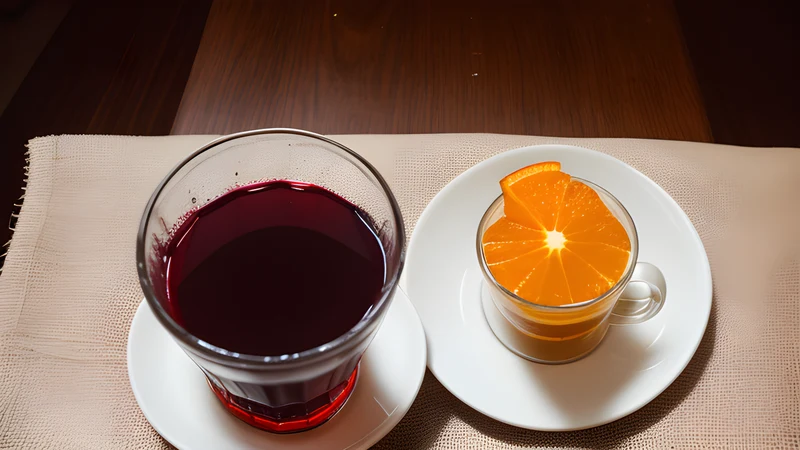
- Serve in heatproof glasses with a fresh orange round in each. Add a 15 ml shot of rum per glass at the table if you want it.
A tankard from 1420, and a burning sugarloaf
Warm spiced wine is one of the oldest recipes we can still read. Apicius, the Roman collection compiled somewhere around the fourth century, opens with conditum paradoxum — wine cooked with honey, then steeped with pepper, mastic, bay, saffron and roasted dates. The pepper is startling until you taste it, and then it makes complete sense.
The medieval version was hippocras, spiced sweetened wine strained through a conical cloth bag known as a Hippocratic sleeve, after the physician — because until quite recently spiced wine was medicine that people happened to enjoy. Cinnamon, ginger and grains of paradise were pharmacy stock, and the line between a tonic and a drink was drawn wherever the apothecary wanted it.
The German thread has a specific and rather charming anchor. A silver-gilt tankard dated 1420, made for Count John IV of Katzenelnbogen, survives and is generally described as the first documented Glühwein vessel. The same count is credited with planting the first recorded Riesling vines in 1435, which makes him a man who took the whole subject seriously in both directions.
The markets came next. Dresden’s Striezelmarkt has run since 1434 and claims to be the oldest in Germany; Nuremberg’s Christkindlesmarkt is the one on the postcards. German wine law takes Glühwein seriously enough to define it: it must be made from actual wine, it must reach at least 7% alcohol by volume, and it may be sweetened and spiced — while adding water to it is forbidden outright. This is why market Glühwein, however mediocre, is always recognisably wine and never squash.
Then there is Feuerzangenbowle, which is Glühwein with a party attached. A cone-shaped sugarloaf sits in tongs across the bowl, gets soaked in overproof rum, and is set on fire, dripping flaming caramel into the wine below. It comes from Heinrich Spoerl’s 1933 novel and the 1944 film starring Heinz Rühmann, and German universities still screen the film every December in lecture theatres full of students with hip flasks and sparklers. It is a genuinely good drink and a genuinely alarming thing to do indoors.
The wine is the whole decision
Buy cheap. The qualities that make an expensive red expensive are precisely the qualities that heat destroys, which makes this the one place in wine where thrift is a technique. The subtle tertiary aromas of an aged Burgundy evaporate at 70°C in about four minutes, and you have poured forty pounds into a pan of cinnamon.
What you want is fruit and low tannin. Tannins are astringent at room temperature and become properly harsh when warm — they bind to your saliva proteins more aggressively as temperature rises, so a big oaky Cabernet Sauvignon or a young Malbec turns bitter and drying the moment it heats, and no amount of sugar rescues it. Oak is the other trap: vanillin and toast notes from barrel ageing go strange and hollow against clove.
Dornfelder is the German answer and close to perfect — deep colour, soft, dark-fruited, made in enormous quantities in the Pfalz and Rheinhessen, and cheap. Spätburgunder (Pinot Noir) at the basic end works beautifully. Outside Germany, a young unoaked Merlot, a Grenache from the Languedoc, a Beaujolais, or a Portuguese table red will all do the job. Five to seven pounds a bottle is the sweet spot, and boxed wine is entirely defensible here.
Sugar at 60 g per litre is my baseline and this recipe runs just above it. Market Glühwein is routinely at double that, which is why the third mug tastes like syrup and the next morning is worse than the alcohol justifies.
The orange sugar
This is the one thing I do that the urn does not, and it takes a minute of work and an hour of ignoring it.
Most of an orange’s aroma lives in oil glands in the coloured zest, and that oil is not water-soluble. Throw orange slices into hot wine and you extract some of it, along with a good deal of bitterness from the pith, and you also boil off the volatile top notes as fast as they are released. Sugar extracts it cold instead. Muddled with pared zest and left for an hour, the sugar’s hygroscopic pull draws the essential oil straight out of the peel and dissolves it into a syrup — the technique is called an oleo-saccharum and it is the backbone of every classic punch recipe in the eighteenth-century books.
The result goes into the wine already dissolved, carrying the citrus oil in a form that survives the heat. The difference against sliced-orange Glühwein is not subtle: the drink smells of orange from a metre away, and it keeps smelling of orange after forty minutes in the pan.
Use unwaxed fruit, since you are eating the outside of it. Take the zest in wide strips with a peeler and stop when you see white — pith carries bitter limonin and contributes nothing.
70°C, and everything that goes wrong above it
Never boil it. Ethanol boils at 78°C, and although a wine-water mixture does not simply lose all its alcohol at that number, the rate of loss climbs steeply as you approach it, and the aromatic compounds you actually want go first. Boiled Glühwein tastes stewed, flat and faintly of jam, and it has quietly become weaker. German producers who sell it commercially state a serving temperature around 70°C for exactly this reason.
Below about 60°C, the spices never properly infuse and the drink feels tepid in the hand. Between 65°C and 75°C the extraction is good, the alcohol stays, and the surface steams without ever breaking into bubbles. If you own a thermometer, use it once and learn what that surface looks like; after that you can do it by eye.
Cloves are a bully. Six is plenty for 1.5 litres. Eugenol, the compound that makes clove taste of clove, is also a mild local anaesthetic — it is why dentists have used clove oil for two centuries — and a heavy hand gives you a drink that numbs the tip of your tongue and tastes of a waiting room. Once the wine is strained, that flavour stops developing, which is another argument for straining rather than leaving everything in the pan all evening.
Use whole spices only. Ground cinnamon and ground clove will not dissolve; they hang in suspension, make the wine cloudy and gritty, and settle as sludge in the bottom of the glass.
Ginger, sliced, goes in early. Gingerol is heat-stable and water-soluble and it gives the drink its warmth in the throat, which people usually attribute to the alcohol.
If it tastes thin at the end, that is the wine, and a splash of rum masks it honestly. If it tastes bitter, that is tannin or pith, and nothing will fix it — which is why the wine choice at the shop matters more than anything you do at the hob.
The pan, and making it for twenty people
A wide pan gets you to temperature evenly and lets you see the surface, which is your only real gauge once the thermometer goes back in the drawer. It should be stainless steel or enamelled cast iron. Bare cast iron and aluminium react with wine acid and will give the drink a metallic edge within half an hour, and a copper pan without a lining is worse.
A slow cooker on Low is the honest answer for a party, and it is what I use when there are more than six people. Most sit somewhere between 75°C and 80°C on Low with the lid on, which is marginally too hot — take the lid off, or prop it, and it settles into the right band and stays there for five hours without any attention at all. It also becomes the serving vessel, which means nobody is standing at the hob playing barman. Strain the spices out at the 40-minute mark all the same; the slow cooker will happily over-extract cloves for the rest of the evening if you let it.
An electric urn, the market’s own tool, holds temperature well and has a tap, and if you are doing this for a street party it is worth the hire. Keep the wine strained and pre-spiced, and never let the thermostat run to its top setting.
Scale the recipe by the litre and everything holds except the spice, which does not scale linearly. For 6 litres, use three times the wine and roughly double the cloves and star anise — a big pan has less surface area per litre, extracts more efficiently and holds its aromatics better, so a straight multiplication gives you something medicinal.
Serve it in glass rather than a mug if you can, because the colour is half the pleasure, and warm the glasses first with hot water from the tap. A cold glass drops a 70°C drink to about 60°C before it reaches the table, which is precisely the temperature at which Glühwein stops being a good idea and becomes wine you left out.
Variations, and the leftovers
Weisser Glühwein — made the same way with a dry Riesling or Silvaner, and it is arguably the better drink: lighter, sharper, and the star anise sits more clearly against white fruit. It is standard in Franconia and around Nuremberg and largely unheard of elsewhere.
Kinderpunsch swaps the wine for cloudy apple juice with a squeeze of lemon and the same spice bill, and children take it seriously.
A Schuss — a shot of dark rum, amaretto or Kirsch stirred into the glass at the table rather than the pan — adds alcohol you have not cooked and is how most market stalls sell the upgrade.
It reheats fine as long as you respect the ceiling: strained, cooled and kept in the fridge for three days, then brought back to 70°C in a pan. Do not put it in a microwave, which produces boiling spots and no useful control.
What it wants beside it is starch and sugar. Warm Laugenbrezel is the market pairing and it is correct — the salt against the sweet wine is the whole thing. Gevulde speculaas shares half the spice cupboard, gingerbread shares the other half, and a slab of apfelstrudel is what I actually want at four o’clock in December with the sun already going.
Related Content