Ghormeh Sabzi: The Herb Stew at Iran's Heart
A kilo of herbs, fried until they go dark
Contents
↓ Jump to recipeIf you ask an Iranian what the national dish is, you will get ghormeh sabzi, and you will get it quickly and without hedging. There is no serious competition. It is the stew every household makes, every diaspora kitchen makes, and every Iranian abroad describes with a slightly faraway expression that is genuinely about the smell rather than the taste.
The smell is fenugreek. Nothing else in cooking does what fenugreek does — a maple-and-celery, bitter, almost animal note that at low concentration is one of the great flavours and at high concentration is unbearable. Ghormeh sabzi sits it against three quarters of a kilo of parsley, coriander and chives, all fried until they go black, and then acidifies the whole thing with dried limes. It should not work. It is one of the best things anyone cooks.
Ghormeh Sabzi: The Herb Stew at Iran's Heart
Ingredients
- 700 g lamb shoulder or leg, cut into 4 cm cubes
- 5 tbsp vegetable oil, plus 3 tbsp for the herbs
- 2 large onions, finely chopped
- 1 tsp ground turmeric
- 1 tsp fine salt
- 1/2 tsp coarsely ground black pepper
- 400 g flat-leaf parsley, leaves and fine stalks
- 200 g coriander, leaves and fine stalks
- 150 g garlic chives or the green tops of spring onions
- 40 g fresh fenugreek leaves, or 3 tbsp dried fenugreek (shanbalileh)
- 6 dried Persian limes (limu omani)
- 1 x 400 g tin red kidney beans, drained
- 1.2 litres water
- 1 tbsp lime juice, to finish
Method
- Pierce each dried lime three or four times with the tip of a knife. Toast them in a dry frying pan over medium heat for 4-5 minutes, turning, until they darken a shade and smell sharply citrus. Set aside.
- Wash and dry the parsley, coriander and chives thoroughly, then chop them very finely — a food processor pulsed in short bursts is acceptable, a purée is not.
- Heat 3 tbsp oil in a wide frying pan over medium heat. Add all the chopped herbs and the fenugreek and fry for 20-25 minutes, stirring often, until the volume has collapsed by two thirds and the herbs are very dark green and almost black at the edges. Set aside.
- In a heavy casserole, heat 5 tbsp oil and soften the onions over medium heat for 12 minutes until deep gold.
- Stir in the turmeric and cook for 60 seconds until it smells toasty.
- Raise the heat, add the lamb, and brown for 8 minutes, turning. Add the salt and pepper.
- Add the fried herbs, the toasted limes and the water. Bring to a boil, then reduce to the barest simmer and cover.
- Cook for 2 hours. Press each dried lime against the side of the pan with a spoon at the 1 hour mark to release its interior.
- Add the kidney beans and cook uncovered for a further 45-60 minutes until the stew is thick, the oil has risen to the surface in a dark green slick, and the lamb falls apart.
- Fish out and discard the spent limes. Stir in the lime juice, taste for salt, and rest for 10 minutes before serving with steamed rice.
What the dish is doing
Ghormeh means braised or stewed; sabzi means greens. The name is entirely descriptive and entirely unhelpful, because the ratio is the whole story. Seven hundred grams of lamb to nearly eight hundred grams of herbs makes the lamb a seasoning for the herbs.
Persian cooking classifies dishes by a hot/cold humoral system inherited from Galenic medicine via the Islamic Golden Age, and ghormeh sabzi is a balancing act within it: the lamb is “hot”, the herbs and limes are “cold”. That framework was in place while the dish was being constructed, and it is why the proportions are the way they are. The system is still live in Iranian kitchens; people will tell you a dish is garm or sard without a hint of irony.
Regional versions differ mostly in the sourness. Tabriz leans harder on the limes. Some northern versions add sour plums or gojeh sabz. Southern cooking sometimes uses tamarind. The Tehran standard, and the one here, is limes and a squeeze at the end.
Sourcing the four things that matter
Three of the ingredients here are hard to fake, and the fourth is easy to get wrong.
Fenugreek. Fresh fenugreek leaves — shanbalileh — are sold at Iranian, Turkish and Indian grocers, the last usually under the name methi, and they freeze perfectly. Forty grams of fresh is the dose. Dried is what most households abroad use and it is entirely legitimate; three tablespoons. What you must not use is fenugreek seed, which is a different and much more aggressive proposition — the seed carries far more of the bitter compounds and will wreck the pot. Check the packet says leaves.
Dried limes. Limu omani are sold whole and rock-hard, usually six or eight to a bag, at any Middle Eastern grocer and increasingly online. Buy the black ones if you have a choice — they are more fermented and deeper-flavoured than the tan ones. Ground dried lime powder exists and I would avoid it; it goes bitter fast and you lose the ability to pull the limes out.
Garlic chives. Tareh is the proper herb. Failing that, the green tops of spring onions get you most of the way, and Chinese garlic chives from an East Asian grocer get you closer. Regular chives are too mild to register.
The herbs themselves. Four hundred grams of parsley is roughly six supermarket packets, which is why you should buy them by the bunch from a greengrocer instead — the same money gets you five times the volume. Use the fine stalks; discard only the thick woody ones. Iranian shops sell pre-chopped frozen sabzi ghormeh, a ready-mixed blend of the right herbs in the right ratio, and it is a completely reasonable shortcut that many Iranian households abroad use without embarrassment. Fry it exactly as you would fresh, allowing an extra five minutes for the water to leave.
The twist: toast the dried limes
Limu omani are limes that have been boiled in brine and then left in the sun until they dry hard, hollow and black-brown inside. They provide the sourness and, more importantly, a fermented, slightly musty depth that fresh lime cannot supply. Everyone agrees they go into the pot. Almost nobody toasts them first.
Four or five minutes in a dry pan, after piercing, and they change. The dried oils in the peel — still present, still volatile — wake up, and the sugars remaining in the desiccated flesh caramelise slightly. Untoasted, a limu omani gives you sour and dusty. Toasted, it gives you sour, dusty, and a bitter-orange top note that carries all the way through three hours of braising. The difference in the finished stew is real and it costs four minutes.
Pierce them first. This is not optional. A sealed dried lime in a simmering stew is a pressure vessel with a weak wall, and they do occasionally burst. Three or four holes with a knife tip lets the liquid in and the air out, and it also means the lime actually flavours the stew rather than floating on top being decorative.
Press them at the one-hour mark to release the interior, and take them out at the end. Left in past three hours they go from pleasantly bitter to genuinely acrid — this is the single most common way ghormeh sabzi goes wrong.
Frying the herbs
This is the technique the whole dish rests on, and it takes twenty-five minutes of standing at a pan, and there is no way to do it faster.
Raw herbs taste of raw herbs. What you want is for them to go through a transformation that has no good English name: the volume collapses to a third, the colour goes from bright green to a dark near-black green, and the flavour stops being fresh and starts being deep, slightly bitter and faintly smoky. Iranian cooks call it sorkh kardan, frying, and the visual marker is the oil separating and going dark green.
Two rules. Dry the herbs properly before chopping — wet herbs steam rather than fry, and you will stand there for forty minutes waiting for water to leave. A salad spinner and then a tea towel. Do not walk away. The gap between correctly dark and burnt is about ninety seconds, and burnt herbs taste of ash and cannot be rescued.
The fenugreek goes in with the rest. Fresh is better if you can get it. Dried shanbalileh is what most people use and three tablespoons is the ceiling — this is the one ingredient in the dish where more is straightforwardly worse. Four tablespoons and the stew turns bitter and medicinal.
The lamb, the onions, the turmeric
The three things that happen before the herbs go in are quick and every one of them is skippable and every one of them costs you.
The onions need twelve minutes. Deep gold, collapsed, sweet. Iranian cooking builds almost every stew on a piaz dagh base, and the sugars developed over that twelve minutes are the only sweetness in a dish that is otherwise sour, bitter and savoury. Five minutes of translucent onion gives you a stew with a hole in the middle of it.
The turmeric goes in dry, into hot oil, for sixty seconds. This is the step people miss. Turmeric’s flavour compounds are fat-soluble and its raw taste is chalky and slightly bitter; a minute in hot oil blooms them and turns the raw earthiness into something warm and rounded. Add turmeric with the water instead and it will taste dusty all the way through. Sixty seconds, no more — turmeric burns fast and burnt turmeric is acrid.
The lamb goes in after. Shoulder is the cut: fatty, collagen-heavy, and it falls apart at three hours. Leg works and is leaner and slightly drier. Neck fillet is cheap and excellent. Cut to 4 cm — this stew cooks long enough that smaller pieces shred away entirely, and shredded lamb in ghormeh sabzi reads as a mistake rather than a texture.
Some Iranian cooks do not brown the lamb at all, adding it straight to the onions and letting it stew. The browned version is deeper and the unbrowned version is cleaner and lets the herbs speak louder. I brown it. Eight minutes, and do not chase a hard crust — colour on two or three faces is enough.
Beef works, incidentally, and shin is the cut. It is not traditional and it is very good. Vegetarian versions built on mushrooms and extra beans exist and are common in Iran during religious fasts; use 400 g of chestnut mushrooms browned hard, and add a second tin of beans.
Getting the finish right
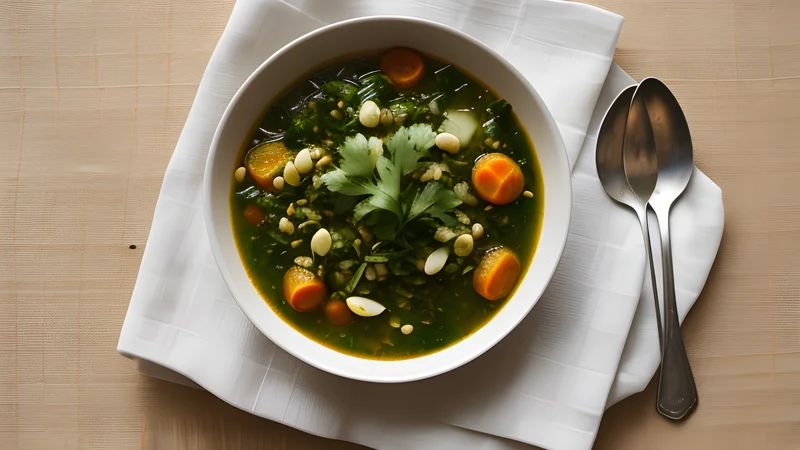
The end point is visual. A finished ghormeh sabzi has a slick of dark green oil floating on the surface, and the stew underneath is thick enough that a spoon leaves a track. Leave that oil where it is. It holds all the fat-soluble herb flavour, and Iranian cooks judge the stew by it. If yours has not separated after three hours, you are under-reduced. Uncover and boil harder.
Beans go in late. Tinned kidney beans will disintegrate over three hours. Forty-five minutes to an hour is enough for them to take on the stew.
If it is not sour enough, add lime juice at the end rather than more dried limes. Dried limes need time; juice works instantly.
If it is bitter, the limes stayed in too long or the fenugreek was heavy-handed. A teaspoon of sugar helps a little. Prevention is the only real cure.
Serve with plain steamed basmati and, if you are prepared to commit, Persian saffron tahdig with a crackling crust, which is the correct partner. A Shirazi salad alongside, and barbari if there is bread on the table. For the same herb-frying technique working in a soup, see ash reshteh.
One thing worth knowing about the timing: ghormeh sabzi is a stew where the third hour is doing something the first two cannot. The herbs, the lamb fat and the lime acid need a long, low, uninterrupted stretch to stop being three separate flavours and become one. At ninety minutes it tastes like lamb with herbs in it. At three hours it tastes like ghormeh sabzi, and there is a recognisable moment somewhere around the two-and-a-half-hour mark when it happens. Iranian cooks talk about the stew “coming together” and they mean this literally. If yours tastes fragmented, it is almost always underdone rather than mis-seasoned.
It keeps five days and improves for three of them. Make double.
Related Content