Garbure: The Ham and Cabbage Soup of the Béarn
A ham bone, white beans, cabbage and confit, thick enough to stand a ladle in
Contents
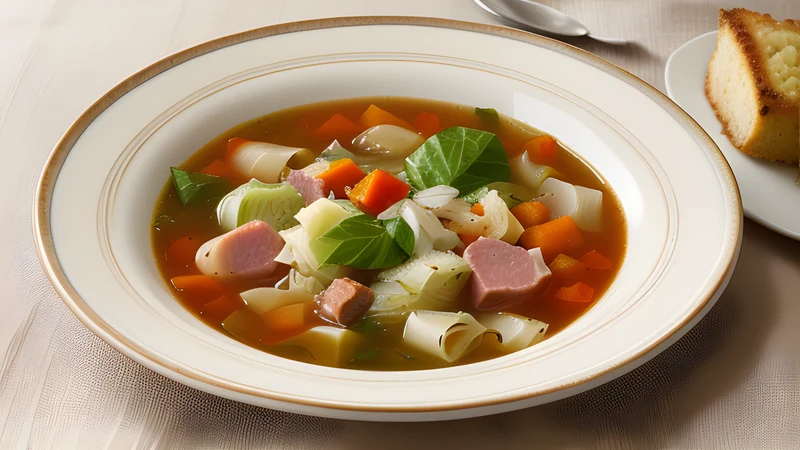
↓ Jump to recipeA garbure is done when the ladle stands up in it. That is the actual test, it is quoted in the Béarn without any irony, and it is more useful than a timer. The soup should be so crowded with cabbage, bean and collapsing potato that a spoon left upright in the pot stays upright for a second or two before it topples. Anything looser is a nice vegetable broth.
Garbure: The Ham and Cabbage Soup of the Béarn
Ingredients
- 300 g dried haricot tarbais or cannellini beans, soaked overnight
- 1 smoked ham hock, about 900 g (or a raw ham bone with meat on it)
- 2 tbsp duck fat
- 2 medium onions (about 250 g), chopped
- 3 carrots (about 250 g), cut into 2 cm chunks
- 2 turnips (about 200 g), peeled and quartered
- 2 leeks (about 250 g), sliced into 2 cm rounds
- 4 garlic cloves, sliced
- 1 bouquet garni: 2 bay leaves, 4 sprigs thyme, 6 parsley stalks, tied
- 2.5 litres cold water
- 500 g green cabbage, preferably Savoy or a frost-touched Vertus, cored and cut into 3 cm ribbons
- 500 g floury potatoes, peeled and cut into 4 cm chunks
- 4 confit duck legs
- 0.5 tsp piment d'Espelette
- 1 tsp fine salt, or to taste, added late
- 0.5 tsp freshly ground black pepper
- 6 thick slices stale country bread
- 150 ml robust red wine, such as Madiran, for the chabrot
Method
- Drain the soaked beans. Put the ham hock in a large pot, cover with cold water, bring to the boil, and boil for 5 minutes. Drain, discard that water, and rinse the hock. This strips the harshest salt.
- Melt the duck fat in the rinsed pot over a medium heat. Cook the onions for 10 minutes until soft and pale, then add the garlic for 1 minute more.
- Return the hock to the pot with the drained beans, the carrots, turnips, leeks and the bouquet garni. Pour over 2.5 litres of cold water. Add no salt yet.
- Bring slowly to the boil, skim off the grey foam, then drop to the barest simmer. Cover partly and cook for 2 hours, until the beans are creamy and the hock meat is loose on the bone.
- Lift out the hock. Pull the meat off in chunks, discard skin, bone and gristle, and return the meat to the pot.
- Add the cabbage and the potatoes and the Espelette. Simmer, partly covered, for 45 minutes. The potatoes should start breaking down at the edges and thickening the broth.
- Meanwhile, warm the confit legs in a 190C fan oven, skin up on a rack, for 20 minutes until the skin crisps and the fat runs.
- Crush 4 or 5 potato chunks against the side of the pot with a spoon to thicken further. Fish out the bouquet garni. Now taste, and add salt and pepper as needed.
- Put a slice of stale bread in the base of each warm bowl and ladle the garbure over it. Set a confit leg, or a piece of one, on top.
- When each bowl is nearly empty, pour in a splash of red wine, swirl it through the last of the broth, and drink it straight from the bowl. This is the chabrot.
The Béarn, and a soup that outranks its ingredients
Garbure comes from the Béarn, the old province in the western Pyrenean foothills around Pau and Oloron, and it is the daily food of a place that was poor, wet, and good at pigs. In the nineteenth century a Béarnais farmhouse ate garbure twice a day — a fresh pot in the morning, the thickened remains at night, and the pot itself often never fully emptied for weeks. New vegetables went in as old ones came out.
The name probably comes from the Spanish garbias, a stew, though the Gascon garbe — a sheaf of wheat — has its supporters. The etymology is contested and the sociology is not: garbure was a soup of what the garden had this week and what the pig gave last winter.
Which means there is no fixed recipe, and the region knows it. The Confrérie de la Garbure in Oloron-Sainte-Marie runs a championship every September and the entries disagree wildly on beans, on turnips, on whether confit belongs. What every version agrees on is the ham bone, the cabbage, and the thickness.
The ham bone is the dish
Everything else on the list is negotiable. The bone stays.
A smoked hock gives you three things at once: salt, smoke, and the collagen that turns 2.5 litres of water into something with weight. In the Béarn the bone is the leftover end of a jambon de Bayonne, cured for nine months and picked clean, and it is put to work in the pot precisely because it has nothing left on it. A hock with meat still attached is the version that makes sense in a shop.
Blanch it first. Five minutes at a boil, then chuck the water. This looks wasteful and it is protective — a nine-month cure or a commercial smoke puts a great deal of salt into that meat, and 2.5 litres reduced over three hours will concentrate every gram of it. Blanching removes roughly a third and gives you a soup you can season yourself.
Then add no salt until the very end. This is the single most common way to wreck a garbure. Taste at the two-and-three-quarter-hour mark and correct then, when the reduction has finished and you know what you are dealing with.
Beans, and the tarbais
Haricot tarbais is the local bean, grown up maize stalks around Tarbes since the eighteenth century and carrying its own protected designation. Its skin is unusually thin, which means it goes creamy without bursting, and it holds its shape across three hours in a way that most white beans do not. Cannellini is a decent stand-in and will start collapsing after two hours; that is a texture change rather than a disaster, since collapsed bean thickens the soup.
Soak overnight in plenty of cold water. The twelve hours are about even cooking rather than speed — an unsoaked bean hydrates from the outside in, and its skin cooks and toughens before the middle has softened.
Never cook them with salt in the water at the start. Salt firms the pectin in the skins and a bean simmered in salted liquid takes half as long again to go creamy. That is a second reason to season late.
Cabbage, and the frost
Savoy, or better, a Béarnais chou de Lormont or Vertus that has taken a frost. The frost is a real variable: freezing damages the cell walls and converts some of the cabbage’s starch to sugar as a natural antifreeze, and a frosted winter cabbage is measurably sweeter and softer than the same variety in September. This is why garbure is a winter soup and why it tastes better in January.
Cut it into wide ribbons, 3 cm. Shredded fine, it dissolves into fibres over forty-five minutes and disappears; in ribbons it keeps enough body that you find it on the spoon.
Forty-five minutes seems long for cabbage and it is deliberate. Garbure has no interest in bright green crunch. The cabbage should be entirely surrendered, sweet and silky, and its sulphurous edge should have cooked off completely.
The potato does the thickening
There is no roux, no flour, no cream. The soup thickens because floury potatoes — Maris Piper, King Edward, Bintje — shed starch into the broth as they break down at the edges, and because you crush four or five of them against the pot wall in the last ten minutes to speed it along.
Waxy potatoes are the wrong choice here, exactly opposite to a beef shin and ale stew, where you want the potato to stay a potato. Here the potato is a thickener that happens to be delicious.
Do not blend it. A stick blender turns garbure into a smooth green-grey purée, and everything that makes it worth eating is textural.
Confit, and the argument about it
Duck confit on top is the Sunday version, and the Confrérie’s competitors argue about it every autumn. The traditionalist position is that a farmhouse garbure had confit in it only when the pot could spare a leg from the jar, which was seldom, and that daily garbure was ham, cabbage and beans. The modern restaurant position is that confit is what makes it a dish rather than a soup.
Both camps are right about what they are describing. I add it, because a crisped confit leg on a bowl of soft grey-green soup is one of the great textural contrasts in French cooking, and because ninety per cent of the garbure served in Pau today has one.
Crisp it separately in a hot oven. Warming it in the pot makes the skin flabby, which is the whole thing you paid for. The same instinct — cured pork, beans, a long pot — produced cassoulet an hour east in the Languedoc, and Tuscan white bean and cavolo nero soup is what the Mediterranean does with the same beans, the same stale bread and none of the smoke.
The vegetables, and the licence you have
The root vegetables are where the Confrérie’s competitors diverge most, and where you should feel free to follow the garden. Carrot and leek are near-universal. Turnip is Béarnais orthodoxy and it divides people — it brings a peppery, faintly mustardy note that some cooks love and some strip out entirely. Broad beans go in during May. Chestnuts appear in October, peeled and dropped in with the cabbage, and they are extraordinary. Green beans, in high summer, turn the whole thing into a different and lighter soup.
What holds it together is the sequence rather than the list. Hard roots and beans go in at the start and take two hours. Cabbage and potato go in with forty-five minutes left, because a cabbage cooked for three hours dissolves entirely and a potato cooked for three hours turns the pot to wallpaper paste. Anything green and quick — peas, beans — goes in for the last ten.
The pot itself matters more than you would think. A wide, heavy casserole gives you evaporation, and evaporation is half the thickening. A tall narrow stockpot with a tight lid will still be soup at three hours because nothing has left it. If yours runs narrow, take the lid off for the last thirty minutes and let the surface work.
The chabrot, which is compulsory
When the bowl is nearly empty, pour in a slug of red wine, swirl it around, and drink the last of the broth straight from the bowl with both hands. This is faire chabrot, from the Occitan for goat — drinking like an animal — and it is a genuine daily habit. It is done by farmers, by grandmothers, and by everyone in a restaurant in Oloron on a Wednesday lunchtime.
Madiran is the local wine: black, tannic, made from Tannat, and built like a wall. The tannin cuts three hours of pork fat and duck skin in a way that nothing else on the table can.
The bread, and the trenchoir
The slice of stale bread in the bottom of the bowl is old technology and it still works. Before deep bowls and cutlery, a trenchoir of day-old bread was the plate; the soup went on top, the bread absorbed it, and you ate the plate at the end. Garbure kept the habit after the plates arrived.
Use bread that has genuinely gone stale — two or three days, dry enough to knock on. Fresh bread turns to paste in about nine seconds under hot soup and gives you a slick of dough at the bottom of the bowl. Stale bread has lost enough water that it drinks the broth and holds together, and the slice at the end is the best mouthful in the bowl.
A Béarnais refinement worth stealing: rub the dried slice with a cut garlic clove before it goes in. The hot soup releases the garlic upwards through the whole bowl, and you get a top note that the pot’s slow-cooked garlic lost hours ago.
Failures and afterlife
Thin. Waxy potatoes, or too much water, or you did not crush anything.
Too salty. No blanch, or you seasoned early. Add a peeled potato and simmer twenty minutes, then remove it.
Beans still hard at two hours. Old beans — dried beans over a year old sometimes never soften — or salt in the pot.
Grey and dreary. It is meant to look like that. Garbure is not photogenic and it does not care.
It keeps a week and improves for the first four days. Thin each reheating with a splash of water, because it sets almost solid in the fridge. Freezing is fine for three months, though the potato goes slightly grainy. The Béarnais answer to leftovers is to add tomorrow’s vegetables to the pot and keep going, which is either the oldest sustainable-cooking idea in France or simply the way you eat when there is nothing else.
Related Content