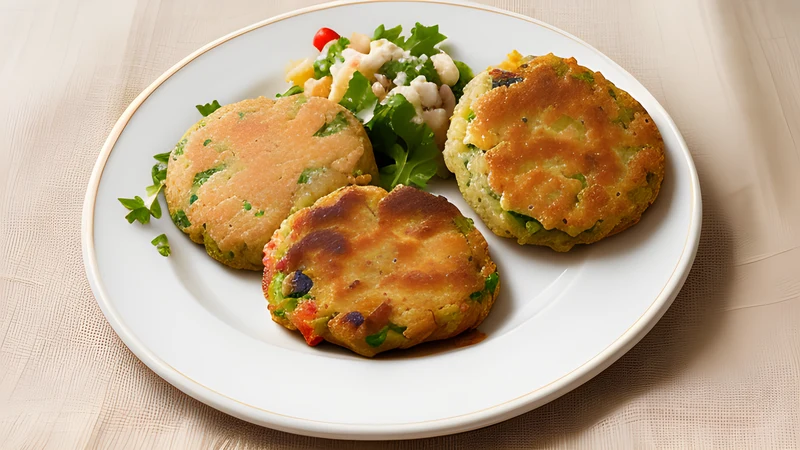
Frikadellen: German Pan-Fried Meat Patties
Stale bread, marjoram, and the difference between tender and bouncy
Contents
↓ Jump to recipeAsk for these in Berlin and they are Buletten. In Munich they are Fleischpflanzerl. Around Hamburg and the Rhineland they are Frikadellen, in parts of the north they get called Klopse, and in Hesse you may hear Fleischküchle. It is the same object every time: minced pork and beef, stale bread, onion, marjoram, flattened into a disc the size of your palm and fried in a pan until the outside is genuinely dark. Germany has a national dish that cannot agree on its own name, which tells you how far back it goes and how many places arrived at it separately.
The word Frikadelle came in from French fricadelle in the seventeenth century, itself built on the Latin frigere, to fry. Bulette took the same journey more directly — French boulette, a little ball, carried into Berlin by Huguenot refugees after 1685, whose descendants also gave the city half its bakery vocabulary. What arrived was a technique for making a small quantity of meat feed a table. What it turned into is the thing German children eat cold out of a paper bag on the train.
Frikadellen: German Pan-Fried Meat Patties
Ingredients
- 2 stale white bread rolls (about 120 g), or 120 g stale white bread, crusts on
- 150 ml whole milk
- 60 g unsalted butter
- 1 large onion (about 180 g), very finely chopped
- 250 g minced pork (around 20% fat)
- 250 g minced beef (around 15% fat)
- 1 large egg
- 2 tsp medium German mustard
- 2 tsp dried marjoram
- 1 tsp fine salt
- 1/2 tsp ground white pepper
- 1/4 tsp freshly grated nutmeg
- 2 tbsp finely chopped flat-leaf parsley
- 2 tbsp neutral oil, for frying
Method
- Tear the rolls into rough 2 cm pieces, put them in a bowl and pour over the milk. Leave for 15 minutes, turning once, until completely soft.
- Melt the butter in a small frying pan over medium heat. Let it foam, subside, and turn nut-brown with dark flecks on the base — about 5 minutes. Add the onion immediately and cook for 8 minutes until soft and golden. Tip the lot, butter included, onto a plate and cool to room temperature.
- Squeeze the soaked bread firmly, but leave it damp — you want it soft rather than dry. Mash it to a paste with a fork.
- In a large bowl combine the bread paste, cooled onions and brown butter, both minces, the egg, mustard, marjoram, salt, white pepper, nutmeg and parsley.
- Mix with your hands for no more than 60 seconds, until evenly combined and no longer. Fry a teaspoon of the mix, taste it, and adjust the salt.
- Wet your hands. Divide into 8 balls of about 110 g, then flatten each to a disc 2 cm thick and 8 cm across. Chill for 20 minutes if you have time.
- Heat the oil in a large frying pan over medium heat. Fry the patties in two batches for 5 minutes on the first side, until deep brown, then 4 minutes on the second.
- Turn the heat to low, cover the pan and cook for a final 3 minutes so the centres reach 72°C. Rest for 5 minutes before serving with mustard.
The bread is the recipe
Every part of a Frikadelle that distinguishes it from a hamburger comes from the soaked roll, and almost every failed Frikadelle fails because the cook treated the bread as filler and skimped on it.
Here is what is actually happening. Salt applied to raw mince dissolves myosin, the dominant muscle protein, and dissolved myosin cross-links into a continuous elastic gel when it heats. That gel is exactly what you want in a sausage or a fish cake — it is the springy, snapping bite. In a Frikadelle it is a disaster, and it is the difference between a patty that yields softly and one that bounces off the plate.
The soaked bread does three jobs against that. Its gelatinised starch holds several times its weight in water and releases it slowly during the fry, so the interior stays moist well past the point where plain mince would have squeezed itself dry. Its physical bulk gets between the meat particles and interrupts the myosin network before it can form a continuous sheet. And the milk brings casein and a little lactose, which brown early and give the crust its colour at a lower temperature than the meat alone would manage.
Two rules follow directly. Squeeze the bread just enough to stop it dripping — the water you wring out is the water you were trying to add. And mix for 60 seconds, hands only, then stop. A stand mixer with a paddle will produce something with the texture of a bath toy in about four minutes. This is a Frikadelle’s only genuine failure mode and it is entirely under your control.
Brown butter, and why the onions go in cooked
Raw onion in a meat patty is a mistake that survives on inertia. It never fully softens in the eight minutes the patty is in the pan, so you get crunchy fragments, and raw onion cells release enough water and sulphur compounds during cooking to make the mix loose and slightly acrid. Cook them first. Every good German home cook does, and then tells you it is optional.
My addition is to brown the butter before the onions go in. Take it past the foam to the point where the milk solids on the base turn the colour of a hazelnut skin, then drop the onions straight in — they arrive cold enough to stop the butter cooking any further, which conveniently solves the timing. What you get back is around thirty new aroma compounds from the Maillard reaction between the butter’s own lactose and casein, mostly the nutty pyrazines and buttery lactones, and they carry into the meat in a way that plain fried onion never does.
It costs five extra minutes and it is the single change that makes people ask what you did differently. Cool the mixture fully before it meets the mince, or the residual heat will start setting the egg and firming the meat before you have shaped anything.
Marjoram is the German note
Marjoram is the herb that makes a Frikadelle taste German, and there is no substitute that gets you there. It is milder and sweeter than its close relative oregano, with more of the woody-floral terpenes — sabinene hydrate especially — and much less of the sharp carvacrol that makes oregano read as Mediterranean. Two teaspoons of dried in this quantity of meat sounds like a lot. It is correct. Dried marjoram is also one of the rare herbs that genuinely improves on drying, because the drying concentrates those terpenes as the grassier notes go off.
Nutmeg does the other half of the job. A quarter-teaspoon is enough to be unidentifiable and to be noticed if you leave it out.
Frying: what goes wrong
The pan is too hot. Medium heat, a full five minutes on the first side. Frikadellen are 2 cm thick and need the centre to reach 72°C, and a hot pan gives you a burnt shell around a raw core. If the crust is dark before three minutes have passed, take the heat down.
They fall apart. Almost always underworked mix or an oversqueezed roll. The egg and the bread paste are the binder; if the mix will not hold a shaped disc without cracking at the edges, it needs another twenty seconds of mixing or a tablespoon more milk.
They puff into spheres. Meat contracts as it cooks and a disc will pull itself towards a ball. Shape them flatter and wider than you think — 2 cm by 8 cm — and press a shallow dimple into the centre of each. They will finish the right shape.
They taste flat. You did not fry the test teaspoon. Raw mince tastes of nothing; there is no way to season this by eye, and a minute spent frying a scrap of the mixture is the most reliable thing in this entire recipe.
Storage, and the cold Frikadelle
These are better cold the next day and Germans are entirely unsentimental about it. Cooled, the fat firms and the marjoram stops sitting on top of the meat, and the texture tightens into something you can eat with your fingers. They keep four days in the fridge and freeze cooked for three months. On a buttered roll with mustard and a slice of pickled cucumber, cold, standing up — that is what the dish is actually for, and any German over thirty has eaten one on a platform at six in the morning.
Reheat them, if you must, in a low oven at 140°C for 12 minutes. A microwave turns the bread paste rubbery within thirty seconds.
The regional versions, and what actually changes
The names differ more than the recipes do, but the differences that exist are real ones.
Berlin’s Bulette is the biggest and the flattest — 120 g, pressed to barely 1.5 cm, fried hard so that the crust makes up a larger share of every bite. It is street food and it is built to be eaten in one hand. Bavarian Fleischpflanzerl are rounder and domed, usually carry more pork, and lean harder on the marjoram; they turn up beside potato salad at every beer garden in Upper Bavaria. Northern versions tend to be thicker and softer, sometimes with a grated raw potato worked in alongside the bread for extra bulk.
The meat ratio is where households genuinely fight. Half pork and half beef, which is what I have given you, is the commonest and the most forgiving: the pork brings fat and sweetness, the beef brings the savoury depth and the darker crust. All-pork produces something noticeably softer and closer to the Danish patty. All-beef is drier and needs the fat percentage pushed to 20% to survive the pan. Butchers in Germany sell the ready-mixed compromise as Hackfleisch gemischt, and buying it is not cheating.
The one variation to treat with suspicion is the addition of breadcrumbs instead of a soaked roll. Dry crumbs absorb water without the gelatinised starch structure that holds it under heat, so they take moisture out of the meat during the fry rather than giving it back. The result is measurably drier. If you have no stale roll, soak fresh bread and squeeze it harder.
The case against, honestly
A Frikadelle is a modest thing and it is worth being clear about its ceiling.
It will never have the beefy intensity of a good burger, because the bread that keeps it tender also dilutes the meat by roughly a third and mutes it. That trade is deliberate and it is the whole design — this was a way of stretching a small amount of mince across a large family — but if what you want is the taste of beef, this is the wrong recipe and no amount of technique will fix it.
It is also unglamorous on the plate. Eight brown discs in a pan, no sauce, no colour. Everything it has to offer is texture and seasoning, which means there is nowhere to hide a lazy mix or an unsalted batch. A mediocre Frikadelle is genuinely dull in a way that a mediocre stew is not.
And it depends on ingredients most supermarkets sell badly. Mince at 5% fat, which is what the chilled aisle pushes hardest, produces a grey, dry patty however carefully you handle it. You need 15–20% fat, which usually means asking a butcher, and it means asking for a coarse mince rather than the fine paste that comes out of a supermarket machine. Coarse mince gives you distinguishable pieces of meat; fine mince has already had its myosin worked before it reaches you, which is the exact problem the bread is fighting.
Get those two things right — fat and coarseness — and the rest of this recipe is nearly automatic.
Where it sits
The same idea runs across northern Europe with the dial set differently each time. Danish frikadeller are the closest relative — nearly the same word, mostly pork, a lighter hand with the herbs and a rounder shape. Swedish köttbullar shrink the patty to a ball and drown it in cream sauce, and Norwegian kjøttkaker go the other way, thickening the mix with potato flour and serving it under brown gravy.
The German outlier is Königsberger Klopse, which takes the same panade principle and poaches the result in salted water instead of frying it, then floats it in a caper cream. Same physics, opposite surface. Frikadellen commit entirely to the crust, and that is why they are the ones that get eaten cold on a train.
Mustard on the side. Potato salad if you are sitting down.
Related Content