Francesinha: Porto's Sandwich Under a Beer Sauce
Four meats, a cheese blanket, and a sauce with chocolate in it
Contents
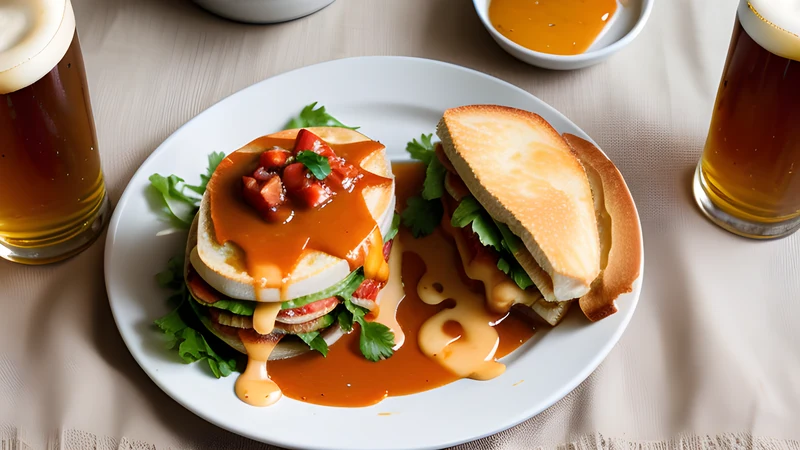
↓ Jump to recipeA francesinha is a sandwich that requires cutlery, a plate with a rim, and a plan for the rest of your afternoon. Four meats, sealed under a blanket of melted cheese, standing in a hot pool of beer-and-tomato sauce, with a fried egg on top and chips in the moat. Porto eats it at two in the morning and at one in the afternoon with equal seriousness.
It is also, underneath the spectacle, a very carefully engineered thing. The sauce is a roux. The cheese is a gasket. The bread is structural. Get any of those wrong and you have a wet mess in a bowl.
Francesinha: Porto's Sandwich Under a Beer Sauce
Ingredients
- 4 thick slices white bloomer bread, about 1.5 cm, crusts left on
- 2 thin beef steaks (about 100 g each), bashed to 5 mm
- 2 fresh linguica or thin chorizo sausages (about 120 g), split lengthways
- 4 slices cooked ham
- 2 slices mortadela or good bologna
- 12 slices mild melting cheese (Gouda, Edam or mild Cheddar)
- 2 eggs, to top
- 2 tbsp sunflower oil
- 300 g chips, to serve
- 30 g butter, for the sauce
- 1 small onion, grated
- 2 garlic cloves, crushed
- 1 tbsp plain flour
- 1 tsp smoked sweet pimenton
- 0.5 tsp piri-piri sauce, or 1 small dried chilli, crumbled
- 2 tbsp tomato puree
- 330 ml lager
- 200 ml beef stock
- 100 ml whole milk
- 1 bay leaf
- 8 g dark chocolate, 70 per cent (about one square)
- 1 tsp fine sea salt
Method
- Make the sauce first. Melt the butter in a saucepan over a medium-low heat. Add the grated onion and cook 6 minutes, until soft and pale. Add the garlic and cook 1 minute.
- Stir in the flour and cook for 2 minutes, stirring constantly, until it smells biscuity. Take the pan off the heat for 1 minute, then stir in the pimenton and the piri-piri.
- Return to the heat, stir in the tomato puree and cook 2 minutes. Pour in the lager in three additions, whisking smooth after each, then add the stock, the milk, the bay leaf and the salt.
- Simmer gently, uncovered, for 25 minutes, whisking now and then, until it coats the back of a spoon and no raw beer taste remains. Fish out the bay leaf.
- Take the pan off the heat, drop in the chocolate, and whisk until it has dissolved completely. Blitz the sauce smooth with a stick blender. Keep it hot.
- Heat 1 tbsp of the oil in a frying pan over a high heat. Season the steaks and fry for 60 seconds a side. Set aside. Fry the split sausages in the same pan, cut side down, for 3 minutes, until browned and rendered.
- Heat the grill to its highest setting. Toast the bread slices lightly on both sides.
- Build each sandwich on an ovenproof plate or a shallow dish: bread, mortadela, sausage, ham, steak, ham, bread. Press down firmly.
- Drape 6 slices of cheese over each sandwich so they cover the top and hang down all four sides, sealing it to the plate.
- Grill for 3 to 5 minutes, until the cheese has melted, slumped and blistered brown in patches. Watch it constantly.
- Fry the eggs in the remaining oil. Slide one onto each sandwich.
- Pour the hot sauce around the sandwich until it stands in a pool about 1 cm deep, taking care not to wash the egg off. Serve immediately with chips tipped in at the side, and a fork and knife.
The little French girl
The story has a name attached and it is unusually well documented. Daniel David da Silva was a Portuguese emigrant who spent years in France and Belgium, came home to Porto in the 1950s, and went to work at a restaurant called A Regaleira on Rua do Bonjardim. What he brought back was the croque-monsieur — bread, ham, cheese, grilled, béchamel on top — and what he decided was that it needed adjusting for Portuguese appetites.
So he added the steak, the sausage, the mortadela, and a spiced sauce, and he named it francesinha, the little French girl. The usual gloss on the name is that Portuguese women were, in his estimation, less spicy than French ones, and the sauce was the joke. It is a 1950s joke and it has aged exactly as well as you would expect. A Regaleira is still open and still serving them.
What makes the francesinha interesting is that it is a rare, datable example of a dish becoming a civic identity within living memory. It is barely seventy years old, and it is now as much Porto’s as port wine is. There are francesinha rankings, francesinha festivals, and long, sincere arguments about whose sauce is best — and every restaurant’s sauce recipe is a genuine secret, guarded, unwritten, passed to one person. The bar A Cozinha do Manel and the Café Santiago are the usual reference points, and no two of the city’s versions taste alike.
That secrecy is why there is no canonical recipe. What follows is a francesinha built on the principles the good ones share, and the sauce is mine.
The chocolate in the sauce
Here is the twist, and unlike most of my twists it is at least partly native: a square of dark chocolate, whisked in off the heat at the end. Several Porto kitchens are widely rumoured to do it and none will confirm it, which is precisely the sort of thing that makes it worth trying.
Eight grams into 600 ml of sauce is well below the threshold where you would taste chocolate. What it does instead is three specific things. Cocoa solids are loaded with bitter alkaloids and polyphenols, and that bitterness is what gives the sauce a floor under the sweetness of the beer and the tomato — the same trick a Mexican mole runs at a much higher dose. The cocoa butter enriches the emulsion and gives the sauce a heavier, glossier drape, so it clings to the cheese instead of running off. And chocolate’s roasted notes reinforce the pimentón without adding more smoke.
The sauce as a whole is a béchamel-adjacent roux thinned with beer, and the roux is the part people skip. Two minutes of cooking the flour is the minimum to drive off the raw pastiness; you want it smelling faintly of biscuits before any liquid goes in. Add the lager in three goes, whisking each smooth, and you get a stable sauce. Add it all at once and you get lumps you will spend ten minutes chasing.
Simmer it a full twenty-five minutes. Raw beer is bitter in a green, aggressive way and it takes that long for the hop compounds to mellow and the alcohol to go. Use a plain lager — Super Bock is the Porto answer, any cheap lager works. An IPA will make the sauce genuinely unpleasant, because the hop load that is delightful in a glass concentrates into something acrid when you reduce it.
The cheese is a gasket
Six slices per sandwich sounds absurd until you understand the job. The cheese is draped over the sandwich and down all four sides, hanging past the bread on every edge, so that when it melts it welds the whole construction to the plate.
That seal is the entire reason the francesinha survives contact with the sauce. Sauce goes around the outside only, pooling at the base, and the cheese wall stops it soaking into the bread from the sides. Inside that shell the sandwich steams gently in its own heat and stays a sandwich. Break the seal — leave a gap, use too little cheese, pour the sauce over the top — and you have bread soup within ninety seconds.
Which is also why the cheese must be a mild, high-moisture, good-melting one. Gouda, Edam, a young mild Cheddar. Mature Cheddar splits under a grill and weeps oil, because its protein network has broken down with age and cannot hold the fat. Mozzarella is too stringy and slides off in a sheet. You want something that slumps and flows and then sets slightly.
The bread matters for the same structural reason. A firm white bloomer, 1.5 cm thick, lightly toasted on both sides first. Toasting dries the surface and buys you crucial minutes against the sauce. Soft supermarket sliced bread will fail; sourdough with a wild open crumb will let sauce straight through the holes.
The meats, and the order they stack in
Four meats sounds like a gimmick and each one is doing a distinct job, which is why the order is fixed in Porto and worth copying.
Mortadela goes on the bottom, against the base bread. It is soft, fatty, mild, and it acts as a moisture barrier between the bread and everything above it — the fat is essentially waterproofing.
Linguiça or a fresh chorizo goes next, split lengthways and fried cut-side down so the paprika fat renders out and the surface caramelises. Split rather than sliced, because a split sausage lies flat and a round one rolls and makes the stack unstable. This is the layer carrying most of the smoke and most of the salt.
Then ham, then steak, then ham again. The double ham is deliberate: it sandwiches the steak between two soft, wet layers that stop it drying out under the grill, and it stops the steak’s juices running straight into the top bread.
The steak wants bashing to 5 mm and frying for sixty seconds a side, no more. It is going under a grill for another five minutes and it will keep cooking; a steak fried to medium at this stage arrives at the table grey and tough. Sirloin or rump both work, and cheap thin-cut frying steak is genuinely fine here because it spends its life buried under cheese and sauce.
Press the stack down firmly before the cheese goes on. A loose sandwich has air gaps that fill with steam and lift the cheese seal off the plate.
Chips, faults, and the honest scale of it
The chips go beside the sandwich, in the sauce, and they are the correct way to eat the sauce that the sandwich cannot carry. Make them properly — twice-fried, the way fish and chips demands — or buy good frozen ones, but do not skip them, because a francesinha with no chips leaves half a bowl of sauce unaccounted for.
The commonest fault is a thin sauce. It should coat a spoon and hold a line when you draw a finger through it. If yours is thin, simmer it another ten minutes; if it is gluey, let it down with a splash of stock. Make it a day ahead if you like — it improves, and it thickens overnight, so bring it back with a little milk.
The second fault is grilling too long. You want the cheese melted and blistered in patches, three to five minutes, and thirty seconds past that the fat splits out and pools orange on the surface.
The third is building it too tall. Two slices of bread and four meats is already 400 g of sandwich; add a fifth and it will not hold together under a fork.
I will be honest about what this is. One of these is somewhere north of 1,200 calories before the chips, and it is a young person’s food, a football food, a food for after a night out. It belongs to the same family of glorious excess as a smash burger at midnight, and it earns the same defence: nobody eats it weekly and everybody should eat it once. Porto drinks it with cold lager and I have never seen anyone finish a whole one and then want anything else at all.
Making it ahead, and the vegetarian question
The sauce is the only component that can be made in advance, and it should be. It keeps five days in the fridge and freezes for three months, and it is better on day two once the pimentón and the chocolate have settled through. It sets to a firm jelly when cold because of the flour and the gelatine in the stock — bring it back over a low heat with 50 ml of milk and whisk it hard, and it returns exactly as it was.
Everything else is assembled to order. There is no world in which a built francesinha waits; the cheese seal starts failing the moment it stops being molten, and a reheated one is a plate of wet bread.
A vegetarian version is not a contradiction, whatever Porto says, and the trick is to keep the structure. Grilled portobello mushrooms in place of the steak, a thick slab of halloumi where the sausage was, and roasted red pepper for the mortadela’s moisture barrier. Make the sauce with a strong mushroom stock instead of beef and keep the chocolate, which matters more without the meat’s own bitterness. It will not fool anybody, and it works.
What does not work is scaling the sandwich down. A half-sized francesinha has the wrong ratio of crust to interior and the cheese seal has less to grip. Make the full thing and share it, which is what half of Porto does anyway.
Related Content