Flammekueche: The Thin Alsatian Tart of Cream and Bacon
Unleavened dough, fromage blanc, onion and lardons, blistered in eight minutes
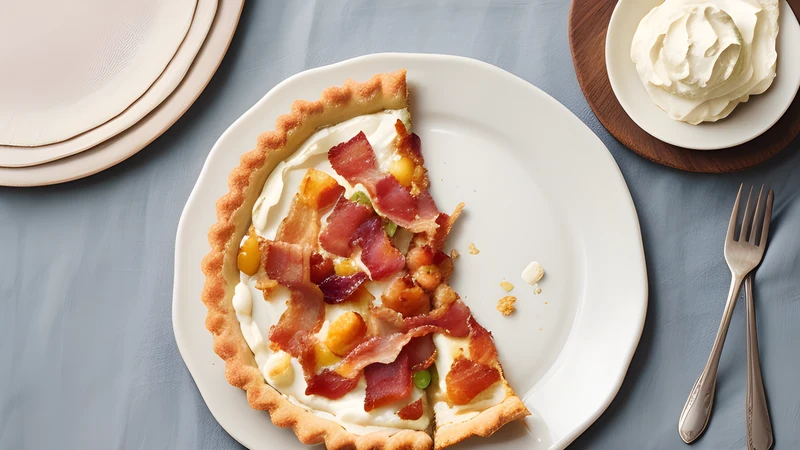
Contents
↓ Jump to recipeThe first flammekueche out of a domestic oven is usually a disappointment, and the second one is usually excellent. The gap between them is your oven telling you it is not hot enough and you not believing it. Turn it up, wait longer, roll thinner. That is the whole learning curve, and it takes about twenty minutes to climb.
Flammekueche: The Thin Alsatian Tart of Cream and Bacon
Ingredients
- 300 g plain flour, plus more for rolling
- 170 ml water, at room temperature
- 2 tbsp neutral oil, such as rapeseed
- 1 tsp fine salt
- 200 g fromage blanc (or full-fat quark)
- 100 g crème fraîche
- 1 tbsp neutral oil, for the topping
- 0.25 tsp freshly grated nutmeg
- 0.5 tsp fine salt, for the topping
- 0.5 tsp freshly ground white pepper
- 2 medium onions (about 250 g), sliced as thinly as you can manage
- 250 g smoked streaky bacon or lardons, cut into 1 cm batons
Method
- Mix the flour and 1 tsp salt in a bowl. Add the water and 2 tbsp oil and bring together with a fork, then knead on a work surface for 5 minutes until smooth and elastic. There is no yeast; you are developing gluten so it will roll thin without tearing.
- Wrap the dough and rest it at room temperature for at least 30 minutes, or up to 2 hours. Skipping this makes it spring back and fight you.
- Heat the oven as high as it will go, 250-280C, with a pizza steel, stone or heavy upturned baking tray on the top shelf for at least 45 minutes.
- Beat the fromage blanc, crème fraîche, 1 tbsp oil, nutmeg, 0.5 tsp salt and the white pepper together until smooth. It should be spreadable and thick, like soured cream.
- Fry the lardons in a dry pan over a medium heat for 4 minutes, until the fat has started to render and the edges are just golden. Drain on kitchen paper. They will finish in the oven.
- Divide the dough into 4. Roll each piece on a floured surface into a rough rectangle about 30 x 20 cm and 1-2 mm thick. You should be able to see the surface through it.
- Slide one sheet onto a floured peel or a sheet of baking parchment. Spread a quarter of the cream mixture right to the edges, leaving no border.
- Scatter over a quarter of the onion and a quarter of the lardons. Do not crowd it; you should see cream between the pieces.
- Slide onto the hot steel and bake for 8-10 minutes, until the edges are blistered dark brown to almost black in patches and the onion tips have caught.
- Cut into squares with a knife or a wheel, and eat standing up while you roll the next one. Repeat with the remaining three.
The name is a temperature reading
Flammekueche is Alsatian for flame cake. In French it is tarte flambée, which has caused a century of confusion with dishes that get brandy poured over them and set alight. Nothing here is set alight. The flames are the oven’s.
The dish comes out of the same wood-fired village bakery that gave us baeckeoffe, and it existed for the same practical reason. Before a baker loaded bread he needed to know the oven’s temperature, and he had no thermometer. So he swept out the ash, rolled a scrap of leftover bread dough paper-thin, dressed it with whatever the farm had — cream, an onion, a bit of bacon — and threw it in at the mouth of the oven. If it blistered and browned in a couple of minutes, the oven was ready for bread. If it burnt, wait. If it sat there pale, build the fire up.
The test piece got eaten. It was a bakery perk, then a farm snack, and it stayed a rural, seasonal, almost invisible dish until the 1960s, when it started appearing in Strasbourg restaurants. It went national in the 1980s and is now on menus in Paris, Berlin and, improbably, most German motorway service stations. The trajectory from oven thermometer to chain restaurant is remarkable, and the dish has survived it more or less intact.
Why there is no yeast
This is the part that separates flammekueche from pizza, and it is the part people override.
The dough is flour, water, oil and salt. No yeast, no rise, no proving. It is closer to a pasta dough than a bread dough, and the point is that it stays flat and shatters. A yeasted dough puffs, and puff means crumb, and crumb means the thing eats like a pizza — soft, chewy, filling. A flammekueche should be structurally about as substantial as a poppadom under its topping, with edges that crack when you fold them.
The oil is doing something specific: it shortens the gluten just enough that a 1 mm sheet does not turn to leather in a 270C oven, while leaving enough structure to lift a wet topping. Leave the oil out and the crust is brittle and dusty.
The rest is compulsory. Freshly kneaded gluten is elastic and will spring back the moment you stop pressing; thirty minutes of relaxation and it rolls like fabric. If it still fights, walk away for another fifteen. You cannot win that argument by force, and a torn sheet cannot be patched.
Roll it thinner than you think
The target is 1-2 mm. Held up to a window you should see light and a suggestion of your hand through it. Most first attempts land around 4 mm, which produces a decent flatbread and no blister.
Flour the surface lightly and often, work from the centre outwards, and turn the sheet a quarter turn between passes to keep it even. Do not chase a neat rectangle. An authentic flammekueche is a lopsided oblong with a thick corner and a thin one, and the thin corner is the best bite on the board.
If a hole opens, pinch it shut and roll over the join. If the sheet has gone floppy and sticky, dust it and give it two minutes to firm up.
Flour, and one thing worth testing
Plain flour works and is what farms used, because it was what the bakery had left over. Strong bread flour makes a dough with more gluten, which rolls thinner without tearing and gives an edge that shatters more cleanly; it also fights back harder and wants a longer rest. I use a fifty-fifty blend of plain and strong, which rolls to 1 mm without complaint and still relaxes in half an hour.
Water temperature matters less than usual here, since nothing is fermenting. Room temperature is fine. What does matter is hydration: 170 ml to 300 g of flour is about 57 per cent, which is dry by bread standards and deliberately so. A wetter dough is easier to knead and impossible to roll thin without it sticking to everything and tearing on the lift.
The cream, and the argument about it
Traditional Alsace uses fromage blanc — a fresh, drained, faintly sour curd — cut with cream. Fromage blanc alone splits and weeps under fierce heat; crème fraîche alone slides off and pools. Two parts to one is the ratio that holds.
Full-fat quark is the honest substitute and behaves almost identically. Greek yoghurt is a poor one: its protein tightens and goes grainy above 200C, and you will get a curdled film. Ricotta is too grainy at the start.
Nutmeg is standard and white pepper is compulsory in Alsace, where black pepper’s fruitiness is thought to fight the cream. Grate the nutmeg fresh — the pre-ground stuff has lost the volatile compounds that make it worth adding.
Spread the cream all the way to the edges. There is no cornicione, no bare rim, no border. The rim burns and blisters and that black-edged frill is the flavour everyone comes back for.
Onions and lardons, and restraint
Slice the onions so thin they are nearly transparent. A thick onion slice will still be raw and squeaky at eight minutes, and there is no second chance — the crust cannot wait for it.
The lardons need a partial render in a dry pan first. Straight from the packet they will not release enough fat in eight minutes and you get pale, chewy, undercooked bacon on a burnt crust. Four minutes to start the fat, then drained. In the oven they finish and their remaining fat runs into the cream, which is the whole mechanism.
Then hold back. The instinct is to load it like a pizza, and a loaded flammekueche steams instead of crisping, sags in the middle, and cannot be lifted. You should see pale cream between every scrap of onion and bacon. Thin dressing, fierce heat, short time.
Heat, and what your oven can actually do
The wood oven ran at 300C or more and cooked these in two minutes. A domestic oven at 250C on a preheated steel takes eight to ten and gets close enough. The steel is the significant variable — it stores and dumps heat into the base the instant the dough lands, which is what stops the cream soaking in. A preheated heavy baking tray, upside down, is a decent poor man’s version. A cold tray gives you a soggy middle every time.
Preheat for forty-five minutes, and ignore the beep. Ovens announce their air temperature long before the steel gets there.
The doneness signal is visual and it is more aggressive than you will be comfortable with. Blistered, dark brown, patches genuinely black at the edges. A golden flammekueche is an underbaked one.
Ahead, and the domestic logistics
The dough can be made a day early and kept wrapped in the fridge; bring it back to room temperature for an hour before rolling, because cold dough tears. The cream mixture keeps three days. The lardons can be part-rendered in the morning and left in the fridge.
What cannot be done ahead is the tart. There is no reheating a flammekueche into anything worth eating — the base absorbs moisture the moment it stops being hot, and a second trip to the oven dries the cream to a crust. Leftovers exist only in the sense that nobody manages to finish four.
The rhythm that works at home is a production line. Roll all four sheets first and stack them between floured parchment while the steel comes up to heat. Have the cream, onions and bacon in three bowls beside the oven. Then it is dress, bake, cut, eat, dress the next one — eight minutes each, and the whole evening’s cooking is over in forty minutes with you never more than a metre from the oven door.
Variations, failures, and the order of the evening
Gratinée adds grated Gruyère or Emmental. Forestière adds sautéed mushrooms. Munster uses the region’s ferocious washed-rind cheese and is not a beginner’s move. And flambée sucrée — apple slices and a splash of Calvados or eau de vie over the same dough, no cream — closes the meal in Alsatian restaurants, where the sweet one arrives after four savoury ones and no one is hungry and everyone eats it. If it is the onion you love, pissaladière does the same instinct from the Mediterranean end with anchovy and olives, and quiche lorraine is what the same cream and bacon become when you give them a case and an hour.
The Munster version deserves its own warning. Munster is a washed-rind cow’s cheese from the Vosges valleys, ripened for three weeks, and it smells like a farmyard in July. Under a 270C oven it liquefies and its aroma fills the house for two days. People who love it will tell you this is a feature. Use half the quantity you think, and open a window.
The failures are few. Soggy middle: cold surface, or too much topping. Leathery: too thick, or no oil. Curdled cream: yoghurt instead of fromage blanc. Pale: your oven is not as hot as the dial says.
One more, which is philosophical. If you find yourself adding tomato sauce, mozzarella, or a raised border, stop — you have drifted into making a mediocre pizza, and the world has plenty. The austerity is the design. Four ingredients on a sheet of nothing, eight minutes, done.
Cook them one at a time and eat them one at a time. Flammekueche does not wait — three minutes on a board and the steam trapped underneath softens the base. In an Alsatian winstub they come out in a slow procession all evening, cut into squares on a wooden board, eaten with fingers, washed down with Sylvaner or the cloudy young wine they call nouveau, and nobody sits down to a plate at all. Reproduce that at home and stand at the counter with the oven on. It is the correct way to eat it and it is also the only way it stays good.
Related Content