Flæskesteg: Danish Roast Pork With Crackling
Score to the fat, salt into the cuts, bay leaves standing up
Contents
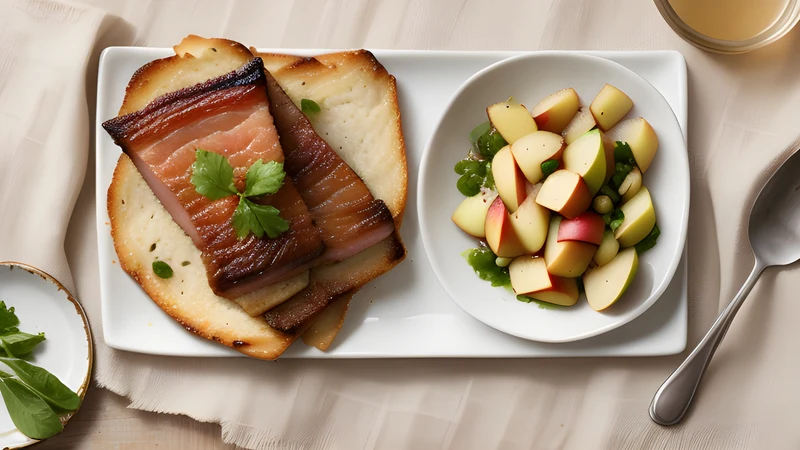
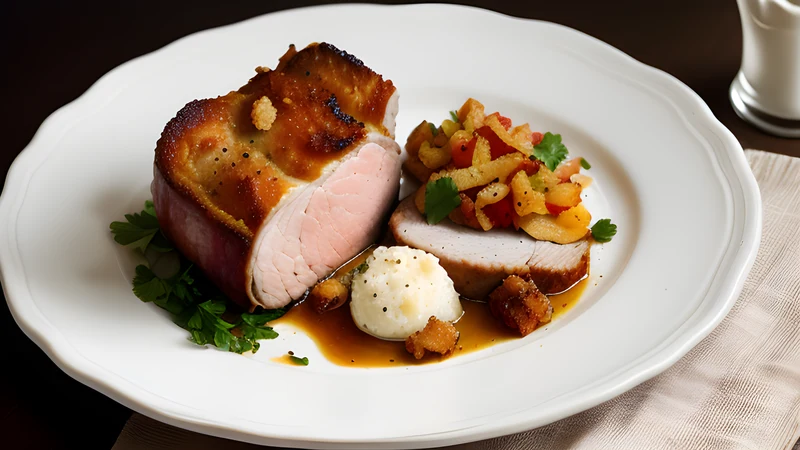
↓ Jump to recipeDenmark votes on its national dish periodically, and the results are always contested, but flæskesteg is never far from the top and it is what actually appears on the table on the twenty-fourth of December. It is a joint of pork loin with the rind on, scored deep, packed with salt, stuck with bay leaves, and roasted until the skin has turned into something you could tile a roof with.
The meat is honestly the least interesting part. Pork loin is lean and it is easy to dry out, and nobody at a Danish Christmas table is talking about the loin. They are talking about the crackling — flæskesværen — and specifically about whether it went all the way to the edges, because a joint with one soft corner is a joint someone will mention.
Flæskesteg: Danish Roast Pork With Crackling
Ingredients
- 2.5 kg boneless pork loin with a thick rind and at least 1 cm of fat under it, in one piece
- 3 tbsp (about 45 g) coarse sea salt
- 15 fresh or dried bay leaves
- 1 tbsp black peppercorns, coarsely crushed (optional)
- 500 ml water, for the tray
- 2 onions, halved
- 2 carrots, cut into chunks
- For the gravy: 30 g butter, 30 g plain flour, 400 ml pork roasting juices topped up with stock, 100 ml double cream, 1 tsp cider vinegar, 1 tsp dark soy or gravy browning, salt and pepper
Method
- Ask your butcher to score the rind at 5 mm intervals, all the way through the rind and into the fat but never into the meat. If doing it yourself, use a very sharp Stanley blade or a scalpel and work on a fridge-cold joint.
- Take the joint out of the fridge 1 hour before cooking. Pat the rind bone dry with kitchen paper.
- Rub the coarse salt into the joint, working it down into every score with your fingertips. Aim to get salt into the bottom of each cut, not just across the top. Use all 3 tbsp.
- Wedge a bay leaf upright into every second or third score so the leaves stand proud. They are aromatic and they hold the scores open.
- Heat the oven to 200°C fan / 220°C conventional. Sit the joint on a rack over a roasting tin, rind up.
- Check the joint is LEVEL. If it tilts, prop the low side with crumpled foil or a folded tea towel under the rack. Fat must render evenly off the whole surface or one end will not crackle.
- Scatter the onions and carrots into the tin and pour in the 500 ml water. Roast at 200°C fan for 30 minutes.
- Drop the oven to 160°C fan / 180°C conventional and roast for a further 90–100 minutes, until a probe in the thickest part of the meat reads 65°C. Top up the water in the tin if it runs dry.
- Turn the oven up to 220°C fan / 240°C conventional for a final 15–20 minutes, watching constantly, until the rind has puffed and blistered across its whole surface and sounds hollow when tapped. Remove any bay leaves that are burning.
- Rest the joint on a board, rind up and uncovered, for 20 minutes. Never cover it with foil — the trapped steam will soften the crackling within 5 minutes.
- For the gravy: strain the tin juices into a jug and skim the fat. Melt the butter in a saucepan, whisk in the flour and cook for 2 minutes. Whisk in the juices a ladle at a time, then the cream. Simmer for 5 minutes, add the vinegar and the browning, and season.
- Cut the crackling off in one sheet with a serrated knife, break it into shards, then carve the meat in 1 cm slices. Serve with the crackling on the side and the gravy in a jug.
The dish and its calendar
Roast pork on the rind turns up across northern Europe. What is Danish is the totality of the commitment. Denmark has kept roughly twice as many pigs as people for the better part of a century, and the pig is the country’s largest agricultural export by a wide margin. Pork is the substrate of the entire national kitchen here, from frikadeller to stegt flæsk, and flæskesteg is what happens when a nation that eats pork every week decides to do the important version.
Its position at Christmas is comparatively modern. The medieval Danish Christmas centred on goose, and roast goose held on in wealthier houses well into the nineteenth century. Duck and pork displaced it as the pig became cheap and the goose did not, and by the mid-twentieth century most Danish households were eating and — duck — for the first course or the pork for the main, or both. The pork won on economics and stayed on merit.
The bay leaves are the visual signature and they are functional. They perfume the fat as it renders and, more usefully, they hold the scores open during the first thirty minutes when the rind is contracting hardest. The photograph of a flæskesteg with a row of leaves standing up out of it like a hedge is the whole dish in one image.
Buying the joint
Ask for a boneless pork loin with the rind on and a full fat cap — at least a centimetre of fat between rind and meat, and preferably a centimetre and a half. That fat layer is the fuel for the whole process; a joint with 4 mm of fat under the skin cannot make good crackling because there is nothing to render out and leave a honeycomb behind. Supermarket loin joints are frequently trimmed to within a few millimetres, which is why so many people conclude they cannot make crackling.
Rind quality is worth a look too. You want it smooth and dry, without the fine mesh of hair follicles that comes from a rushed scald at the abattoir, and without moisture sitting on it. If it came shrink-wrapped, unwrap it, pat it dry, and leave it uncovered on a rack in the fridge overnight. That single step gets you most of the way to good crackling before the oven is even on.
Two and a half kilos feeds six to eight with leftovers and takes roughly two and a half hours. Scale the time by probe temperature rather than by weight — a 2 kg joint is not proportionally faster, because thickness rather than mass drives the heat transfer, and a long thin joint of the same weight cooks in noticeably less time.
Scoring, which decides everything
The scoring is the technique. Everything else is temperature management.
Cuts go at 5 mm intervals, straight through the rind and down into the fat, stopping at the meat. Too shallow and the rind contracts as one sheet and buckles, leaving valleys that never crisp. Too deep and you cut into the muscle, which then bleeds juice up into the fat and steams the skin from below — the fastest way to a leathery, chewy result.
Getting this right by hand is difficult. Pork rind is tough, and a kitchen knife tends to skid. Two things help: a fridge-cold joint, because cold fat resists a blade instead of squashing under it, and a proper blade — a scalpel, a clean Stanley knife or a very sharp filleting knife. A butcher will do it in ninety seconds on a bandsaw-scored machine or by hand, and this is one of the few jobs I hand over without embarrassment.
The salt then goes into the cuts. This is the step that separates competent flæskesteg from disappointing flæskesteg. Salt on the surface of the rind seasons the surface. Salt worked down to the bottom of each score draws moisture out of the whole thickness of the skin, and dry skin is what puffs. Use your fingertips, work along each cut, and use all three tablespoons even though it looks like far too much. Most of it ends up in the tray.
The physics of crackling
Crackling is a dehydration event followed by a puffing event, and the two need different temperatures, which is why the roast has three stages.
Pork rind is collagen and water. In the first stage — thirty minutes hot — the surface water flashes off and the fat beneath begins to render. In the long middle stage at 160°C fan, collagen gradually converts to gelatin and the subcutaneous fat renders out through the scores, which is the fat draining that leaves a hollow honeycomb behind. In the final blast at 220°C fan, the residual water in that structure turns to steam and inflates it. That is the puff. The bubbles you want are the skin blowing itself up from the inside.
Get the sequence wrong and you fail predictably. Roast the whole thing hot and the surface sets before the fat renders, giving you hard glassy skin over a layer of soft grease. Roast the whole thing low and nothing puffs at all — you get a chewy tan sheet. Skip the drying and salting and the water content is too high for the final blast to do anything but boil.
The water in the roasting tin does two jobs and no harm. It keeps the drippings from scorching into something bitter, which matters because those drippings are the gravy. And it does not steam the rind, because the rind is up on a rack in a fan oven with air moving over it, thirty centimetres above the water and much hotter than it.
The level joint matters more than it sounds. Rendered fat runs downhill. A joint that tilts by even ten degrees will pool fat at the low end, and pooled fat is a fryer, which crisps that corner and leaves the high end dry-roasting with nothing. Foil under the rack, checked with your eyes at the door, costs nothing.
Temperature, and the resting rule
Sixty-five degrees in the thickest part of the loin, measured before the final blast. Pork loin at 65°C is faintly pink at the centre, juicy, and entirely safe — the trichinella fear that produced a generation of grey pork is not a live concern in Danish or British commercial pork, and 63°C held briefly is the actual food-safety line. Take it to 75°C and you have made a very handsome joint of sawdust.
The joint will climb another three or four degrees during the final blast and the rest. Probe it before the blast, while the number still tells you something you can act on.
Rest it uncovered, rind up, for twenty minutes. Foil is the single most common way people destroy crackling they have already made successfully: the joint continues to give off steam, the foil traps it against the skin, and the honeycomb reabsorbs water and goes limp. Twenty minutes uncovered in a warm kitchen loses you almost nothing in heat and saves the entire dish.
The plate around it
Flæskesteg comes with braised red cabbage, plain boiled potatoes, brunede kartofler, and a cream gravy made from the tin. All five, together, and the plate is a study in fat against acid — the cabbage carries vinegar, the gravy carries a splash of it, and the caramelised potatoes carry the sugar that the whole thing is balanced against.
The pudding is risalamande, rice and almonds and whipped cream with a cherry sauce, and the whole almond hidden in it that wins someone a marzipan pig. If you are building a Danish menu across the year rather than for Christmas, rødgrød med fløde is the summer answer and takes twenty minutes.
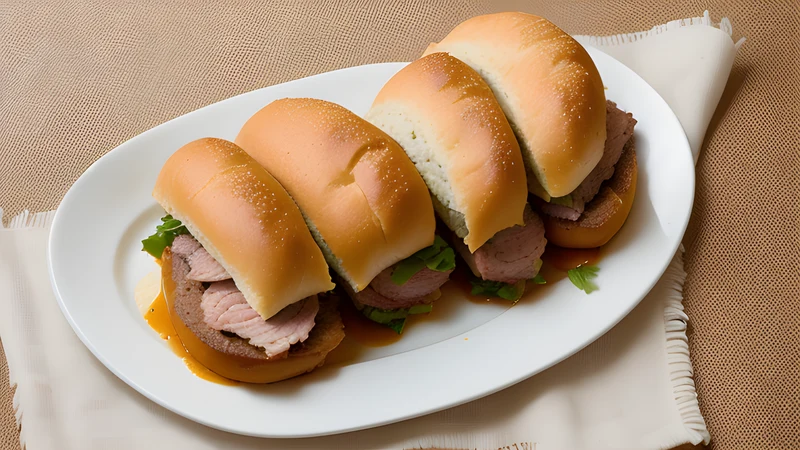
Leftovers are the point of cooking 2.5 kg. Cold flæskesteg sliced thin on buttered rye with red cabbage and a spoon of pickled cucumber is ribbensteg med rødkål, one of the standard smørrebrød, and it is better than most things I have paid for in a restaurant. The crackling does not survive the night; eat it standing up in the kitchen, which is traditional.
Related Content