Fish Amok: Cambodian Custard Steamed in Banana Leaf
Cambodia's national dish, a silky kroeung-spiced fish custard set in a leaf bowl
Contents
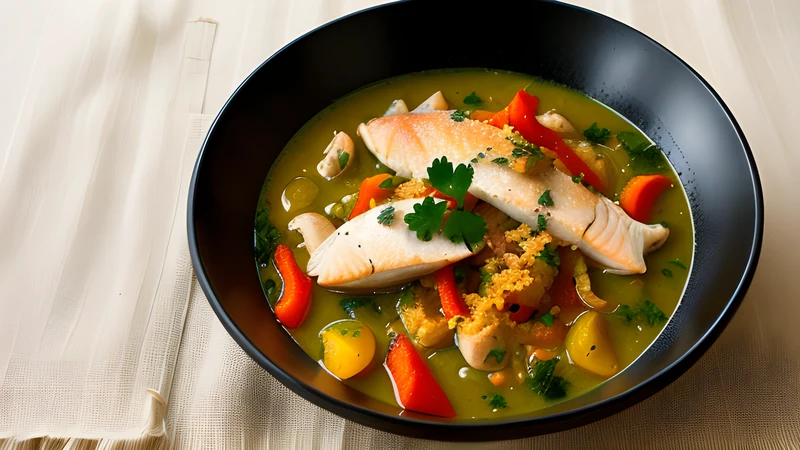
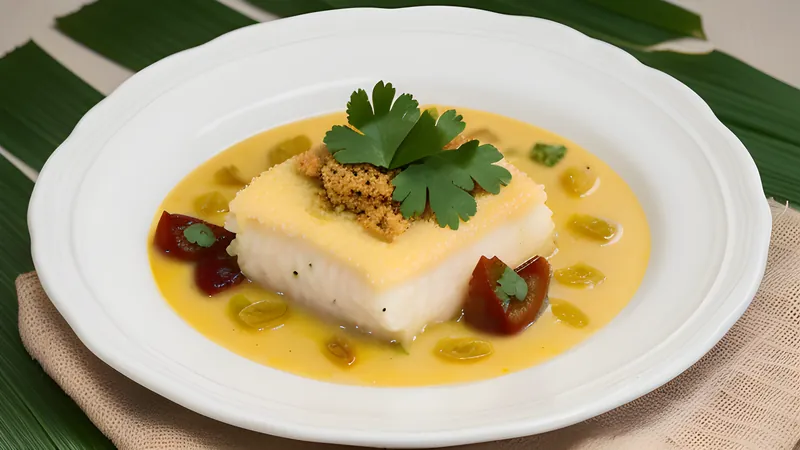
↓ Jump to recipeAmok is the dish Cambodians point to when they need one answer to “what is Cambodian food.” It’s not the oldest recipe in the country’s repertoire and it’s not the most eaten day to day, but it is the one that does something no neighbouring cuisine quite does: it turns fish into a custard, silky and barely set, delicately spiced, steamed inside a folded leaf rather than a bowl.
Fish Amok: Cambodian Custard Steamed in Banana Leaf
Ingredients
- 600g firm white fish fillets (snakehead, sea bass or cod), cut into 3cm chunks
- 4 stalks lemongrass, tough outer layers removed, finely sliced
- 4 kaffir lime leaves, stems removed, finely shredded, plus extra for garnish
- 3 shallots, roughly chopped
- 5 garlic cloves
- 1 thumb fresh turmeric or 1 tsp ground turmeric
- 1 thumb galangal, peeled and chopped
- 2 red chillies, deseeded
- 1 tbsp shrimp paste (prahok or kapi)
- 400ml coconut milk, full-fat
- 3 large eggs
- 2 tbsp fish sauce
- 1 tbsp palm sugar
- 100g Chinese cabbage leaves, wilted
- 4 tbsp coconut cream, for the top
- 1 red chilli, thinly sliced, for garnish
- Banana leaves, cut into rounds and folded into bowls (or ramekins as a substitute)
- Steamed jasmine rice, to serve
Method
- Make the kroeung paste: pound or blend the lemongrass, half the kaffir lime leaf, shallots, garlic, turmeric, galangal and chillies to a smooth paste.
- Fry the paste with the shrimp paste in a dry pan over low heat for 3-4 minutes until fragrant and slightly darker, then set aside to cool.
- In a bowl, whisk the eggs with the coconut milk, fish sauce and palm sugar until smooth.
- Stir the cooled kroeung paste into the egg mixture along with the remaining shredded kaffir lime leaf.
- Line each banana leaf bowl with a wilted cabbage leaf, then divide the fish chunks between the bowls.
- Pour the custard mixture over the fish in each bowl, filling to just below the rim.
- Spoon a tablespoon of coconut cream over the top of each and place in a steamer basket.
- Steam over simmering water for 20-25 minutes until the custard is set with a slight wobble in the centre, like a baked cheesecake.
- Garnish with shredded kaffir lime leaf and sliced chilli. Serve immediately with steamed rice.
A dish named after its method, not its ingredient
“Amok” doesn’t mean fish — it refers to the steaming technique itself, wrapping food in banana leaf and cooking it gently over water until it sets into a soft, custard-like texture. Fish amok is the best-known version because Cambodia’s rivers and the vast Tonle Sap lake have supplied freshwater fish as a dietary staple for centuries, but the same technique applies to chicken, snails, or vegetables, all steamed the same gentle way in the same folded leaf. What makes it recognisably Khmer rather than a variation on Thai or Vietnamese fish curries is the custard structure itself: whole eggs whisked into coconut milk, so the dish sets soft rather than staying a liquid curry, closer in texture to a savoury flan than to a soup.
The base flavouring is kroeung, a pounded paste of lemongrass, galangal, turmeric, garlic and shallot that underlies most Khmer curries and is Cambodia’s answer to Thai curry paste — related in ingredients, distinct in balance, generally milder on chilli and more forward on turmeric’s earthy bitterness. Fresh turmeric root, if you can get it, gives a brighter, slightly peppery flavour that dried ground turmeric doesn’t fully replicate, staining your hands and chopping board a deep yellow in the process — wear gloves if you’d rather not spend the next two days with yellow fingertips.
Why the banana leaf matters
Cooking inside a folded banana leaf bowl does more than present the dish attractively. The leaf is porous enough to let steam through gently while holding the custard’s shape as it sets, and it imparts a faint grassy, tea-like aroma to the fish that a ceramic ramekin can’t replicate — the same reason otak-otak, the grilled fish paste of Malaysia and Indonesia, insists on banana leaf rather than foil. Folding the bowls (called “krueng” in some regions, though usage varies) takes practice: a leaf is softened briefly over a flame or in hot water to make it pliable, then folded and pinned at the corners with a toothpick or a thin bamboo skewer to hold a shallow open-topped shape.
If banana leaves aren’t available, small ramekins or heatproof teacups work as a straightforward substitute — you lose the aroma and the visual folklore of the dish but the custard itself sets identically. Steaming rather than baking is not optional: an oven’s dry heat would scorch the top of the custard and overcook the fish before the centre set, whereas gentle, moist steam heat cooks the whole thing evenly from all sides.
Getting the custard texture right
The ratio that matters most is eggs to coconut milk. Too many eggs and the custard turns rubbery and eggy, closer to a Chinese steamed egg than a delicate Khmer amok; too few and it never sets, staying loose and curry-like. Three eggs to 400ml of coconut milk is the reliable ratio for a custard that holds its shape when spooned but still quivers gently at the centre, the same wobble test you’d use for a baked cheesecake or a crème caramel.
Steaming heat needs to stay gentle and even — a hard, rolling boil under the steamer basket will cause the custard to bubble and turn porous with small holes, the textural equivalent of an overcooked crème brûlée. Keep the water at a bare simmer, check at the 20-minute mark, and pull the bowls the moment the centre holds a slight wobble rather than waiting for it to look completely firm, since residual heat continues setting it for a few minutes after it leaves the steamer.
Choosing the fish
Traditional amok uses snakehead fish (trey platong), a firm freshwater fish common in the Mekong and Tonle Sap systems, prized for holding its shape through steaming without falling apart into the custard. Outside Cambodia, sea bass, cod, or any firm white fish fillet works as a substitute — avoid oily or strongly flavoured fish like mackerel, which would fight the delicate kroeung spicing rather than complementing it. Cut the fish into fairly large chunks, around 3cm, since smaller pieces can overcook and turn stringy during the 20-25 minute steam.
The kroeung paste
Making kroeung by hand, with a mortar and pestle, produces a rougher, more fragrant paste than a blender does — the pounding action releases the lemongrass’s oils more thoroughly than blade-chopping. That said, a small food processor or blender gets a workable paste in a fraction of the time, and for a home cook making amok on a weeknight, that trade-off is entirely reasonable. Fry the finished paste briefly in a dry pan before it goes into the egg mixture; this step, easy to skip, matters more than it looks — raw kroeung tastes sharp and slightly bitter, while a few minutes over gentle heat mellows the garlic and shallot and lets the turmeric’s flavour round out.
Shrimp paste is the ingredient most likely to intimidate a first-time cook, and it’s worth pushing past the smell. Cooked briefly with the rest of the paste, it disappears into a deep savoury backbone rather than reading as “fishy” on its own — the same transformation that makes anchovy paste disappear into a good Caesar dressing.
What can go wrong
A split or grainy custard is the most common disappointment, and it almost always comes from heat that’s too high or too prolonged. Once the custard has set with a gentle wobble, pull it from the steamer immediately — every extra minute past that point pushes the eggs further toward curdling, and coconut milk under sustained high heat has a tendency to separate into fat and liquid rather than staying emulsified. If you lift the lid and see the surface bubbling rather than gently steaming, turn the heat down before it goes any further.
A bitter or overly sharp result usually traces back to raw or under-fried kroeung. Garlic and shallot both taste harsh uncooked, and turmeric’s earthiness reads as bitter rather than warm until it’s had a few minutes of gentle heat to mellow. Don’t rush this frying step even though it looks like a minor stage sandwiched between the pounding and the steaming — three or four minutes over low heat changes the finished flavour more than almost any other step in the recipe.
Watery custard, the opposite problem, usually means either too few eggs relative to coconut milk or fish that released too much liquid during steaming. Pat the fish very dry before it goes into the bowls, and if you’re scaling the recipe up or down, keep the three-eggs-to-400ml ratio fixed rather than eyeballing it — amok is one of the few dishes in this style of cooking where precision in a single ratio matters more than instinct.
Variations
Some cooks fold in a beaten extra egg white just before steaming for a slightly lighter, more aerated set, closer to a soufflé than a flan — not traditional, but a reasonable modern tweak if you prefer a softer texture. Chicken amok, made the same way with diced chicken thigh in place of fish, is common in Cambodian homes and restaurants alike and suits the same kroeung base without any adjustment beyond a slightly longer steam to cook the chicken through fully.
Vegetable amok, built on mushrooms, aubergine or pumpkin in place of fish, is the standard vegetarian option on most Phnom Penh menus, and it works well precisely because the custard and kroeung carry so much of the dish’s character that the protein or vegetable inside is almost a vehicle for them. Snails, a traditional but less commonly exported version, are simmered separately until tender before being folded into the custard, prized for the way their slight chewiness plays against the custard’s softness.
Some regional versions add a thin layer of rice flour to the custard mixture for a firmer, more sliceable set, closer to a terrine than a wobbly flan — useful if you’re serving amok at a buffet or want cleaner portions, though it moves the texture away from the classic silky version described here.
Serving
Fish amok is traditionally eaten with steamed rice and often alongside a simple soup to round out the meal, the custard itself rich enough that a small portion per person, in its own leaf bowl, is the standard serving size rather than a large single dish for the table. The coconut cream spooned over the top before steaming rises slightly during cooking and sets into a pale, glossy layer, visually distinguishing amok from flatter curries and giving each mouthful a slightly richer top layer than the custard beneath.
Folding a banana leaf bowl
Cut a rectangle of banana leaf roughly 20cm by 20cm, then pass it briefly over a gas flame or dip it in just-boiled water for a few seconds — either method softens the leaf’s fibres enough to fold without cracking. Bring two opposite corners up and pleat them together, then repeat with the remaining two corners, pinning each pleat with a toothpick or a sliver of bamboo skewer so the bowl holds a shallow, open-topped shape roughly the size of a small teacup. It takes a few attempts to get a bowl that holds its shape and doesn’t leak, so practise on a spare piece of leaf before committing to the batch you’re steaming for dinner.
Storage and make-ahead
The kroeung paste keeps well on its own, refrigerated in an airtight container for up to a week, or frozen in small portions for up to three months — making a double batch when you have the mortar and pestle out is worth doing, since it’s the most time-consuming part of the recipe and freezes without losing potency. The finished custard, however, doesn’t reheat well: like any egg-and-coconut-milk custard, a second steaming or a microwave blast tends to split it, turning the silky set texture grainy and separated.
If you’re planning ahead, prepare the kroeung and portion the fish the day before, then assemble and steam fresh just before serving — the whole steaming step takes under half an hour, so there’s little practical benefit to steaming in advance even if it were textrually safe to do so. Leftover steamed amok will keep a day in the fridge and can be eaten cold or gently warmed through in a low oven, though the texture is noticeably better fresh from the steamer.
For more of Southeast Asia’s leaf-wrapped cooking, otak-otak takes a similar fish-and-spice-paste idea in a grilled rather than steamed direction, while lok lak shows the other, punchier side of Khmer cooking — amok’s gentleness is a deliberate choice, not the only register Cambodian food knows how to play in.
Related Content