Fesenjan: Persian Chicken in Walnut and Pomegranate
The stew that turns two ingredients into mahogany
Contents
↓ Jump to recipeThe first time I made fesenjan I ruined it in the last ten minutes. Everything had gone right — the walnuts ground to a damp paste, the onions collapsed, the stew turned that improbable dark brown that makes people ask what’s in it. Then I got impatient, pushed the heat up to thicken it faster, and the walnut oil at the base of the pan scorched. The whole potful tasted of burnt biscuit. Two hours of work, one minute of hurry.
That’s the shape of this dish. It has four ingredients that matter — walnuts, pomegranate molasses, onion, chicken — and almost all of the skill is in temperature control. Get the heat wrong and no amount of sugar or salt will save it.
Fesenjan: Persian Chicken in Walnut and Pomegranate
Ingredients
- 400 g shelled walnut halves
- 8 bone-in, skin-on chicken thighs (about 1.2 kg)
- 3 tbsp sunflower or other neutral oil
- 2 medium onions (about 300 g), coarsely grated
- 1/2 tsp ground turmeric
- 1/4 tsp ground cinnamon
- 150 ml pomegranate molasses (rob-e anar)
- 800 ml hot chicken stock
- 1-2 tbsp caster sugar, to taste
- 1 1/2 tsp fine salt, plus more to finish
- 1/2 tsp freshly ground black pepper
- Seeds of 1/2 pomegranate, to serve
- A few walnut halves, roughly broken, to serve
Method
- Heat the oven to 170C fan. Spread the walnuts on a baking tray and toast for 12-14 minutes, until they smell of biscuits and the cut faces are the colour of milky coffee. Cool for 10 minutes.
- Blitz the cooled walnuts in a food processor in 20-second bursts, scraping down twice, until they form a damp, gritty paste like wet sand. Stop before it turns to butter.
- Pat the chicken thighs dry and season with 1/2 tsp of the salt. Heat 2 tbsp oil in a wide casserole over medium-high heat and brown the thighs skin-side down for 6-7 minutes, then 2 minutes on the second side. Work in two batches. Set aside.
- Pour off all but 1 tbsp of fat. Add the remaining 1 tbsp oil and the grated onion with 1/2 tsp salt. Cook over medium heat for 12-15 minutes, stirring often, until the onion collapses to a soft golden mass.
- Stir in the turmeric and cinnamon and fry for 45 seconds, until fragrant.
- Add the walnut paste and stir constantly for 4-5 minutes over medium-low heat. It will stiffen, then loosen as the oil comes out.
- Pour in the hot stock, 100 ml of the pomegranate molasses, the remaining 1/2 tsp salt and the pepper. Bring to a bare simmer, stirring to break up any lumps.
- Cook uncovered at the barest simmer for 60 minutes, stirring every 10 minutes and scraping the base. The sauce will darken from beige to milk chocolate.
- Slide in the browned chicken and any resting juices. Cover partly and simmer for a further 60-75 minutes, stirring every 15 minutes, until the sauce is mahogany and walnut oil beads on the surface.
- Stir in the reserved 50 ml pomegranate molasses off the heat. Taste. Add sugar 1 tsp at a time until the sourness sits just short of a wince, then correct the salt.
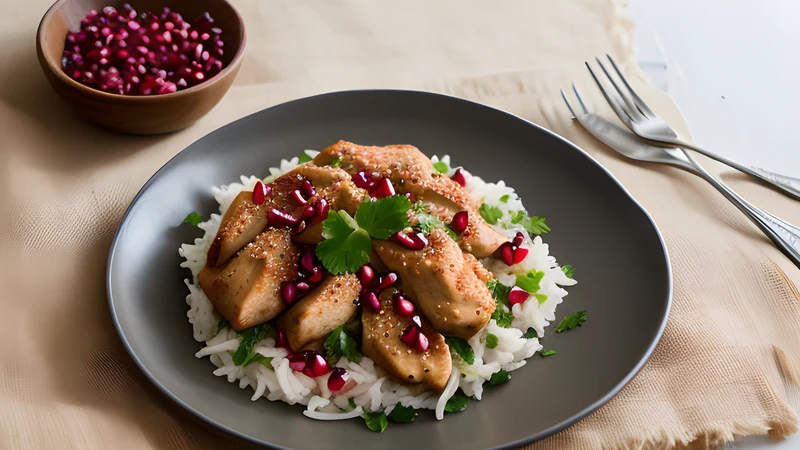
- Rest off the heat for 15 minutes so the oil rises. Scatter with pomegranate seeds and broken walnuts and serve with steamed rice.
Where fesenjan comes from
Khoresh-e fesenjan belongs to Gilan, the humid Caspian province in northern Iran where both walnut trees and pomegranates grow within sight of each other. The classic Gilani version uses duck — fesenjan-e ordak — and the fat from the bird carries the walnut sauce in a way chicken only approximates. Chicken thighs became the standard elsewhere in Iran because they’re cheap and forgiving, and because they take the two-hour simmer without falling apart.
Head south towards Tehran and Isfahan and the dish sweetens. Central Iranian cooks add sugar with a confident hand; the stew arrives glossy and almost dessert-adjacent, sometimes with tiny meatballs instead of poultry, a Qazvin habit worth trying once. Stay in the north and it stays sour — Gilani cooks use their own pomegranate paste, cooked down until it makes your jaw ache, and add no sugar at all. Iranians argue about this the way the English argue about scones. The recipe below sits between the two camps and lets you push it either way with the sugar at the end.
Fesenjan is a celebration food. It appears at weddings, at Yalda in December, and on the Nowruz table in spring, partly because pomegranate carries centuries of associations with fertility and abundance across the Iranian plateau, and partly for the flat practical reason that it costs a great deal to make. Four hundred grams of walnuts is not a weeknight decision.
Why the walnuts have to be toasted, and ground warm-ish
Raw walnuts have a papery bitterness from the tannins in their skins. Those tannins survive toasting perfectly well; what changes is that toasting builds enough Maillard flavour around them that the bitterness reads as depth. Twelve to fourteen minutes at 170C fan is the window I’ve settled on. Under-toasted and the finished stew tastes chalky. Over-toasted and the bitterness spikes, because you’re now browning the skins themselves.
Cool them for ten minutes before grinding. Hot nuts release oil fast in the processor and you’ll skid past paste into walnut butter, which behaves badly — it stays claggy and never emulsifies into the stock properly. You want damp sand, with a little visible grit. That grit matters. During the long simmer, the walnut particles slowly surrender their oil into the liquid, and the sauce thickens from within. A pre-emulsified butter has nothing left to give.
If you don’t own a processor, a box grater on the fine side works. It’s tedious, it takes fifteen minutes, and the texture is arguably better.
Buying walnuts for this
Four hundred grams is enough walnut that quality shows. Walnuts are roughly sixty-five per cent oil, and that oil is heavily polyunsaturated, which is a technical way of saying it goes rancid faster than almost any other nut. A rancid walnut tastes of old paint, and in a stew where walnuts are eighty per cent of the flavour, one bad handful contaminates the pot.
Buy from somewhere with turnover — a Middle Eastern or Turkish grocer will shift more walnuts in a week than a supermarket does in a month, and they’ll be cheaper by half. Look for halves rather than pieces, and pale gold flesh with the skin still light brown. Dark, shrivelled kernels have been sitting somewhere warm. Crack one open and eat it before you commit: it should taste sweet and faintly milky, with the bitterness arriving late and mildly.
If your walnuts are borderline, blanching rescues them. Cover the kernels with boiling water for one minute, drain, and rub them in a tea towel — a fair amount of skin comes away and takes the harshest tannins with it. You lose some colour in the finished stew, so I only do this when I’ve been sold a bad bag.
Store the rest in the freezer, sealed. Walnuts keep for a year at minus eighteen and about two months in a cupboard, and there’s no reason to find this out the expensive way.
The heat rule
Fesenjan is a broken emulsion waiting to happen. Nut oil, water and protein are being held in a loose suspension, and vigorous boiling drives the oil out in a greasy slick while the solids drop and catch on the base. Keep it at what Persian cooks call a “smiling” simmer — a bubble every second or two, no more. On my hob that’s the lowest gas setting with the pan sitting slightly off-centre.
Stir every ten minutes for the first hour, every fifteen after the chicken goes in, and scrape the base each time with a flat wooden spoon. If you feel resistance, you’ve already got a layer forming. Drop the heat immediately and add 50 ml of hot water.
The colour tells you everything. Beige at the start, milk chocolate at the hour mark, and finally a dark red-brown mahogany with a slick of clear walnut oil pooling at the edges. That oil is the finish line. Cooks in Gilan call it the sign the stew has “come out”, and until it appears the dish isn’t ready no matter what the clock says.
The twist: hold back a third of the molasses
Pomegranate molasses that has simmered for two hours is a different substance from pomegranate molasses out of the bottle. The long cook rounds it off, deepens it, and quietly removes the bright, almost floral top note that made you buy it in the first place.
So I use 100 ml in the pot and stir the remaining 50 ml in off the heat, once the pan is done. The cooked molasses builds the body; the raw spoonful puts the fruit back on top. It’s the same logic behind finishing a ragù with a splash of fresh tomato passata, and it takes one second.
Buy your molasses with the label facing you. The good stuff lists pomegranate juice concentrate and nothing else. Anything with glucose syrup or citric acid near the front is sweeter and thinner, and you’ll need less sugar to balance it — taste before you reach for the caster sugar.
Balancing at the end
Salt, sour, sweet, in that order. Get the salt right first, because under-salted fesenjan reads as flat and you’ll wrongly try to fix it with sugar. Then taste for sourness. It should stop just short of making you flinch. Add sugar a teaspoon at a time, stirring and tasting between each — I usually land at two teaspoons with a good sour molasses, and none at all with a supermarket bottle.
The rest is non-negotiable. Fifteen minutes off the heat lets the walnut oil rise, which is what gives you that glossy dark surface, and lets the sauce set to the consistency of thick double cream.
What to serve it with
Steamed Persian rice, and really nothing else needs to be on the table. If you want the full treatment, make saffron tahdig with its crackling crust — the crisp base against the soft dark stew is the whole point of the pairing, and the mild rice gives the sourness somewhere to land. A plate of raw herbs and radishes on the side is standard. Barbari flatbread is more of a breakfast bread, though nobody in my kitchen has ever complained about using it to wipe the pot.
If the walnut-sauce idea appeals, Georgia does the cold version: satsivi, chicken in walnut sauce, served at room temperature with garlic and marigold instead of pomegranate. And ash reshteh makes a good green, herby starter if you’re building a Persian table.
When it goes wrong
It’s greasy, with a slick of oil on top and thin liquid underneath. The emulsion has broken from too much heat. Take it off the burner, add 75 ml of cold water, and stir hard for a minute — cold shock plus agitation usually pulls it back together. Return it to the lowest possible heat afterwards.
It tastes bitter and slightly burnt. Walnut solids have caught on the base. Do not stir, whatever your instinct says — stirring drags the scorched layer through the whole pot. Pour the stew carefully into a clean pan, leaving the bottom centimetre behind, and carry on. Caught early, you’ll lose nothing.
It’s still thin after two hours. Either the walnuts were ground too fine and turned to butter, or you added too much stock. Simmer with the lid off and the heat at its lowest for another 20-30 minutes and check again — fesenjan thickens late and suddenly.
It’s grainy on the tongue. The walnuts were under-toasted or under-ground, and haven’t released their oil. More time at low heat is the only answer; graininess resolves with patience.
It tastes flat despite plenty of molasses. Under-salted, nine times out of ten. Add salt a quarter-teaspoon at a time before you touch the sugar.
Variations and storage
Duck — the original. Use four legs, brown them hard, and pour off the rendered fat before the onions go in or the stew turns greasy. Add 20 minutes to the covered simmer.
Vegetarian — roast 600 g of butternut squash in 2 cm cubes at 200C fan for 25 minutes and fold it in for the last 20 minutes. Use vegetable stock and a tablespoon of extra oil at the walnut stage, since there’s no chicken fat doing the work.
Koofteh — the Qazvin habit. Small meatballs of minced lamb, grated onion and turmeric, poached in the sauce for the final 40 minutes.
Fesenjan improves overnight, decisively. The walnut oil redistributes and the sourness settles. Cool it within two hours, refrigerate for up to three days, and reheat gently with a splash of water, stirring until the oil comes back into suspension. It freezes for three months, though the sauce splits a little on thawing — a minute of stirring over low heat brings it back together.
Related Content