Fasolada: The Bean Soup Greeks Call the National Dish
White beans, celery and olive oil, with the onions charred black first
Contents
↓ Jump to recipeAsk a Greek what the national dish is and a surprising number of them will skip past the moussaka and the lamb entirely and say fasolada. A bean soup. No meat, no stock, nothing that costs money except a great deal of olive oil. It is the food of Lent, of Tuesdays, of the years when there was nothing else, and it has survived into a country that can now afford anything precisely because it is delicious rather than because it is worthy.
I make it about once a fortnight from October onwards. The version below has one deviation from the Greek grandmother orthodoxy: the onions go into a dry pan first and get burnt black on their cut faces before they join the pot. Everything else is as it has been for a very long time.
Fasolada: The Bean Soup Greeks Call the National Dish
Ingredients
- 350 g dried white beans (cannellini, or Greek gigantes broken down to medium haricot size)
- 1 tsp bicarbonate of soda (for the soak)
- 2 medium onions, peeled and halved through the root
- 150 ml Greek extra virgin olive oil, plus more to finish
- 3 celery sticks, sliced 1 cm thick, plus a large handful of the pale inner leaves
- 2 carrots, halved lengthways and sliced 1 cm thick
- 4 garlic cloves, sliced
- 2 tbsp tomato purée
- 400 g tin chopped tomatoes
- 1 bay leaf
- 1.5 litres water, plus more as needed
- 2 tsp fine sea salt, plus more to taste
- 1 tsp dried Greek oregano
- Black pepper
- 1 tbsp red wine vinegar
- Flat-leaf parsley, chopped, to serve
Method
- Soak the beans overnight in cold water with the bicarbonate of soda, covered by at least 5 cm. Drain and rinse thoroughly.
- Put the beans in a large pot with fresh cold water to cover by 5 cm. Bring to the boil, boil hard for 5 minutes, skim the grey foam, then drain and rinse again.
- Set a dry heavy frying pan over a high heat. Lay the onion halves cut side down and leave them, untouched, for 6-8 minutes until the cut faces are properly blackened. Set aside.
- Wipe the pan, pour in the olive oil and set over a medium-low heat. Add the celery, carrot and garlic and cook gently for 12 minutes, stirring, until the celery is limp and the garlic is pale gold. Do not let anything brown.
- Stir in the tomato purée and cook for 2 minutes until it darkens to brick red and smells sweet rather than sharp.
- Scrape the vegetables and all the oil into the pot with the drained beans. Add the tinned tomatoes, bay leaf, the charred onion halves cut side down, and 1.5 litres water.
- Bring to a gentle simmer, part-cover, and cook for 75-90 minutes, until the beans are completely soft and give no resistance at all. Top up with hot water if the beans ever break the surface.
- Add the salt only now, plus the oregano and a generous grind of black pepper. Simmer uncovered for a further 10 minutes.
- Lift out the onion halves and the bay leaf. Ladle about 250 ml of the soup, beans and all, into a jug and blitz it smooth with a stick blender, then stir it back into the pot.
- Stir in the celery leaves and the red wine vinegar. Rest the soup off the heat for 15 minutes.
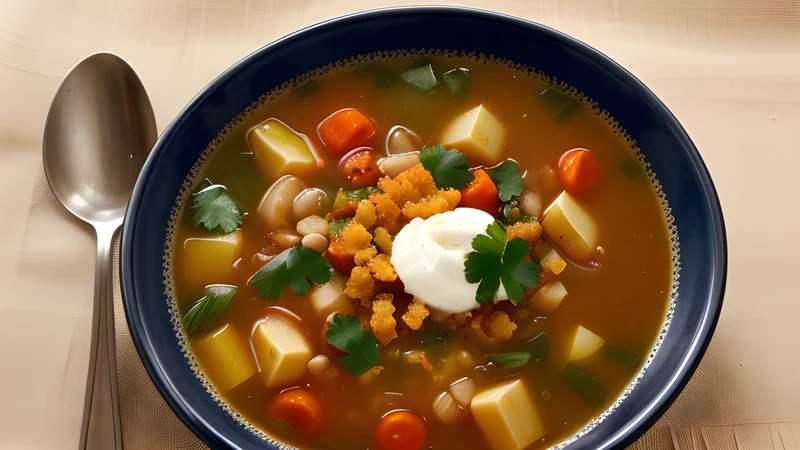
- Serve in wide bowls, each one finished with a hard pour of raw olive oil and chopped parsley.
Where the soup comes from
Beans arrived in Greece late. The white bean, Phaseolus vulgaris, is American, and it did not reach the eastern Mediterranean in any quantity until the seventeenth century, which makes fasolada one of the younger dishes in the Greek canon despite feeling ancient. What it replaced was older: the Greeks had been eating pulse soups since antiquity, built on broad beans, lentils and chickpeas. Aristophanes has characters eating etnos, a thick pea purée, and the archaeological record of the Aegean is thick with lentils. The New World bean simply moved into a slot that had been occupied for three thousand years.
It found its permanent home in the Orthodox fasting calendar. Depending on how strictly you count, an observant Greek Orthodox household abstains from meat, dairy, eggs and fish for something close to 180 days a year — the whole of Great Lent, most Wednesdays and Fridays, the Dormition fast in August, the Nativity fast. On those days olive oil is often permitted and animal fat is not, which means a cuisine developed under real constraint: fat had to come from the tree, protein from the pulse, depth from vegetables and time. Fasolada is what that constraint produces when it is handled by people who have been practising for centuries.
The phrase you will see attached to it is to ethniko fagito — the national food. The tag seems to have hardened in the twentieth century, and it carries a slight edge of self-deprecation and a much larger amount of pride. During the German occupation of 1941-44, when Athens starved, beans were what there was. A generation grew up associating the smell with survival and then, unusually, kept cooking it once the hunger ended. That is the interesting bit. Most famine food gets abandoned the moment it can be. Fasolada did not.
Why there is no stock in it
The temptation, if you come to this from a British or French cooking background, is to build it on chicken stock. Resist. Fasolada is a ladero — one of the family of Greek dishes cooked in oil and water, where the oil is the flavour and the water is merely the medium. Roughly a third of a bottle of olive oil goes into four portions here, and if that seems extravagant, it is the entire point. The oil emulsifies partially into the starch the beans give up, and what you get is a soup with the body of something enriched with cream and none of the dairy weight.
Use oil you would happily eat on bread. A grassy, peppery Greek Koroneiki is ideal and widely available; if you can only get a mild supermarket blend, buy a small bottle of something good for the finishing pour, which matters more than what goes in at the start, because heat kills the volatile peppery compounds and the raw oil at the end is where they survive.
The bean, and the salt argument
Dry beans, always. Tinned beans cannot give up starch the way dry ones do, because they have already given it up into the tin, and fasolada made with them tastes thin no matter how long you simmer it. Cannellini is the easy choice in the UK. Greek recipes often specify medium fasolia, and gigantes are for the baked dish gigantes plaki rather than for soup.
Two technical points that people argue about. First, the bicarbonate in the soaking water: it raises the pH, which weakens the pectin holding the cell walls together, and beans soaked this way cook noticeably faster and softer. Half a teaspoon per litre is plenty; more and you get a soapy taste and mushy skins. Second, salt. The folk rule says salting early makes beans tough, and the food-science rebuttal says the opposite — that sodium ions displace calcium and magnesium in the pectin and actually soften the skins. Both camps have data. My compromise is the one in the method: salt at the end, when I can taste the whole thing properly, because the real risk with fasolada is a soup that is seasoned blind at the 20-minute mark and then reduces for another hour into something aggressive.
The bean is done when it is completely gone — no chalk, no bite, the skin slipping. Undercooked beans in this soup are the single most common fault. Give it the full 90 minutes and taste four separate beans, because a pot always contains stragglers.
The charred onion
Here is my deviation. A dry pan, screaming hot, onion halves face down, and eight minutes of not touching them. The cut faces go from gold to brown to genuinely black, and the smell in the kitchen goes slightly alarming. Then they go into the pot whole, face down, and they poach in the soup for an hour and a half, releasing that bitterness slowly into a broth sweet enough to take it.
The mechanism is straightforward: charring drives the Maillard reaction past its polite stage and produces pyrazines, the same class of compounds that make coffee and toast smell of what they smell of. In a soup that contains no browned meat and no stock, they supply the savoury bottom note that is otherwise missing. This is the same instinct behind the charring in souvlaki with tzatziki and charred pitta, where the black edges do the work the marinade cannot.
Lift the onions out at the end and eat them standing at the stove. That is the cook’s payment.
Body without a blender
A ladleful blitzed and stirred back is the difference between bean soup and fasolada. Whole-blitzing turns it into a purée, which is a different and less interesting dish. Blitzing about a fifth releases enough starch to thicken the broth into something that coats a spoon while leaving most of the beans intact.
The vinegar at the end is compulsory in my kitchen and optional in Greece. A tablespoon of red wine vinegar in a pot this size will not read as sour; it reads as clarity, cutting through the oil and making the tomato taste more like tomato. Lemon does the same job with a different accent, in the manner of Greece’s silky egg-and-lemon soup, where acid carries the whole structure.
The celery is doing more than you think
Carrot and onion are in fasolada because they are in everything. Celery is in fasolada because fasolada would collapse without it, and the proportion here — three sticks plus a fistful of the pale inner leaves for four portions — is much higher than a standard soffritto would use.
Celery contributes phthalides, a family of compounds almost unique to the plant, and they are what give the soup its savoury, faintly medicinal backbone. In a pot with no meat, no bones and no stock cube, they are the closest thing to a broth note available. The leaves matter more than the sticks: the volatile fraction concentrates in the foliage, and those pale yellow inner leaves at the heart of the head carry several times the aroma of the ribs. They also fade fast under heat, which is why they go in at the end rather than the beginning while the sliced ribs get the full 90 minutes to give up everything they have.
Greeks call the plant selino and use it as a herb far more than the British do. If your head of celery came without its leaves, a small handful of flat-leaf parsley plus a couple of lovage leaves gets you approximately there. Celeriac does not; it is sweet and starchy and misses the point entirely.
The carrot, incidentally, is doing sugar work rather than flavour work. Two carrots over an hour and a half break down enough to sweeten the tomato and balance the vinegar at the end. Cut them thick, at a centimetre, so they survive as objects.
How it is actually eaten
The bowl is only part of it. Fasolada in Greece arrives as the centre of a table with three or four things around it, all of them salty, and all of them there to be alternated with mouthfuls of soup.
Feta, in a slab rather than crumbled, is the standard. Olives, usually the wrinkled dry-cured ones from Thassos. Bread, and a lot of it. And, in the villages, salted fish — sardella, small salted sardines packed in barrels, or a grilled salt herring. The pairing sounds odd to modern ears and it is the oldest part of the whole arrangement: a plain oil-and-pulse dish with an intensely salty animal thing beside it is a Mediterranean pattern going back to Roman garum, and the salt does what a stock would have done if there had been one.
Temperature matters and it surprises people. Fasolada is at its best warm rather than hot — around 60C, well below the temperature a British soup arrives at. Too hot and the olive oil’s aromatics blow off before the spoon reaches your mouth, and the beans taste of nothing much. That fifteen-minute rest off the heat before serving is doing real work, and it is why Greek cooks are so relaxed about a pot that has been sitting on the stove since lunchtime.
Tips, faults and variations
It tastes flat. Almost always underseasoning or the tomato purée going in raw. That two-minute fry of the purée matters — it converts harsh, green-tasting notes into sweetness.
The beans burst and the soup went cloudy and gluey. Too hard a boil. After the initial 5-minute hard boil to knock out the foam, it should never do more than shrug.
It is better tomorrow. Emphatically. Make it a day ahead if you can; the oil and starch finish emulsifying overnight and the celery flavour spreads. It keeps 5 days refrigerated and freezes well, though it thickens considerably — loosen with hot water and a fresh pour of oil, never with more salt.
Variations. A dried chilli or a strip of orange peel in the pot for the last 30 minutes both work. Some islands add a spoonful of trahana. Northern versions go heavier on paprika and lighter on celery. What you should not do is add smoked meat, at which point you have made a pleasant bean and bacon soup and lost the thing that makes fasolada itself.
And a bowl of watermelon Greek salad alongside in summer is anachronistic and very good.
Related Content