Fårikål: Norway's Mutton and Cabbage
Four ingredients, one pot, and a national argument about flour
Contents
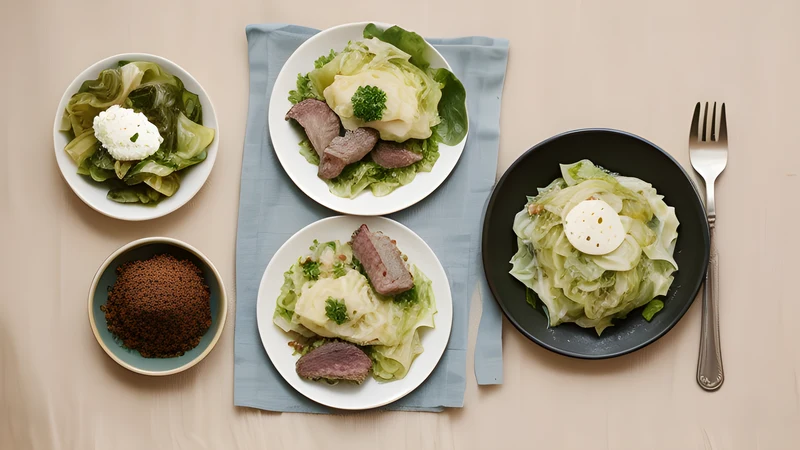
↓ Jump to recipeNorway has voted on its national dish twice. In 1972 the national broadcaster ran a poll and fårikål won. In 2014 the Ministry of Agriculture, apparently feeling that forty-two years was long enough, ran a fresh competition to find a replacement. Fårikål won again, with something like 45% of the vote, beating everything the modern Norwegian kitchen could put up against it.
The dish it defended its title with is mutton, cabbage, black pepper, salt and water. That is the complete list.
Fårikål: Norway's Mutton and Cabbage
Ingredients
- 1.5 kg mutton or hogget on the bone (shoulder, neck and breast), cut into 4 cm pieces
- 1.5 kg white cabbage, about 1 large head
- 4 tsp whole black peppercorns
- 2 tsp fine sea salt
- 300 ml cold water
- 3 tbsp plain flour (optional, see method)
- 1 kg waxy potatoes, to serve
Method
- Quarter the cabbage through the root and cut away the toughest part of the core, leaving enough to hold each wedge together. Cut three of the quarters into 3 cm wedges. Keep the fourth quarter whole.
- Heat a dry, heavy frying pan over high heat. Press the cut faces of the reserved cabbage quarter onto the hot metal for 3 to 4 minutes per side, until blackened in patches and smelling sweet and smoky. Cool, then cut it into 3 cm wedges like the rest.
- Choose the fattiest pieces of mutton and lay them fat side down across the base of a heavy casserole, in a single layer.
- Scatter over a quarter of the peppercorns, a quarter of the salt and, if using, a light dusting of flour.
- Add a layer of cabbage wedges, distributing the charred pieces through it. Season again.
- Continue layering meat and cabbage, seasoning each layer, finishing with cabbage on top.
- Pour in the cold water. Cover tightly and bring to a bare simmer over medium heat — this takes about 20 minutes. Do not stir.
- Reduce the heat until you can see one bubble breaking every second or two. Simmer, covered, for 2 to 2.5 hours, until the meat pulls from the bone under a fork and the cabbage is translucent.
- Boil the potatoes in salted water for 20 minutes. Serve the fårikål in deep bowls with plenty of the liquor, the potatoes alongside, and warn everyone about the peppercorns.
Why September, and why sheep
Fårikål means “sheep in cabbage”, and the timing is not sentimental. Norwegian sheep spend the summer on utmarksbeite — rough mountain and forest grazing, unfenced, on land that will grow nothing else. They come down in September, in the sanking, and September is when a smallholding has both fresh mutton and a cabbage crop that has just finished sizing up in the cold nights. The dish is what happens when the two things arrive in the same week and you own one pot.
That coincidence is now a national holiday of sorts. Fårikålens festdag falls on the last Thursday in September, and it is observed with the seriousness Norwegians usually reserve for skiing.
The sheep matter. Får means sheep rather than lamb, and it matters because mutton — an animal over a year old — carries branched-chain fatty acids that lamb largely does not: 4-methyloctanoic and 4-methylnonanoic acid, the compounds responsible for what English speakers call “muttony” and Norwegians call the point. Lamb will make a pleasant, mild stew. Mutton makes fårikål. If your butcher can only offer hogget — a sheep in its second year — take it; it sits usefully in between.
Breed matters less, but it is interesting. Most Norwegian mutton is norsk kvit sau, a modern composite bred for carcass weight. Spælsau, the old short-tailed native breed, has less meat on it and considerably more flavour. Villsau — the feral coastal sheep that graze heather on the western islands year-round — tastes faintly of the heather, which sounds like marketing until you cook one.
Where the pot came from
Nobody in Norway invented mutton and cabbage. Boiled sheep with brassica turns up across northern Europe wherever the two things were cheap at the same time of year, and the Norwegian version most likely arrived through Denmark during the long centuries of Danish rule. Norwegian cookery writing has it by the middle of the nineteenth century — Hanna Winsnes’s household manual of 1845, the book that taught the Norwegian middle class to cook, is usually where the trail is picked up — and by then it was already an ordinary thing that ordinary people made rather than a novelty worth explaining.
What made it national was the twentieth century. Norway spent much of it being poor, then occupied, then suddenly rich on oil, and the food that survived that sequence intact tended to be the food that needed nothing. Fårikål needs a pot, an animal, a field and two and a half hours. It cannot be improved by money. That is a large part of why it beat everything on the 2014 ballot: a Norwegian looking at a list of national dish candidates is being asked which one their grandmother made, and the answer is this one.
The commercial infrastructure follows the calendar. From late August, Norwegian supermarkets sell packs labelled simply fårikålkjøtt — mutton cut for the dish, bone in, fat on, the ratio already sorted out for you. It appears, sells out repeatedly, and vanishes again around November. No other country I know of sells a cut of meat named after a single recipe.
The four ingredients, and the one argument
The flour question has divided Norwegian kitchens for a century. A light dusting of plain flour between the layers thickens the liquor into something between a broth and a sauce. Purists regard this as an adulteration and point out, correctly, that a properly made fårikål produces a liquor rich enough from the rendered fat and the cabbage’s own dissolved pectin.
I dust. Three tablespoons across four layers is barely there, and it gives the liquor enough body to cling to a potato instead of running off it. If you skip it, cook uncovered for the final twenty minutes to reduce.
The pepper is not negotiable. Four teaspoons of whole black peppercorns in one pot sounds insane and is correct. Whole peppercorns release their piperine slowly over two and a half hours, which produces a warmth that runs through the whole dish rather than a sharp bite on the tongue; ground pepper would give you the opposite, and would go bitter and dusty besides. Norwegians eat them. You will bite one roughly every fourth spoonful and it will be a small, pleasant detonation. If you have guests who will not forgive you, tie the peppercorns in muslin — but understand that you are making a compromise rather than an improvement, because the muslin keeps them out of the spoon and eating them is half the fun.
The fat goes at the bottom
This is the piece of technique that carries the dish.
Pick out the fattiest pieces of mutton and lay them fat side down directly on the base of the pot. As the pot comes up to temperature, that fat renders out and pools underneath everything. It cannot escape, because the pot is covered and the cabbage above is releasing water. So it does the only thing available to it: it rises, slowly, through every layer, for two and a half hours.
That is how a stew with no browning, no stock and no aromatics beyond pepper ends up tasting of something. There is no Maillard reaction here worth the name — fårikål is a white dish, and any recipe telling you to brown the meat first has quietly turned it into a different stew. The flavour is rendered mutton fat, extracted slowly into cabbage that is simultaneously breaking down and giving up its sugars.
Which is also why 300 ml of water is all you add. A kilo and a half of cabbage is roughly 92% water, and most of that comes out. Add a litre of stock and you will dilute the fat, dilute the cabbage sugars, and end up with soup. I have done it. It is fine and it is not fårikål.
Do not stir. Stirring collapses the layers, breaks the cabbage into shreds and buries the meat, and the whole architecture of fat rising through cabbage stops working. The pot does the work; your job is to leave it alone.
The twist: one charred quarter
Here is the change I make, and it is the only one I would defend to a Norwegian.
Take one quarter of the cabbage and press its cut faces onto a screaming-hot dry pan until they blacken in patches — three or four minutes a side, until the kitchen smells sweet and slightly acrid. Then cut it into wedges and distribute it through the layers with everything else.
You are not browning the dish. Twelve wedges of charred cabbage in a pot of a hundred will not turn the liquor brown. What they do is contribute pyrazines and thiophenes — the compounds that scorched brassica produces — into a dish that otherwise has none. The result reads as depth. People taste it and assume you used stock.
One quarter is the ceiling. Char half the cabbage and you have made a smoky stew, which is a perfectly good thing and no longer this thing.
Timing, and the second day
Two to two and a half hours at a bare simmer. The visual target is one bubble breaking the surface every second or two — a rolling boil will shred the cabbage and, more damagingly, will agitate the connective tissue in the mutton into stringiness rather than letting it dissolve gently into gelatine.
The meat is done when it parts from the bone under light pressure from a fork and holds its shape. Cabbage is done when it has gone from opaque white to translucent and the wedges slump when you tilt the spoon.
Make it the day before. This is not a suggestion. Overnight in the fridge, the cabbage continues to soften, the peppercorns keep leaching, and — usefully — the fat sets in a solid cap on top, so you can decide precisely how rich you want the reheated dish to be. I take about a third of it off. Reheat gently, covered, for 30 minutes.
Troubleshooting
Watery and bland. You added too much liquid, or your cabbage was young and lean. Lift the lid for the last half hour.
Stringy meat. It boiled. Nothing to be done except cook it another hour and hope the collagen catches up.
Mutton too strong. Genuinely possible if you have an old animal. Blanch the meat for 3 minutes in boiling water and drain before layering — you lose some richness and lose most of the roughness with it.
Cabbage disintegrated. You stirred, or you cut the core out entirely. The core is the skeleton.
Variations, regional and heretical
With carrot. Parts of eastern Norway add a couple of sliced carrots to the layers. It sweetens the liquor and it is entirely defensible, though the orange in a white dish looks wrong to anyone raised without it.
Savoy instead of white. Savoy cabbage collapses faster and tastes greener and more sulphurous. It works if you shorten the cook by half an hour, and it will get you an argument.
Fårikål med surkål. Substitute a third of the cabbage with sauerkraut. This drags the dish towards its German cousins and produces something genuinely good and entirely un-Norwegian.
The one that isn’t a variation. Recipes that brown the meat, add stock, add onion, add garlic, add bay: these are lamb and cabbage casseroles and they are fine. Calling them fårikål in Norway is a way of starting a conversation you will not win.
What goes with it
Boiled waxy potatoes and nothing else, is the honest answer. Flatbread if you are being expansive. A spoonful of raw-stirred lingonberry preserve is a Swedish habit that a good many Norwegians have quietly adopted, and the acidity does the dish a real favour.
The leftovers become a different dish entirely. Chopped fine and fried hard in a pan, fårikål is halfway to lapskaus, the Norwegian meat and root vegetable hash, which is what Norwegian kitchens have always done with the Thursday pot by the following Sunday. If you want the same mutton flavour treated in the opposite direction — dry, salted and smoked rather than wet and simmered — Icelandic hangikjöt is the other end of the North Atlantic sheep spectrum.
Beer, cold. Aquavit, colder. Then a walk, because you have just eaten a pound of mutton and half a cabbage and there is no polite way around it.
Related Content