Far Breton: The Prune Custard of Brittany
A dense batter pudding studded with prunes soaked in smoked tea
Contents
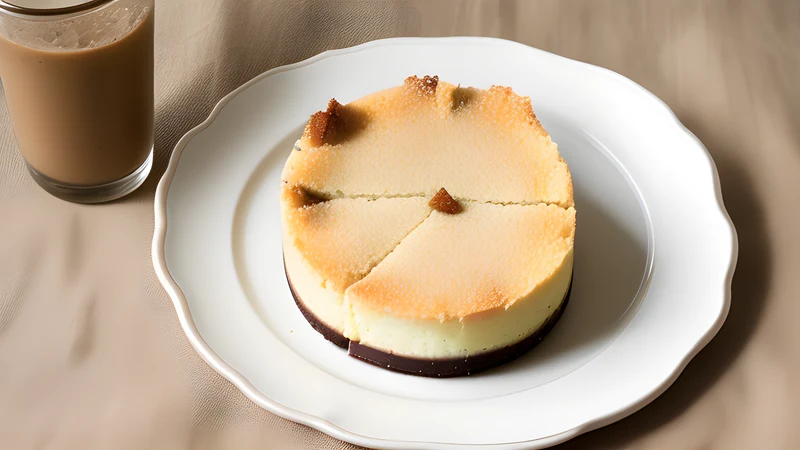
↓ Jump to recipeFar breton sinks. Not through any failure of yours — it rises like a soufflé in the last fifteen minutes, domes up over the rim of the dish, looks briefly like the greatest thing you have ever baked, and then collapses into a dense, wrinkled, wobbling slab as it cools. That slab is the dish. If yours stays up, something has gone wrong.
The word far comes from the Latin far, meaning spelt or coarse grain, and it’s the same root as farine and farro. It started as a savoury grain porridge that Breton farmhands ate with meat, cooked in a cloth or a dish, closer to a Yorkshire pudding than a dessert. Sugar arrived, then prunes came up from Agen along the trade routes, and by the nineteenth century the far had become the thing that every Breton grandmother made on a Sunday and every Breton has an opinion about.
Far Breton: The Prune Custard of Brittany
Ingredients
- 250 g soft stoned prunes, preferably Agen
- 300 ml strong Lapsang souchong tea, freshly brewed and hot
- 2 tbsp dark rum
- 200 g plain flour
- 150 g caster sugar
- 4 eggs, at room temperature
- 2 egg yolks
- 600 ml whole milk, at room temperature
- 100 ml double cream
- 50 g salted butter, melted and cooled, plus 20 g for the dish
- 1 tsp vanilla extract
- 0.5 tsp fine salt
- 1 tbsp caster sugar, for the dish
Method
- Brew the Lapsang souchong strong — 4 teaspoons of leaf to 300 ml of water, steeped 5 minutes. Strain it over the prunes, add the rum, cover and leave for at least 4 hours or overnight.
- Drain the prunes thoroughly and pat them dry on kitchen paper. Reserve 3 tablespoons of the soaking liquid and discard the rest.
- Butter a 26 cm round or 30 x 20 cm rectangular ceramic dish heavily with the 20 g of butter, then dust it with the 1 tbsp of caster sugar and tap out the excess.
- Whisk the flour, 150 g sugar and salt together in a large bowl.
- In a jug, whisk the eggs, yolks, vanilla and the 3 tbsp reserved soaking liquid until smooth.
- Pour the egg mixture into the flour and whisk hard for 60 seconds to a thick, smooth paste with no lumps. Getting the lumps out now is far easier than later.
- Whisk in the milk and cream in four additions, then the 50 g of melted butter. The batter will be thin, like single cream.
- Rest the batter, covered, at room temperature for 1 hour. Do not skip this.
- Scatter the prunes evenly across the base of the prepared dish. Pour the rested batter gently over them — the prunes will float, and this is correct.
- Bake at 180C fan for 45 to 50 minutes, until the top is deeply browned and blistered and the centre wobbles as one piece when the dish is nudged. A skewer should come out with moist crumbs.
- Cool in the dish for at least 2 hours. It will sink dramatically and unevenly, which is what it is meant to do. Serve at room temperature.
Why it’s a custard with too much flour
The batter is 200 g of flour to 600 ml of milk plus 100 ml of cream and six eggs’ worth of protein. Compare that to a clafoutis, which runs at roughly half the flour for the same liquid, and you can see where the difference in texture comes from.
That flour load does something specific. In a clafoutis, the eggs set into a delicate custard and the small amount of flour just gives it enough body to slice. In a far, the starch gelatinises into a genuine network alongside the setting egg proteins, and the two structures together produce something dense, slightly chewy, and much closer to a set batter pudding than to a custard.
The rise-and-fall is a steam event. The batter is thin and wet, and in the oven’s heat the water in it turns to vapour faster than the structure can set. The whole thing inflates. Then it comes out, the steam condenses, and the structure — now set but heavy — has nothing holding it up. Down it goes. The wrinkled, sunken surface is the signature and every Breton bakery sells it looking exactly like that.
The smoked tea
The twist, and the one I’d defend hardest of these.
Every far breton recipe soaks its prunes in something. Usually rum, sometimes Armagnac, occasionally just hot water. Rum works and it adds sweetness on top of a dish that already has 150 g of sugar and 250 g of dried fruit in it.
Lapsang souchong changes the equation. It’s a Fujian black tea dried over pine fires, and the smoke compounds — guaiacol and syringol, mostly, the same molecules that make bacon smell of bacon — are water-soluble and they get into the prunes over a few hours of soaking. What comes back is a prune that tastes of prune with a faint, savoury smoke underneath it, and that smoke is exactly what a very sweet, very dense pudding needs to stop it being one-note.
There is a historical fig leaf here, too, thin as it is. Prunes are dried plums, and prunes d’Agen were traditionally dried in wood-fired ovens, which gave them a smokiness that modern industrial drying has engineered out. The tea is putting back something the fruit used to have.
Brew it strong — 4 teaspoons of leaf to 300 ml — and pour it over the prunes hot. Hot liquid opens the fruit’s cells and the exchange happens in hours instead of days. Keep the 2 tablespoons of rum; the alcohol dissolves a different set of aromatics than the water does, and the two together get more out of the prune than either alone.
Then drain and dry the prunes properly. Wet prunes bleed into the batter and give you a grey pudding. Three tablespoons of the soaking liquid go into the batter and the rest gets thrown away.
Prunes, and the pit question
Agen prunes if you can find them: they’re a specific variety, the Prune d’Ente, and they’re meatier and less sweet than the Californian ones that fill most supermarket shelves. Californian prunes are fine and are noticeably sweeter, so drop the batter sugar to 130 g if that’s what you have.
Traditional Breton far uses prunes with the stones in. Bretons will tell you the stone adds flavour, and there’s a grain of truth to it — prune stones contain amygdalin, which gives a faint almond note, the same compound that makes a stones-in cherry clafoutis taste different from a stoned one. There’s also a solid grain of dentistry. I use stoned prunes and add nothing to replace it, because 250 g of prunes carry the dish easily on their own.
The prunes will float. Every recipe that tells you to scatter them across the base is telling you the truth about the method and lying about the outcome — as the batter is poured, and again as it heats and thins, the fruit rises. Nothing you do prevents it. Some cooks pour half the batter, bake for 15 minutes to set a base, then add the fruit and the rest. It works and it produces a visible seam through the middle of every slice, which I think looks worse than floating prunes.
The rest, and the lumps
Rest the batter one hour. This is the step people skip and it does two things.
It hydrates the flour. Dry starch granules need time in liquid to absorb it fully, and a batter baked immediately has partly dry flour in it, which gives a slightly gritty, chalky texture on the tongue.
It relaxes the gluten. You whisked hard to get the lumps out, and that whisking developed gluten strands. Bake straight away and those strands tighten in the heat and give you a rubbery far. An hour on the counter and they relax.
Room temperature. Cold batter into a hot oven sets unevenly and rises less.
On the lumps: make a thick paste first — flour, sugar, salt, then the eggs — and beat that until it’s completely smooth before any milk goes near it. Lumps form when you add liquid to flour gradually, because the flour on the outside of each clump gelatinises and seals the dry flour inside. A thick paste has nowhere for a lump to hide. Once it’s smooth, the milk thins it without incident.
The dish, and why ceramic
A 26 cm round or 30 x 20 cm rectangle, in ceramic or glass, giving a depth of around 4 cm.
Depth is the variable that matters. Shallower than 3 cm and the far cooks through before the top browns, and you get a pale, dry biscuit. Deeper than 5 cm and the outside is leather before the centre sets. Four centimetres is the band where the browning and the setting finish at the same moment.
Ceramic over metal, and this is worth a paragraph. Metal conducts heat fast, and a far in a metal tin sets its edges hard in the first ten minutes and then bulges up through the soft middle, which cooks unevenly. Ceramic and glass are poor conductors, they heat slowly and evenly, and the batter sets from the outside in at a manageable pace. Bretons bake theirs in earthenware for exactly this reason and have done since before anyone could explain it.
Butter the dish heavily and dust it with sugar. The sugar coating caramelises against the ceramic and gives the finished far a thin, faintly crisp shell on its sides and base, which is a good contrast against a very soft interior. It also, usefully, stops it welding itself to the dish.
Salted butter, because Brittany
50 g of melted salted butter goes into the batter, and it is salted for the same reason everything in Brittany is salted: the region has produced sea salt at Guérande since the ninth century, salt was untaxed here under the gabelle when it was ruinously taxed elsewhere, and Breton cooking simply assumes butter has salt in it.
The half teaspoon of additional fine salt on top of that looks like a lot for a pudding. It is deliberate. Salt suppresses the perception of bitterness and sharpens the perception of sweetness, so a well-salted far tastes more of prune and caramel than an unsalted one does at the same sugar level. It’s also the only thing standing between 150 g of sugar and a dessert that tastes flat.
Cool the melted butter before it goes in. Hot butter into a batter with six eggs in it scrambles them, and you’ll be sieving out yellow threads.
Baking and the wobble
180C fan, 45 to 50 minutes. Look for a deeply browned, blistered top — considerably darker than feels safe — and a centre that wobbles as a single mass when you nudge the dish. Separate ripples in the middle mean the custard hasn’t set and it needs another five minutes.
A skewer should come out with moist crumbs clinging. Clean means overbaked, and an overbaked far is dry and tough rather than dense and tender.
Then leave it alone for two hours. The starch and egg network continues to set as it cools, and a hot far is a soupy, structureless thing that will not slice. Room temperature is the correct serving temperature, and the window is narrower than you’d think in either direction.
Storage and what not to do to it
It keeps three days, covered, at room temperature. The fridge makes it rubbery and mutes the smoke, so keep it out unless your kitchen is over 25C. It doesn’t freeze.
Do not serve it with cream, custard or ice cream. It’s already a custard and it’s already dense; anything wet alongside it turns the plate into porridge. A cup of coffee, and possibly a small glass of the same rum.
Do not, whatever else, dust it with icing sugar to hide the wrinkles. The wrinkles are the point. It’s the only pudding I know that’s judged on how thoroughly it collapsed, and after the discipline of something like a kouign-amann — three turns, 14C butter, a caramel that will burn you — there’s real pleasure in a Breton bake that succeeds by falling over.
Related Content