Strawberry Eton Mess with Balsamic
Crushed meringue, cream and berries
Contents
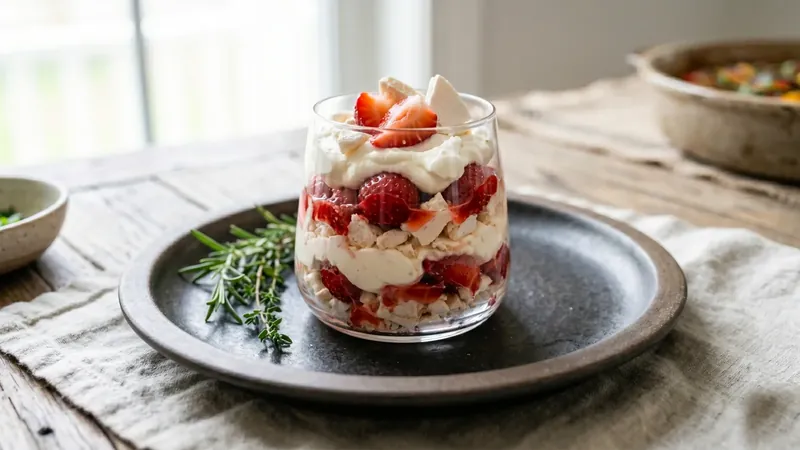
↓ Jump to recipeEton mess is the most forgiving of desserts, a glorious tumble of crushed meringue, softly whipped cream and ripe strawberries that comes together in minutes. The twist is a splash of good balsamic vinegar tossed through the berries: it draws out their juices and deepens their flavour, lending a subtle savoury sharpness that makes the sweetness sing. Assembled at the last moment so the meringue keeps its crunch, it is summer in a glass and impossible to get wrong.
Strawberry Eton Mess with Balsamic
Ingredients
- 500g ripe strawberries, hulled
- 1 tbsp good balsamic vinegar
- 2 tbsp icing sugar
- 300ml double cream
- 1 tsp vanilla extract
- 100g meringue nests or shop-bought meringue
- A few small basil or mint leaves, to serve
Method
- Halve or quarter half the strawberries and place in a bowl.
- Drizzle over the balsamic vinegar and 1 tbsp of the icing sugar, then toss and leave to macerate for 20 minutes.
- Blitz or mash the remaining strawberries to a rough puree and stir through any juices from the macerated fruit.
- Whip the double cream with the vanilla and remaining icing sugar to soft, billowing peaks.
- Break the meringue into bite-sized pieces, keeping a few larger shards for the top.
- Gently fold most of the meringue and most of the macerated strawberries through the cream, leaving streaks rather than mixing fully.
- Ripple the strawberry puree through for a marbled effect.
- Spoon loosely into glasses or bowls and top with the reserved strawberries and meringue.
- Finish with a few basil or mint leaves and serve immediately, before the meringue softens.
The Story
Eton mess is as English as a summer afternoon, and its name ties it firmly to Eton College, the famous school whose annual cricket match against Harrow has long been a fixture of the social season. The pudding is traditionally associated with this event, served as a celebratory treat, and the most enduring story of its creation is delightfully casual: that a meringue-based dessert was somehow dropped or crushed and then simply served in its broken state, the happy accident giving rise to the deliberately tumbled mess we make today. Whether literally true or not, it captures the spirit of the dish perfectly.
The beauty of Eton mess lies in its embrace of imperfection. Where a pavlova demands a flawless meringue and careful presentation, this dessert positively wants everything broken up and folded together loosely, with streaks of cream, fruit and shattered meringue rather than a uniform mixture. That makes it both forgiving for the cook and pleasing to eat, since every spoonful offers a different balance of crisp, soft and juicy. It is also a brilliant use for meringues that have cracked or for a batch made specifically to be smashed.
Strawberries are the classic fruit, and choosing them ripe and fragrant matters more than anything else, as they carry the whole dessert. A strawberry picked before it is ready will never sweeten further, because unlike a banana or a pear it does not ripen off the plant, so the pale, hard, cottony ones flown in out of season are a lost cause here. Look for berries that are red all the way to the shoulder, smell strongly of strawberry through the punnet, and give very slightly when pressed. English strawberries in June and July, or whatever is genuinely in season where you are, will always beat imports. The contrast of textures is the point: the crunch of meringue that gradually softens, the pillowy cream and the soft, juicy berries. It is a dessert that hides nothing, so every element has to be good; there is no pastry or custard to carry a weak strawberry.
The balsamic vinegar is the quiet stroke of cleverness. Tossing the strawberries with a little vinegar and sugar and leaving them to sit is a technique known as macerating, which draws out their juices into a glossy syrup and intensifies their taste. It works by osmosis: the sugar draws water out of the fruit cells, softening the berries and creating a sweet-tart syrup that carries far more flavour than the dry strawberries did on their own. The acidity of a good aged balsamic plays against the fruit’s sweetness and adds a rounded, almost savoury depth that ordinary sugar alone cannot give. It is a well-established pairing in the region around Modena in northern Italy, where true balsamic vinegar is made and where strawberries dressed with a few drops of it are a classic; the vinegar’s own grape-must sweetness is what makes the match work rather than clash. Use a decent thick, syrupy balsamic here, not a thin, harshly acidic supermarket one, and go carefully: a single tablespoon across 500g of fruit is plenty. You want a whisper of depth, not a salad dressing. A few leaves of basil or mint at the end echo that grown-up note, torn rather than chopped so they bruise a little and release their scent without turning the cream green.
Getting the Textures Right
Everything about Eton mess comes down to texture, and there are a few small things that decide whether it sings or sags. The cream must be whipped only to soft, billowing peaks, the point where it just holds a floppy fold and no further. Over-whipped cream turns grainy and stiff and loses the pillowy quality that is the whole pleasure of the dish; if you are whisking by hand you have more control, and it is worth finishing the last few strokes by hand even if you started with a machine. Double cream, at around 48% fat, whips reliably and holds; single or whipping cream will not give the same body.
The meringue is the other half of the equation. It needs to be properly crisp and dry, the sort that shatters cleanly rather than bending. This is where the timing rule bites: meringue is hygroscopic, meaning it pulls moisture out of the air and out of the cream and fruit it sits against, so the moment you fold everything together the clock starts. Fold too early and by the time it reaches the table the meringue has gone chewy and soft. That is why I assemble at the very last minute and keep a few larger shards back to scatter on top, where they stay crisp longest. If you are making the components ahead, keep the whipped cream, the macerated fruit and the meringue entirely separate until you serve, and bring them together in front of your guests.
Meringue: Buy It or Make It
Shop-bought meringue nests are perfectly good here, and there is no shame in them for a dessert that is meant to be quick and forgiving. But if you want to make your own, the principle is simple: whisk egg whites to stiff peaks, then whisk in caster sugar a spoonful at a time until the mixture is glossy and thick, roughly 50g of sugar per egg white. Spread or pipe it onto a lined tray and bake low and slow, around 110°C, for an hour and a half, then leave it in the switched-off oven to dry out completely. Cracked, imperfect meringue is exactly what you want here, so a batch that did not turn out picture-perfect for a pavlova finds its home in a mess. The same Swiss or French meringue base underpins showier puddings like a lemon meringue pie with Italian meringue, so it is a technique worth having in your hands.
Variations and Serving
Strawberries are traditional, but the format welcomes almost any soft summer fruit. Raspberries bring a sharper edge and need no balsamic; a mix of raspberries and strawberries is glorious. Later in the year, poached rhubarb or roasted plums fold in beautifully and give a deeper, more autumnal mess. A spoonful of lemon curd rippled through the cream adds a bright, sharp streak, and a handful of toasted flaked almonds gives contrast to all that softness.
A quick word on the balsamic quantity for a crowd, since this scales up well for a party: keep the ratio at roughly one tablespoon of balsamic and one of icing sugar per 500g of strawberries, and taste the macerated fruit before you fold it in. It should taste of intensified strawberry with a savoury shadow behind it, not of vinegar. If in doubt, use less; you can always add a few drops more, but you cannot take it out. Serve it loosely spooned into glasses so the layers show, and eat it soon after assembling. It is the ideal pudding for a summer lunch precisely because it demands no baking on the day and rewards a relaxed, generous hand; the same easy, crowd-pleasing logic runs through a simple Victoria sponge with roasted strawberry jam, the other pudding I reach for when strawberries are at their best and I cannot be bothered to fuss. Both prove the same point: with good fruit and a little cream, you do not need to work hard to eat well.
Related Content