Erwtensoep: Dutch Split Pea Soup Thick Enough to Stand a Spoon In
Snert, made a day ahead, with rookworst and rye bread and a spoon that stays upright
Contents
↓ Jump to recipeThe test is a spoon. You stand it upright in the middle of the bowl, let go, and if it stays put you have made snert. If it leans over slowly you have made an acceptable soup that a Dutch person would eat without complaint and quietly judge. If it falls flat you have made pea water and should go back to the pan.
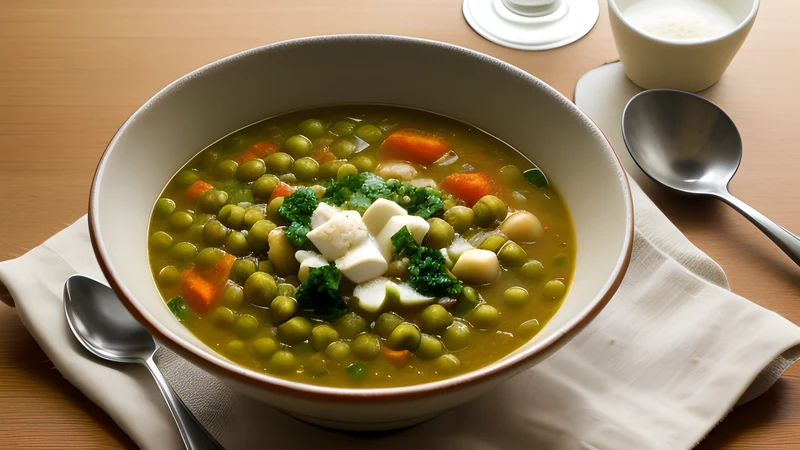
This is not a joke that food writers invented. The upright spoon is the actual, stated, argued-about standard, and it drives the whole method: a kilo and a half of vegetables and meat go into two and a half litres of water and the pot spends over two hours reducing while the peas disintegrate. What comes out is closer to a very loose porridge than to soup in the English sense.
Erwtensoep: Dutch Split Pea Soup Thick Enough to Stand a Spoon In
Ingredients
- 500 g green split peas, rinsed in a sieve until the water runs clear
- 2.5 litres cold water
- 600 g pork ribs or a smoked pork hock
- 250 g pork belly, in one piece, rind on
- 2 bay leaves
- 8 black peppercorns
- 1 large onion (about 200 g), finely chopped
- 2 leeks (about 300 g), white and pale green parts, sliced into 1 cm rounds
- 300 g celeriac, peeled and cut into 1 cm dice
- 200 g carrot, peeled and cut into 1 cm dice
- 250 g floury potato, peeled and cut into 2 cm chunks
- 1 rookworst (about 300 g), or another coarse smoked pork sausage
- 4 celery sticks with leaves, sticks sliced thin, leaves chopped and reserved
- 2 tsp fine salt, or to taste
- 1 tsp freshly ground black pepper
- 2 tsp Dijon mustard
- Dark rye bread and butter, to serve
Method
- Put the split peas, water, pork ribs, pork belly, bay leaves and peppercorns in a large heavy pan. Bring slowly to a boil over medium heat, skimming off the grey foam that rises in the first 10 minutes.
- Reduce to a bare simmer, half-cover the pan and cook for 60 minutes, stirring the base every 15 minutes to stop the peas catching.
- Lift out the pork belly and ribs and set aside. Add the onion, leeks, celeriac, carrot, potato and sliced celery sticks.
- Simmer, uncovered, for a further 60 minutes, stirring the base every 10 minutes, until the peas have broken down completely and the soup is thick and rough.
- Strip the meat from the ribs, discard the bones, and cut the pork belly into 1 cm dice. Return all the meat to the pan.
- Lay the rookworst on top of the soup, cover and simmer very gently for 12 minutes until heated through. Lift it out and slice it into 1 cm rounds.
- Stir in the salt, black pepper, Dijon mustard and the chopped celery leaves. Taste and adjust the salt.
- Cool the soup completely, uncovered, then refrigerate overnight. This step is traditional and it genuinely improves the soup.
- The next day, reheat over low heat, stirring constantly and adding up to 200 ml water to loosen it. Do not let it boil hard or it will catch.
- Ladle into deep bowls, lay the sliced rookworst on top and stand a spoon upright in the middle. Serve with buttered dark rye bread.
Snert, skating, and why it must be made the day before
The formal name is erwtensoep. Nobody calls it that. It is snert, an old word of uncertain origin — probably imitative, possibly related to a dialect verb for slurping — and the informality tells you what kind of food it is. This is a dish with no pretensions at all.
Split peas were the protein of the Low Countries long before the potato arrived. Dried peas store for years, tolerate the damp Dutch climate, and deliver around 25 g of protein per 100 g dry weight, which in a country where meat was expensive made them structural rather than optional. Seventeenth-century Dutch ships carried barrels of them; the East India Company victualled on peas and salt pork, which is more or less this recipe minus the vegetables. Pea soup with pork is what Dutch cooking is built on when you strip away everything else.
The skating connection is the part outsiders always want to hear about. When the canals freeze hard enough — which happens rarely now, and is a genuine national event when it does — stalls appear on the ice selling snert in paper cups. The Elfstedentocht, the two-hundred-kilometre eleven-cities skating tour through Friesland, has been held fifteen times since 1909 and last in 1997; snert is what the skaters and the crowds eat. Even in years with no ice, snert is winter food by definition, and Dutch supermarkets sell it in cartons from October.
The day-ahead rule is the strictest convention attached to the dish, and unusually for a food superstition, the chemistry backs it up. Overnight, three things happen. The starch granules released by the disintegrating peas continue absorbing water and retrograding, which thickens the soup considerably — snert is always noticeably stiffer cold than it was hot. The gelatin from the pork ribs sets and then re-melts on reheating, distributing more evenly. And the flavour compounds simply have time to diffuse: the smoke from the pork, the anise notes from the celeriac and celery leaf, the sulphur from the leek all migrate out of their individual pieces and into the body of the soup. A Dutch cook will tell you snert eaten the same day is not snert. They are right, and it is one of the few places where tradition and food science agree without argument.
The peas, and the two things that ruin them
Green split peas are field peas, dried and mechanically split along the natural seam, with the skin removed. The splitting matters: it exposes the cotyledon directly to water, so they need no soaking and they break down entirely in about ninety minutes. Whole dried peas keep their skins, need overnight soaking, and stay stubbornly intact — you cannot make snert with them.
Rinse them properly. Split peas carry a fine dust of pea flour and field debris, and unrinsed peas make the soup taste faintly chalky and throw much more grey scum in the first ten minutes.
Two things prevent peas from softening, and both are worth knowing. The first is age. Pulses that have sat in a warehouse for three years develop cross-links between the pectin in their cell walls and free calcium, and no amount of boiling breaks them down. Old peas simply stay gritty forever. Buy from a shop with turnover and check the date.
The second is acid. Add tomato, vinegar or wine at the start and the peas will still be hard after three hours, because acidic conditions stabilise the pectin in the cell walls. Everything acidic — the mustard here — goes in at the end. Salt, contrary to the old kitchen lore, does no harm at all and arguably helps; the calcium in hard water is the real culprit, and if your water is very hard, a pinch of bicarbonate of soda in the pot speeds things up noticeably.
Stir the base. Peas sink, and once a layer of pea starch is sitting on the bottom of the pan it will scorch, and scorched pea is a flavour that permeates the entire pot within about four minutes. Every fifteen minutes with a flat-ended wooden spatula, right across the base.
Building the body
The vegetables go in at the hour mark rather than the start, which keeps the celeriac and carrot recognisable instead of dissolving. Celeriac is the one people leave out and should not: its aromatic compounds are what give snert its particular savoury, slightly medicinal backbone, and swapping in more potato makes a blander soup.
Celery leaves are a genuine Dutch signature. The pale inner leaves from a head of celery carry far more aromatic oil than the stalks, and stirred in raw at the end they give a fresh green note over the top of two hours of pork. Do not throw them away.
The potato is a thickener rather than a vegetable. It falls apart entirely and its starch adds body. Use a floury variety; a waxy one will sit in the soup as intact cubes and contribute nothing.
Pork ribs and pork belly do different jobs. The ribs are for gelatin — connective tissue converting to gelatin over two hours is what gives the soup its clinging, coating texture. The belly is for fat and meat. A smoked hock replaces both and adds smoke, which is why it is the common shortcut.
The sausage, the bread and the ritual
The rookworst goes in at the very end, for twelve minutes, and it goes in whole. There are two reasons. The first is mechanical: a coarse smoked sausage in a natural casing is already fully cooked, so it needs bringing to about 70°C and nothing more. Simmer it hard and the casing contracts faster than the filling, splits, and dumps its fat into the soup, leaving you with a sad grey tube. Twelve minutes on a lazy bubble with the lid on brings it up gently and tightens the skin.
The second reason is that a whole sausage sitting in the pot for two hours would give all its smoke to the soup and keep none for itself. Snert already has smoke from the pork; the sausage is meant to arrive as a separate, sharper hit of it, sliced across the top of the bowl. Slice it just before serving, on the round rather than the diagonal, in coins about a centimetre thick.
The bread is the other half of the meal, and Dutch households are unbending about what it should be. Roggebrood — a dense, dark, steamed rye, almost black, sliced thin — buttered heavily and topped with katenspek, a cold smoked streaky bacon cut into near-transparent sheets. You eat the bread alongside rather than in the soup. Dunking is regarded with the same mild horror an Italian reserves for cream in a carbonara. The rye is sour and cold and slightly sticky, the bacon is fatty and smoky, and the contrast against a hot, thick, sweet-earthy soup is the whole point of the pairing.
If roggebrood is beyond reach, any dense sourdough rye does the job, provided it is a real rye rather than a wheat loaf with rye colouring. What you want is the acidity, which cuts through pork fat the way the mustard does from a different direction.
As for the ritual itself: snert is eaten in a deep bowl, with a soup spoon, sitting down, usually at about six in the evening when it is dark outside and has been since four. There is no starter and there is rarely a pudding. It is a complete meal that costs almost nothing and takes two afternoons, which is a fair description of most of the good things in Dutch cooking.
Where it goes wrong
The peas never softened. They were old, or something acidic went in early. There is no rescue.
It caught on the bottom. Too high a heat and not enough stirring. Do not scrape the burnt layer up trying to save it — decant the good soup off the top into a clean pan and accept the loss.
It is too thin. Not enough reduction. Simmer uncovered for another twenty minutes, or add a boiled floury potato mashed into it.
It is a solid block. Correct, actually. That is what the fridge does. Loosen it with water on reheating.
It tastes flat despite the meat. Salt, and then the mustard. Snert needs about 2 tsp of salt for this volume, and the mustard is doing acid work that nothing else in the pot provides.
Variations, and the second day
Frisian cooks add more celeriac and skip the potato. Some households add a whole smoked hock and no ribs at all. A spoonful of the fat skimmed from the top, kept and stirred back in, gives a richer bowl. Katenspek — Dutch smoked bacon — sliced thin and laid on the rye bread alongside is the standard accompaniment, and the bread should be a dense dark rye like rugbrød rather than anything soft.
The Nordic cousins are worth knowing. Sweden’s ärtsoppa uses yellow peas, is thinner, gets eaten on Thursdays and comes with pancakes afterwards. The Dutch version is thicker, greener and has no fixed day. Both take mustard, which tells you something about how much fat is involved in each.
Snert keeps five days in the fridge and freezes for three months, though it separates slightly on thawing and wants vigorous stirring and a splash of water. It only gets better up to about day three. Serve the leftovers with a fried egg on top and a slice of the rye, which is the same instinct that turns cold stamppot into fried patties: Dutch winter cooking assumes the pot will feed you more than once.
Related Content