Empanada Gallega: Galicia's Flat Two-Crust Pie
The filling is cold, the dough drinks the oil, and the pie is a metre wide
Contents
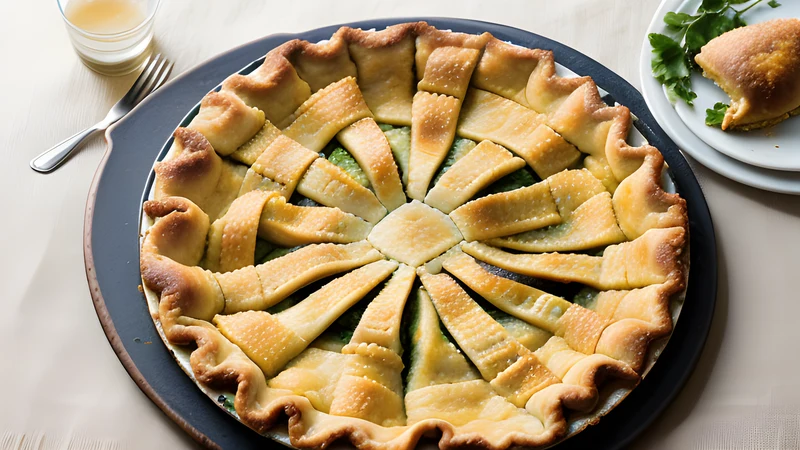
↓ Jump to recipeAn empanada gallega arrives as a flat, two-crust, tray-sized pie, cut into squares, eaten warm or cold, and in Galicia it can be a metre across. Ask for one in a Santiago bakery and they will hand you a slab wrapped in paper, sold by weight, off a pie the size of a table. The Argentine empanada that most of the world means by the word is a descendant that shrank in the crossing — the empanadas mendocinas with their pleated repulgue are the same idea reduced to a portion. This is the ancestor, and it feeds a room.
It is also a pie built around one hard rule that everything else follows from: the filling goes in cold, and it goes in dry.
Empanada Gallega: Galicia's Flat Two-Crust Pie
Ingredients
- 800 g onions (about 4 large), sliced 3 mm thick
- 2 green Italian peppers (about 250 g), sliced thinly
- 120 ml extra virgin olive oil
- 3 garlic cloves, sliced
- 1 generous pinch saffron threads (about 0.15 g)
- 1 tsp smoked sweet pimenton
- 2 tbsp tomato puree
- 400 g tinned tuna in olive oil, drained well
- 2 hard-boiled eggs, chopped (optional)
- 1.5 tsp fine sea salt, for the filling
- 500 g strong white bread flour, plus more for dusting
- 7 g fast-action dried yeast
- 1 tsp fine sea salt, for the dough
- 180 ml warm water
- 1 egg, beaten, to glaze
Method
- Warm the olive oil in a wide pan over a low heat. Add the onions, peppers and 1.5 tsp salt. Cook very gently for 45 minutes, stirring every 5 minutes, until everything has collapsed to a soft, sweet, jammy mass with no colour.
- Add the garlic and cook 2 minutes, then stir in the tomato puree and cook 3 minutes more, until it darkens.
- Take the pan off the heat and let it stand 2 minutes. Crumble in the saffron and stir in the pimenton. Leave to cool for 10 minutes.
- Set a sieve over a bowl and tip the sofrito into it. Press gently. You want about 80 ml of deep orange oil in the bowl — this is the dough's liquid. Keep the drained sofrito separate.
- Make the dough: mix the flour, yeast and 1 tsp salt in a large bowl. Add the warm water and 70 ml of the reserved saffron oil. Bring together, then knead on an unfloured surface for 8 minutes until smooth and elastic. Cover and prove for 1 hour, until roughly doubled.
- Meanwhile, flake the drained tuna into the cooled sofrito and fold in the chopped egg, if using. The filling MUST be completely cold before it meets the dough — refrigerate it for 30 minutes if needed.
- Heat the oven to 190C fan / 210C conventional. Line a 30 x 40 cm baking tray with parchment.
- Divide the dough into two pieces, one slightly larger. Roll the larger piece on a floured surface to a 32 x 42 cm rectangle, 2 to 3 mm thick, and lay it on the tray so it overhangs the edges.
- Spread the cold filling over it in an even 1 cm layer, leaving a 3 cm border bare all round. Brush that border with water.
- Roll the second piece to a 30 x 40 cm rectangle and lay it over the filling. Press the borders together, then fold the overhanging bottom edge up and over the top and crimp it into a rope with your thumb and forefinger.
- Cut a 2 cm hole in the exact centre with the tip of a knife. Prick the top crust 10 times with a fork. Brush all over with beaten egg.
- Bake for 35 to 40 minutes, until deep gold and hollow-sounding underneath. Slide onto a rack and cool for at least 30 minutes before cutting.
Carved into a cathedral in 1188
The empanada has a birth certificate of sorts, and it is in stone. On the Pórtico de la Gloria, the Romanesque doorway that Master Mateo finished at Santiago de Compostela cathedral in 1188, there is a carved scene of men at a table eating what is unmistakably a flat filled pie. It is routinely cited as the earliest depiction of the dish, and while a carving is not a recipe, it puts a two-crust pie on a Galician table eight hundred years ago.
The word is plain enough — empanar means to wrap in bread — and the concept is older than Galicia. Filled breads travelled the Mediterranean with Roman and then Arab cooking, and the Iberian version was shaped by a specific logistical fact: Galicia is the wet green corner of Spain, its people fished the Atlantic and walked to Compostela, and both activities require food that survives a day in a bag. A pie whose crust is a lid, a plate and a wrapper all at once solves that.
The fillings map the region’s economy with some precision. Tuna is the everyday one, because Galicia’s canning industry at Vigo and the Rías Baixas has been putting bonito in tins since the nineteenth century and a tin lives in every cupboard. Zamburiñas, the small queen scallops, are the special-occasion one. Xoubas, small sardines, are the coastal one. Zorza, marinated pork, is the inland one. What none of them vary is the base: onions and peppers cooked to nothing in olive oil, which the Galicians call the zaragallada, and which is doing far more work than the protein sitting in it.
The pie goes to festivals, to funerals, to the beach, and to the romerías, the local pilgrimages, wrapped in a cloth and cut with whatever is to hand. It is cold food that was designed as cold food, which is why it is one of the few pies that is genuinely better an hour out of the oven than straight from it.
Saffron oil, and stealing the fat back
Here is the twist, and it began as thrift. When you cook 800 g of onion in 120 ml of olive oil for forty-five minutes, you end up with a sofrito swimming in oil that is now deep orange, sweet, and carrying everything the vegetables gave up. Most recipes tell you to drain that oil off and, by implication, throw it away. That is a waste of the best-tasting fat in your kitchen.
So it becomes the dough’s liquid. Seventy millilitres of it goes into the flour in place of plain olive oil or water, and the crust bakes up faintly orange, faintly sweet, and tasting of the filling before you get to the filling. And because the oil is already there and warm and off the heat, it is the ideal vehicle for saffron: saffron’s colour and flavour compounds, crocin and safranal, are more soluble in warm fat and water than in anything cold, and steeping the threads in an 80°C oil for ten minutes extracts them far more thoroughly than crumbling them dry into a dough ever would.
Galicia would not do this. Saffron is a Castilian ingredient and a Galician cook uses pimentón and stops. But saffron and onion is one of the oldest good ideas in Spanish cooking — it is the spine of a seafood paella — and here it gives the crust a savoury, faintly metallic depth that plain bread dough lacks. The pimentón goes in at the same moment and for the same reason: off the heat, where it swells into warm oil instead of scorching.
Use threads and crumble them between your fingers. Ground saffron sold cheaply in a jar is very often mostly safflower or turmeric, and it will colour your oil without flavouring anything.
The cold, dry filling rule
This is the rule that decides whether you get a pie or a disaster, and it has two halves.
Cold, because warm filling on raw dough starts cooking the crust from the inside before it ever sees the oven. The fat in the dough melts, the gluten structure relaxes, and the base goes from pastry to paste. Thirty minutes in the fridge costs you nothing and saves the pie.
Dry, because the top crust is only 2 to 3 mm thick and steam will lift it clean off the filling, leaving a dome with a gap under it and a base that has poached in tuna water. This is why you drain the tuna properly — squeeze it in the sieve — and why the sofrito is pressed. It is also why the empanada has a hole in the middle. That hole is called the chimenea, the chimney, and it earns its place. Steam has to leave, and if you do not give it a route it will find one, usually by blowing the crimp open at the side and emptying half the filling onto your tray.
The fork pricks do the same job, distributed. Ten of them across the top is not excessive.
Forty-five minutes of onions
The sofrito is the longest step and the one people cut, and cutting it is why most home empanadas taste thin. Eight hundred grams of raw onion is a mountain that will not fit comfortably in the pan when you start. It reduces to roughly a quarter of its volume, and the point of the forty-five minutes is chemical rather than merely softening.
Onions are about 89 per cent water and carry a lot of sucrose and fructose locked up alongside the sulphur compounds that make them pungent. Long, low heat drives off the water, volatilises most of the sulphur — which is why a properly cooked sofrito smells sweet rather than sharp — and concentrates the sugars without browning them. The temperature is the discipline. Above about 140°C you start to caramelise and Maillard-brown, which gives you a different and darker flavour that reads as French rather than Galician. The pan should never sizzle aggressively. If it does, the heat is too high or the pan is too small.
A wide pan matters more than a heavy one here, because the water needs surface area to leave from. A 28 cm sauté pan will do 800 g of onion; a 20 cm saucepan will steam it for an hour and never get there. Stir every five minutes rather than constantly. And salt at the start, all 1.5 teaspoons of it — the salt draws water out through osmosis and gets the collapse started, which is the same logic that makes salted onions weep within minutes on a chopping board.
You will know it is done when the onions have lost every trace of individual slice-shape and the mass moves as one thing when you tilt the pan.
Getting the dough right
This is a bread dough with a lot of oil in it, which makes it forgiving. Knead it on an unfloured surface — oil-enriched doughs stop sticking after about three minutes and extra flour will only tighten the crust. Eight minutes by hand is plenty; stop when it is smooth and stretchy, well short of windowpane-thin, because a very strong gluten network is the enemy of a thin crisp crust.
Roll it thinner than feels safe. Two to three millimetres. The single most common home version of this pie has a crust like a pizza base, which is edible and wrong: the ratio should be a thin sandwich around a generous filling, roughly 1 cm of sofrito to 2 mm of dough on each side. If the dough springs back while you roll it, cover it and walk away for ten minutes to let the gluten relax, then carry on. Fighting it produces a crust that shrinks in the oven and splits.
The rope crimp is the fold-and-pinch: bring the overhang up over the top crust, then pinch a section between thumb and forefinger and lay it flat, repeatedly, working round the pie. It seals better than a fork-press because there are three layers of dough in it, and it is the only decorative element the pie has.
Faults, keeping and variations
A soggy base means one of three things: filling that went in warm, filling that went in wet, or a tray on the wrong shelf. Bake on the middle shelf on a solid metal tray, and if you have a baking stone, put the tray on it — the base wants direct conducted heat for the first ten minutes.
A pale, tough crust usually means too much flour worked in at the rolling stage, or an oven below temperature. A crust that has slipped off the filling in a single sheet means the chimney closed up; cut it wider next time.
Cool it for at least thirty minutes on a wire rack, lifted clear of the tray, or the base will steam itself soft in its last five minutes of life. It keeps three days in the fridge wrapped in paper rather than plastic, and it is at its best on day one at room temperature. It freezes well baked and reheats at 180°C for fifteen minutes.
For fillings, swap the tuna for 400 g of cooked shredded chicken, or for salt cod soaked overnight and flaked, which puts it in the same family as bacalhau à Brás. Add 100 g of diced chorizo to the sofrito for the twenty final minutes and the oil comes out redder still. The one thing that will not work is a filling that releases liquid in the oven — raw mushrooms, raw tomato, anything watery. The sofrito already gave at the office.
How to eat it
Cut it into squares with a serrated knife, sawing gently, and lift them out with a palette knife. Wedges are wrong; the pie is a rectangle and the geometry of the tray decides the portion.
Galicians eat it standing up, at room temperature, with beer or with Albariño from the Rías Baixas, whose sharp saline edge is a considerable improvement on the beer. It goes to the beach, it goes in a lunchbox, it turns up at four in the afternoon in a bar as a free tapa with a glass of wine, and none of those occasions involve a plate.
If you want a hot meal out of it, a green salad with a hard vinegar dressing is the whole accompaniment. The pie is already bread, oil, vegetable and protein in one object, which is precisely why it has survived eight centuries with almost nothing done to it.
Related Content