Eccles Cakes with Currants and Flaky Butter Pastry
Buttery, sugar-crusted parcels of spiced currants
Contents
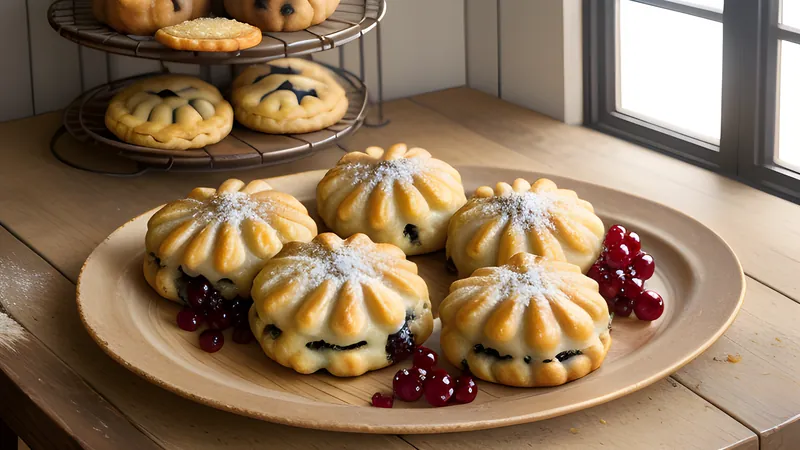
↓ Jump to recipeThe Eccles cake is one of those defiantly regional British bakes that has somehow never gone national in the way it deserves. Outside the north-west of England you can struggle to find a good one, which is a shame, because at their best they are extraordinary: a flat, blistered disc of impossibly flaky pastry, crusted with crunchy sugar, hiding a dark, spiced, almost boozy heart of buttery currants. Some people call them fly cakes or fly pies on account of the dark fruit showing through the pastry, which is the sort of affectionate, unglamorous name only a genuinely good thing earns.
A small cake with a long memory
Eccles cakes take their name from the town of Eccles, now part of Greater Manchester, where they have been sold since at least the late eighteenth century. James Birch is usually credited with first selling them commercially from his shop on the corner of Vicarage Road around 1793, and they quickly became tied to the local wakes and religious feast days. There is a longer thread of Puritan disapproval behind them: under the Commonwealth in the 1650s, cakes and pastries associated with saints’ days and feasts were frowned upon and in places suppressed as too frivolous and pagan, which is the kernel of truth behind the oft-told story that Eccles cakes were “banned”. They survived, as good cakes do.
They belong to a small family of British currant pastries that includes the Chorley cake, made with a plainer shortcrust and less sugar, and the Banbury cake from Oxfordshire, which is more oval and spiced with a slightly different hand. Each town is quietly convinced its own version is best, and the argument has been going on for two centuries. The fruit-through-thin-pastry look they all share is what earned Eccles cakes their affectionate local nicknames, “fly cakes” or “dead fly pies”, on account of the dark currants showing through, the sort of unglamorous name only a genuinely good thing earns.
Eccles Cakes with Currants and Flaky Butter Pastry
Ingredients
- 375g all-butter puff pastry (or rough puff, see below)
- 50g unsalted butter
- 75g soft dark brown sugar
- 200g currants
- Zest of 1 orange
- 0.5 tsp mixed spice
- 0.25 tsp ground nutmeg
- 1 tbsp dark rum (optional)
- 1 egg white, lightly beaten, to glaze
- 2 tbsp demerara sugar, to finish
Method
- Melt the butter with the brown sugar, then stir in the currants, orange zest, mixed spice, nutmeg and rum. Leave to cool and thicken.
- Roll the pastry to about 3mm thick and cut out eight 12cm rounds.
- Place a heaped tablespoon of the currant mixture in the centre of each round.
- Gather the edges of the pastry up over the filling and pinch firmly to seal into a parcel.
- Turn each parcel sealed side down and gently flatten with your palm into a disc, letting a few currants show through.
- Cut three short slashes across the top of each, brush with egg white and sprinkle generously with demerara sugar.
- Chill the cakes for 15 minutes, then bake at 200C fan for 18 to 20 minutes until puffed, deep golden and crisp.
- Cool on a wire rack until just warm before eating.
Pastry: buy it or make it
You have two honest choices here. The genuinely time-poor should buy a good all-butter puff pastry, and there is no shame in it; the filling does most of the work. But if you have an hour and the inclination, a quick rough puff is worth the effort and not remotely difficult.
For a rough puff to make the 375g you need, rub 100g of cold cubed butter into 200g plain flour and a pinch of salt, leaving plenty of pea-sized lumps of butter visible rather than rubbing it fully in. Bind it into a rough, shaggy dough with about 100ml of ice-cold water. Roll it out into a long rectangle on a floured surface, fold it into thirds like a letter, give it a quarter-turn, and roll and fold again. Do this three or four times in total, chilling for 15 minutes if the butter starts to soften, then rest the finished dough in the fridge for 30 minutes. Those visible streaks of butter melt in the oven and throw off steam, forcing the dough apart into flaky layers without the laborious folding-in of a full puff. Keep everything cold, work fast, and you will get pastry that shatters in a shower of buttery shards. If you enjoy this sort of layered pastry-making, the same cold-butter, laminated logic drives my Danish pastry dough, taken a good deal further.
Shaping the parcels
The method is satisfyingly low-tech. Spoon a generous mound of the cooled, thickened currant filling into the centre of each pastry round, gather the edges up and over like a little drawstring purse, and pinch them firmly shut. Then turn the parcel over so the seam is underneath and squash it gently flat with your palm. This is the moment the Eccles cake takes its characteristic shape: a flat disc with the currants pressing up against the thin pastry, a few of them peeking through. Do not overfill or they will burst in the oven, though a little leakage is traditional and tasty.
The sugar crust matters
The three slashes cut across the top are not just decoration; they let steam escape so the pastry rises in flaky layers instead of bursting at the seam. Make them shallow, cutting through only the top layer of pastry rather than deep into the filling, so the currants stay put. Brushing with egg white rather than whole egg, then showering with demerara sugar, gives you that signature crunchy, glittering top that crackles when you bite it. Egg white is used deliberately: whole egg with its yolk gives a deep, almost mahogany glaze that can look and taste heavy, while egg white alone dries to a clear, slightly tacky surface that grips the sugar and bakes to a pale gold, letting the demerara do the browning. Demerara, with its large, hard crystals, is the right sugar too; caster would dissolve and disappear, where demerara stays crunchy and catches the heat into little caramelised nuggets. Chill the shaped cakes for 15 minutes before baking so the butter is firm and the pastry puffs properly in the heat rather than melting into a flat, greasy slab.
Eating and keeping
Eat them just warm, when the pastry is at its crispest and the filling still slightly molten, ideally with a strong cup of tea and, if you want to do it the Lancashire way, a slice of crumbly Lancashire cheese alongside. The salty cheese against the sweet spiced fruit is one of those odd, perfect pairings that sounds wrong and tastes completely right. It is the same sweet-and-salty logic I keep coming back to, whether it is Lancashire cheese here or the flaky salt scattered over a batch of brown butter chocolate chip cookies.
They keep for a couple of days in an airtight tin, though the pastry loses a little of its crispness by the second day. Refresh them for 5 minutes in a 160C fan oven to bring the crunch back. They also freeze well unbaked: shape and slash them, freeze on a tray until solid, then bag them up, and bake straight from frozen with an extra 3 to 4 minutes on the time.
Substitutions and variations
Currants are traditional and best here, their concentrated, slightly tart flavour standing up to the spice, but you can use half sultanas or raisins for a milder, sweeter filling. Currants are dried from small, seedless Zante grapes and are not the same as the fresh blackcurrants or redcurrants you might grow in the garden, a confusion that trips up more cooks than you would think; buy dried currants, not fresh. Lemon zest works in place of orange, and a splash of brandy or whisky stands in for the rum, each giving a slightly different note; brandy is warmer and fruitier, whisky drier and smokier. For a warmer, more autumnal cake, push the mixed spice up to a full teaspoon and add a pinch of ground cinnamon. If you would rather keep it non-alcoholic, replace the rum with a tablespoon of orange juice; you lose a little of the caramelised depth but gain a fresher, brighter filling.
Where they go wrong
Two things spoil an Eccles cake. The first is overfilling: a heaped tablespoon is generous, and any more will burst the pastry and leak sugar all over the tray, where it burns. A little visible leakage is traditional and tasty; a blowout is not. The second is warm, soft pastry going into the oven, which melts before the layers can set and gives you a flat, greasy cake instead of a puffed one. Chilling the shaped cakes for 15 minutes before baking, so the butter is firm again, is the fix, and it is the same discipline that keeps any all-butter pastry crisp rather than collapsing, whether it is these or a fruit-filled bake like a blackberry and apple pie. Get those two right and they will puff, blister and glitter exactly as they should.
Related Content