Dutch Baby Pancake with Lemon and Powdered Sugar
A puffed, golden cloud from one hot pan
Contents
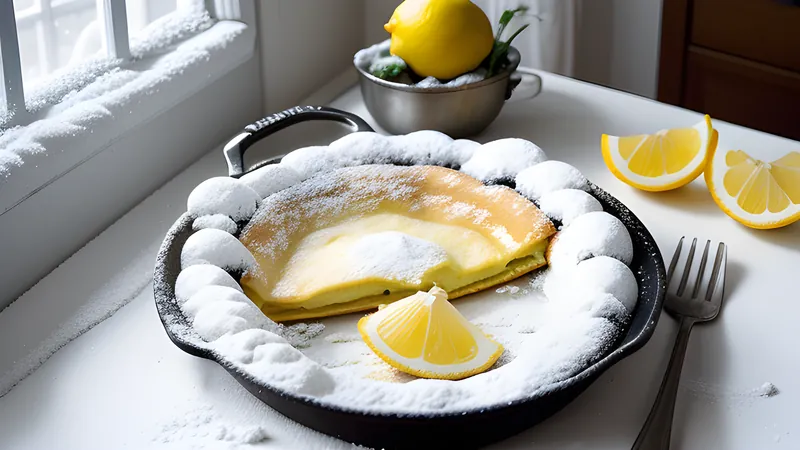
↓ Jump to recipeA Dutch baby is the most theatrical thing you can make for breakfast with so little effort. You blend a thin batter, pour it into a screaming hot buttery pan, and twenty minutes later it billows up the sides into a crisp, golden, custardy crater. It collapses the moment it leaves the oven, which is half the fun. A squeeze of lemon, a heavy dusting of icing sugar, and that is breakfast sorted. My one small twist is folding lemon zest into the batter itself, so the brightness runs all the way through.
Dutch Baby Pancake with Lemon and Powdered Sugar
Ingredients
- 3 large eggs, at room temperature
- 80g plain flour
- 120ml whole milk, at room temperature
- 1 tbsp caster sugar
- 0.25 tsp fine salt
- 1 tsp vanilla extract
- Finely grated zest of 1 lemon (the twist)
- 40g unsalted butter
- Icing sugar, to dust
- 1 lemon, cut into wedges, to serve
Method
- Place a 25cm ovenproof frying pan or skillet in the oven and heat to 220C fan.
- Blend the eggs, flour, milk, caster sugar, salt, vanilla and lemon zest until completely smooth, then rest for 10 minutes.
- Carefully add the butter to the hot pan and swirl until melted and foaming, coating the base and sides.
- Pour the batter into the centre of the hot pan and return it to the oven immediately.
- Bake for 18 to 20 minutes, without opening the door, until dramatically puffed and deep golden at the edges.
- Dust generously with icing sugar and serve at once with lemon wedges to squeeze over.
Method
- Slide a 25cm ovenproof frying pan or skillet into the oven and heat to 220C fan. The pan must be properly hot before the batter goes in.
- Tip the eggs, flour, milk, caster sugar, salt, vanilla and lemon zest into a blender and blitz until completely smooth. Let the batter rest for 10 minutes; this relaxes the flour and helps the rise.
- Carefully pull out the hot pan, add the butter and swirl until it has melted and is foaming, coating the base and right up the sides.
- Pour the batter straight into the centre of the hot pan and return it to the oven at once.
- Bake for 18 to 20 minutes without opening the door. It will puff dramatically and turn deep golden at the edges.
- Dust heavily with icing sugar and serve immediately, with lemon wedges to squeeze over at the table.
What can go wrong, and why
The commonest disappointment is a Dutch baby that rises meanly or not at all, and it almost always traces back to temperature. Room-temperature eggs and milk matter more than you might expect: a fridge-cold batter hitting a hot pan cools the metal, generates steam more slowly, and rises far less enthusiastically. Take the eggs and milk out half an hour before you start, or warm the measured milk very briefly. The pan, meanwhile, needs to be properly, aggressively hot before the butter and batter go in, which is why it preheats empty in a hot oven; a lukewarm pan gives a lukewarm rise.
Resting the batter for 10 minutes is not optional either. It lets the flour hydrate fully and the gluten relax, and it lets any air whipped in by the blender settle, both of which give a taller, more even puff. And above all, do not open the oven door while it bakes. The rush of cool air can collapse it before the egg has set firmly enough to hold, and there is no recovering from that.
If the butter browns and burns in the pan before you get the batter in, you have left it too long; add it, swirl, and pour the batter in promptly. A little browning is good and adds a nutty note, the same reason I lean on browned butter elsewhere, but blackened butter tastes acrid.
Substitutions, variations and serving
The lemon-and-sugar finish is the classic, but a Dutch baby is a willing canvas. Soft fruit collapses beautifully on top: try 2 apples, peeled, sliced and cooked in the butter for 3 to 4 minutes before the batter goes in, or a handful of berries thrown on for the last 5 minutes of baking. For something richer, serve with a spoonful of crème fraîche and a drizzle of honey or maple syrup. A savoury version, made by leaving out the sugar and vanilla and adding 50g grated Gruyère and a scatter of thyme, then topped with a poached egg, makes a fine lunch and shares its logic with a cheese-and-egg dish like my buckwheat crêpes with ham, Gruyère and a fried egg.
If you cannot get lemon, orange zest works just as well, and a good pinch of ground cardamom folded into the batter is a lovely, less obvious twist. Plain flour is standard; a spoonful of it swapped for cornflour gives an even crisper edge. Whole milk gives the richest result, but semi-skimmed is fine, and a 50:50 mix of milk and water makes a slightly lighter, crisper pancake if that is what you are after. Whatever you use, keep the total liquid the same so the batter stays thin enough to climb the pan.
Scaling it up
One Dutch baby in a 25cm pan feeds two comfortably, or three at a stretch alongside coffee and fruit. It does not scale up within the same pan, though: pour a double quantity of batter into one pan and it will not rise properly, sitting thick and eggy in the middle rather than climbing the sides. If you are feeding four, the better route is two pans side by side in the oven, or making them in sequence, batter rested and ready, so each goes into a screaming-hot pan and comes out at its peak. A Dutch baby waits for no one, so time it to land as everyone sits down rather than trying to hold one warm.
If you want the same effortless, made-in-minutes breakfast feeling but with something you can cook to order for a crowd, the batter for lemon sugar crêpes is thinner and more forgiving and lets you keep a stack going. But for sheer drama from one pan, nothing beats watching a Dutch baby heave itself up the sides of the skillet through the oven door.
It is best eaten the instant it lands on the table, while the edges are crisp and the centre still soft and custardy. It does not keep, it does not reheat, and it does not need to. Make it, carry it straight to the table, squeeze the lemon over, and eat.
Related Content