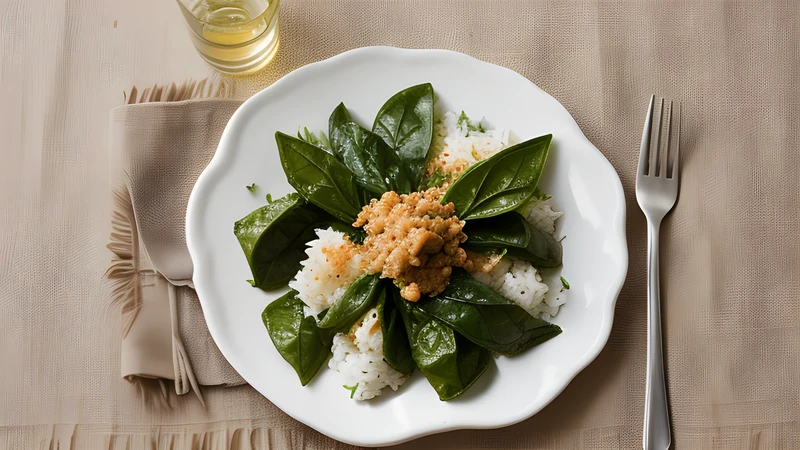
Dolmades: Vine Leaves Rolled Around Rice and Dill
An afternoon's rolling, a pot lined with lemon, and preserved lemon through the rice
Contents
↓ Jump to recipeNobody makes forty dolmades because they want dolmades. They make them because a certain kind of afternoon has presented itself: an hour and a half at a kitchen table, a pile of leaves, something to listen to. The rolling is the dish. Everything afterwards is just waiting.
These are the Greek dolmadakia yialantzi — small dolmades, meatless, olive-oil-cooked, served cold. The filling below carries one thing that would puzzle a grandmother in the Peloponnese: two tablespoons of chopped preserved lemon rind, which does something to the dill that fresh lemon juice cannot.
Dolmades: Vine Leaves Rolled Around Rice and Dill
Ingredients
- 1 jar (about 250 g drained) preserved vine leaves in brine, or 50 fresh young leaves
- 200 g short-grain rice (Greek glasse, Arborio or Calasparra)
- 120 ml Greek extra virgin olive oil, plus 3 tbsp to finish
- 2 large onions, very finely chopped
- 6 spring onions, finely sliced including the green
- 1 tsp fine sea salt
- 40 g fresh dill, finely chopped (about 2 large bunches)
- 20 g fresh mint leaves, finely chopped
- 20 g flat-leaf parsley, finely chopped
- 1 preserved lemon, flesh discarded, rind rinsed and chopped to a fine dice (about 2 tbsp)
- 2 tbsp pine nuts
- 1 tbsp dried currants
- Juice of 1 lemon (about 40 ml), for the filling
- Black pepper
- 1 lemon, sliced into 5 mm rounds, for lining the pot
- 500 ml hot water
- Juice of 1 more lemon (about 40 ml), for the braise
- Thick Greek yoghurt, to serve
Method
- If using brined leaves, unroll them gently and put them in a bowl. Pour over boiling water, leave 5 minutes, drain and rinse under cold water. Taste a leaf: if it is still salty, repeat. If using fresh leaves, blanch them in boiling water for 30 seconds until they turn olive-drab, then refresh in cold water.
- Snip the hard stem off each leaf with scissors. Set aside any torn leaves and the smallest ones for lining the pot.
- Rinse the rice in a sieve under cold water for 30 seconds, until the water runs nearly clear. Drain well.
- Heat 120 ml olive oil in a wide pan over a medium-low heat. Add the onions, spring onions and 1 tsp salt and cook gently for 15 minutes, stirring, until completely soft and translucent with no colour at all.
- Stir in the pine nuts and currants and cook 2 minutes, then add the drained rice and stir for 2 minutes so every grain is coated in oil.
- Take off the heat. Stir in the dill, mint, parsley, preserved lemon dice, the juice of 1 lemon and a heavy grind of black pepper. The rice stays raw. Cool for 15 minutes.
- Line the base of a heavy 24 cm pan with the torn leaves and the lemon rounds.
- Lay a leaf vein side up, stem end towards you. Put 1 heaped teaspoon of filling in a short line near the stem end. Fold the bottom over it, fold both sides in, then roll away from you into a cigar about 6 cm long. Roll firmly enough to hold, loose enough that a thumb can dent it — the rice needs room to double.
- Pack the dolmades seam side down into the pan in tight concentric circles, building a second layer once the first is full. They should be snug enough to hold each other still.
- Pour over 500 ml hot water and the juice of the second lemon. The liquid should just reach the top layer.
- Set a heatproof plate directly on top of the dolmades to weigh them down. Bring to a bare simmer, cover the pan, and cook on the lowest heat for 45-50 minutes.
- Check one from the centre: the rice should be fully tender with no chalk. If it is not, add 100 ml hot water and give it another 10 minutes.
- Take off the heat, pour the last 3 tbsp of olive oil over, and leave the plate in place. Cool in the pan for at least 1 hour.
- Serve at room temperature with thick yoghurt and more lemon.
Where they come from, and the argument about that
The word is Turkish. Dolma, from dolmak, to be filled. That etymology causes real feeling in Greece, and the honest position is that it settles nothing about origin. The Ottoman court kitchens standardised and named a great many things across five centuries, and stuffed-leaf cookery in the eastern Mediterranean is older than the Ottomans by a long way. Athenaeus, writing around 200 AD, describes thrion — fig leaves wrapped around a stuffing. The Byzantines were doing it before Constantinople fell.
What is fair to say is that the version below is Greek in its details. The mountains of dill are Greek. The olive-oil braise, the room-temperature serving, and the classification as a ladero — a dish where oil is the cooking medium and the flavour both — put it squarely in the Lenten repertoire, and dolmadakia yialantzi appear on Greek tables in enormous quantities during Great Lent for that reason. Yialantzi is another Turkish loan: yalancı, meaning “liar”, because the dolma is pretending to have meat in it. The lie is affectionate.
The Armenian, Turkish, Azerbaijani, Lebanese and Egyptian versions all differ in ways that matter to the people making them: cinnamon or no cinnamon, allspice, currants, dried mint, meat, tomato. Everyone is right in their own kitchen.
The leaf
Fresh vine leaves are best and available for about six weeks in late spring, when the leaves are the size of your palm and still pliable. Anything older is leathery and veined and will not soften.
Realistically you buy a jar. Brined leaves are a genuinely good product — they are picked at the right stage and preserved immediately — with one problem, which is the salt. Jarred leaves are packed in something close to a saturated brine, and if you roll straight out of the jar the finished dolmades will be inedible. Boiling water for five minutes, drained, then tasted, then repeated if needed. Taste. Brands vary enormously.
Snip the stem hard against the leaf. The stem is the piece that punctures the roll from the inside as it tightens.
Rolling: the two errors
The first error is too much filling. A heaped teaspoon looks derisory in a large leaf and it is correct. Raw rice roughly doubles as it cooks, and a dolma packed generously will burst its seam and empty into the pot.
The second error is rolling tight. Every instinct says tight, like a spring roll. It should be firm enough to hold shape when you lift it and slack enough to take a thumbprint. The rice needs somewhere to go.
The concentric packing in the pan is structural. Dolmades hold each other closed; a pan with gaps in it produces unrolled dolmades. If you run out before the pan is full, pack the space with lemon rounds and spare leaves.
The plate on top is the piece people skip and should not. Vine leaf parcels are buoyant and will bob and unroll in the braising liquid. A heatproof plate the diameter of the pan holds them under and turns forty separate objects into one solid mass that cooks evenly.
Why the rice goes in raw
The filling is a raw-rice mixture: the grains are sweated in oil with the onion, coated, and stopped. All the actual cooking happens inside the leaf, where the rice absorbs the braising liquid through the leaf wall along with everything dissolved in it. Precooking the rice gives you two cooked-rice textures fighting each other and a filling that will not bind.
Short-grain matters. Its high amylopectin content is what makes the cooked filling cohere into a sliceable plug rather than falling out in loose grains, the same property that carries stuffed peppers with rice, feta and herbs. Basmati produces a dolma that disintegrates on the plate.
The dill quantity is deliberate: 40 g is two supermarket bunches and it will look absurd going in. Dill’s volatile carvone and limonene fade quickly under heat, so you overload at the start to have any left at the end.
The preserved lemon
Fresh lemon juice contributes acid, and the acid leaves with the steam. Preserved lemon contributes something else — the rind has been sitting in salt for a month, its bitterness fermented out, and what remains is the oil-heavy peel with a rounded, almost floral sourness that survives 50 minutes of braising. It is a Moroccan ingredient in a Greek dish and it earns its place because dolmades are eaten cold, and cold food needs a louder acid than warm food does.
Discard the flesh, rinse the rind, dice it finer than you think. Two tablespoons across forty parcels is a background hum. If you have none, double the fresh lemon juice in the filling and add the zest of a whole lemon.
What the leaf itself contributes
The vine leaf does real work of its own, and swapping it for cabbage or chard gives you a recognisably different dish rather than a substitution.
Grape leaves are high in tannins — the same class of compounds that make red wine dry your mouth — and blanching or brining knocks the level down to something pleasant while leaving plenty behind. That residual astringency is the reason dolmades taste faintly like the vineyard they came from, and it is what stops a parcel of oily, herby rice from reading as cloying. Cabbage leaves have none of it, which is why Balkan sarma compensates with sauerkraut, smoked meat or a sour tomato broth.
There is a second, more practical property. Vine leaves are structurally reinforced with a dense network of veins and a thick cuticle, so they hold together through 50 minutes of braising in a way that spinach or chard simply will not. The leaf functions as a semi-permeable membrane: it lets the braising liquid in to cook the rice, and it holds the rice, oil and herbs in.
The trade-off is size. A jarred leaf is picked young and runs about 12-15 cm across, which produces a finger-sized dolmadaki and a rolling session of about ninety minutes for a full pan. Larger leaves make larger parcels, cook unevenly, and are generally reserved for the meat-filled versions.
Pine nuts, currants, and the Constantinople accent
The pine nuts and currants are optional in the Peloponnese and near-compulsory in any recipe with a Constantinopolitan lineage, which includes most of the good ones.
The combination is an Ottoman-court signature that spread across the whole eastern Mediterranean — it appears in Turkish iç pilav, in Sicilian cooking via the Arabs, in Venetian sarde in saor. The logic is textural as much as anything: a filling of soft rice and soft herbs has no incident in it, and a currant that bursts sweet against a bland grain, or a pine nut that gives a fraction of resistance, gives the mouth something to notice.
Toast the pine nuts for the two minutes specified and no longer. They are around 68 per cent fat, much of it unsaturated, and they cross from golden to acrid faster than any other nut in a domestic kitchen. Currants — the small dried Corinth grapes that gave the word its name, from raisins de Corinthe — are correct here; sultanas are three times the size, blow out of proportion, and taste of the sulphur they were dried with.
Making forty of anything
Practicalities, because this is the part that decides whether you do it again.
The filling can be made a full day ahead and refrigerated, which turns a three-hour job into two ninety-minute ones. It is easier to roll cold, since the mixture is firmer and stays where the leaf puts it.
Set up properly before you start: leaves in a stack to your left, filling in a bowl in front, pan on the right, and a small bowl of water for your fingers. The first six will be bad and the last thirty will be uniform, which is the standard learning curve for any rolling job, and it is why Greek households do this with two or three people at a table and it takes an afternoon rather than an hour.
Any leftover filling is excellent stuffed into halved tomatoes or peppers and baked at 180C for 45 minutes with a splash of water in the tray — which is essentially gemista, and nothing is wasted.
Why they are served cold
Dolmadakia yialantzi go on the table at room temperature, always, and this is the detail that separates them from every meat dolma in the region.
The reason is olive oil. There are 120 ml of it in the filling and another three tablespoons poured over at the end, and extra virgin olive oil is a liquid whose whole character is aromatic. Served hot, those aromatics blow off in the steam and the parcel tastes greasy. Served at 20C, the oil has thickened very slightly, it coats the rice, and the grassy, peppery notes arrive intact. This is true of the entire ladera family — the Greek oil-cooked vegetable dishes are a room-temperature cuisine by design rather than by accident of catering.
Cooling in the pan under its plate is part of the cooking. As the temperature drops the rice’s starch retrogrades slightly and firms, the leaf tightens around it, and the remaining braising liquid is drawn into the parcel instead of evaporating. An hour is the minimum. Overnight is better.
Which means the fridge is a compromise rather than a home. Take them out a full hour before you want them, or the solidified oil will taste of candle wax and you will have wasted an afternoon’s rolling.
Faults, storage and variations
They burst. Overfilled, or the water boiled rather than shivered.
The rice is chalky. Underdone. Add 100 ml hot water and go another 10 minutes; there is no other fix, and a chalky dolma is unrescuable once cold.
They fell apart lifting them out. Cool them in the pan completely. They set as they cool, and a hot dolma has no structure.
Storage. Five days refrigerated, and better on day two. Bring them to room temperature for an hour before serving — cold from the fridge, the olive oil is solid and tastes of nothing. They freeze poorly; the leaf goes to mush.
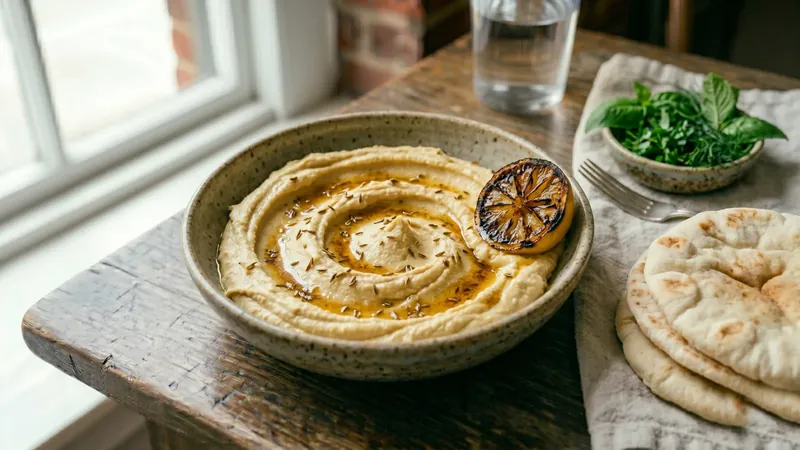
Variations. Add 1/2 tsp ground cinnamon and 1/4 tsp allspice for a Constantinopolitan filling. Swap half the water for tomato juice for the Turkish style. Meat versions use 250 g minced lamb with the rice cut to 120 g and cook 15 minutes longer. Serve them alongside charred lemon hummus and olives and the afternoon has justified itself.
Related Content