Deruny: Ukrainian Potato Pancakes With Soured Cream
Grated raw potato, one egg, and the starch you must not throw away
Contents
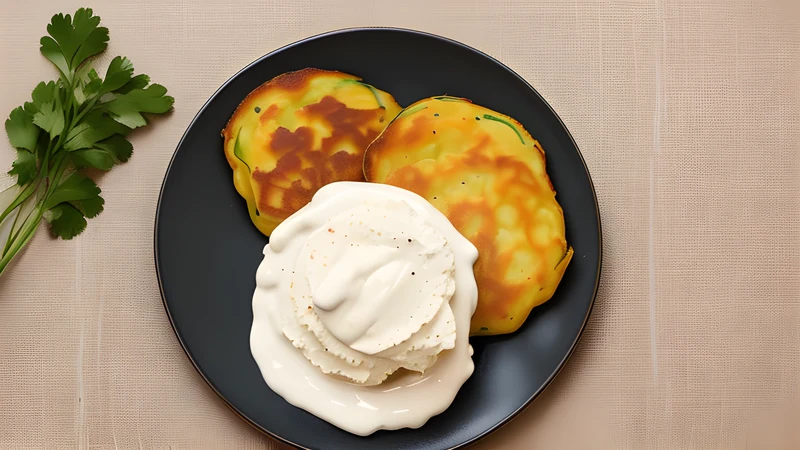
↓ Jump to recipeDeruny are grated raw potato fried in fat until the edges go lacy and brown and the middle stays soft and slightly translucent. Ukraine eats them for breakfast, for lunch, as a side, and as a bed for mushroom sauce or braised meat. Zhytomyr holds a festival for them. There is a monument to them in that city, which tells you where the dish sits in the national affection.
The whole recipe hinges on one operation most people skip: you wring the water out of the grated potato, then reclaim the starch that settles out of that water and put it back. That reclaimed starch is the binder. Get it right and you need almost no flour, and the pancakes come out crisp instead of pale and floppy. Get it wrong and you are making a potato omelette.
Deruny: Ukrainian Potato Pancakes With Soured Cream
Ingredients
- 1kg floury potatoes (Maris Piper or King Edward), peeled
- 1 medium onion (about 120g), peeled
- 1 large egg
- 2 tbsp plain flour
- 1.5 tsp fine sea salt
- 0.5 tsp white pepper
- 2 garlic cloves, crushed to a paste
- 60ml sunflower oil, for frying
- 30g lard, for frying
- 250g thick soured cream, to serve
- 1 small bunch dill, chopped, to serve
- 100g smoked streaky bacon, cut into lardons (optional topping)
Method
- Set a large bowl on the worktop. Grate the potatoes on the fine side of a box grater (the small teardrop holes, not the coarse shreds) straight into the bowl. Grate the onion into the same bowl as you go.
- Work fast. Grating the onion in among the potato slows the browning, because onion juice contains sulphur compounds that inhibit the enzyme that turns potato grey.
- Tip the grated mixture into a clean tea towel or a double layer of muslin over a second bowl. Gather it up and wring it hard for 30 seconds. Keep every drop of the liquid.
- Leave the wrung liquid to stand for 3 minutes. A dense white layer of starch will settle at the bottom of the bowl.
- Pour off and discard the cloudy water on top, keeping the white starch paste stuck to the base of the bowl.
- Scrape the wrung potato back into the bowl with the reclaimed starch. Add the egg, flour, salt, white pepper and crushed garlic. Mix thoroughly with a spoon.
- Heat the oil and lard together in a wide, heavy frying pan over a medium-high heat until a shred of potato dropped in sizzles immediately and vigorously (about 175C).
- Drop heaped tablespoons of the mixture into the fat and flatten each to a rough disc 8-9cm across and 5mm thick. Fry 3-4 at a time; do not crowd the pan.
- Fry for 3-4 minutes on the first side, until the underside is deep golden brown and the edges have gone lacy and crisp.
- Flip once and fry for 2-3 minutes on the second side.
- Lift onto a wire rack set over a tray, salt lightly, and keep warm in a 120C oven while you fry the rest. Never stack them on kitchen paper in a pile.
- If using bacon, fry the lardons separately from cold until crisp and scatter over.
- Serve hot with cold soured cream and chopped dill.
Where deruny come from
The potato reached Ukraine late — the 1760s in any quantity, pushed by imperial decree, and resisted for a generation by peasants who suspected it of being poisonous and were vindicated by anyone who ate the green parts. By the mid-nineteenth century it had won, because it yielded more calories per hectare than rye on soil that rye struggled with, and because it survived in a cellar until spring.
Deruny follow from that. The name comes from derty, to tear or to grate — the dish is named after the verb that makes it. It belongs to the northern woodland belt, Polissia and Zhytomyr especially, where the soil is sandy and poor and the potato did better than the grain. Zhytomyr now runs an annual deruny festival and has erected a monument to the pancake, complete with a bronze pot, which is either civic pride or a very long joke.
The dish carries a hard edge of history. During the Holodomor, the famine of 1932-33, grated potato stretched with whatever was to hand was one of the few things a household could still make from what the requisition brigades had missed. Ukrainian food writing does not treat deruny as light comedy for this reason. It is a dish that fed people when there was nothing.
What survives from the poverty version is the technique. No milk, no butter in the mixture, minimal flour, one egg — deruny are built to be made from potatoes, an onion, and whatever fat existed. Everything on top of them is a later addition, and every one of those additions is optional.
Grate fine, and understand why
There are two schools of potato pancake. The Swiss rösti and the Jewish latke are coarse-shredded, so you get visible strands and a tangle with air in it. Deruny are fine-grated, and the correct texture is close to a wet pulp with body — some grain, no long strands.
The fine side of a box grater is the one with the small raised teardrop holes that most people never use. It shreds cell walls open and releases a lot of starch and a lot of water, which is exactly what you want: the starch is the glue and the water is the problem.
A food processor with a fine grating disc works and is much faster. A blender does not; it liquidises, the cells rupture completely, and you get a batter that fries into rubbery discs.
Ukrainian cooks argue about the fineness. Around Zhytomyr they go fine enough that the raw mixture is almost a purée. In the west it is coarser. My preference is fine, because I want the lace edge, and the lace edge is made of starch and small particles that crisp fast.
The starch reclamation
Here is the step that separates deruny from disappointment.
A kilo of potatoes is about 78% water and about 17% starch. When you grate fine and wring, you pull out roughly 200-250ml of liquid. That liquid is a suspension of potato starch granules, released when you cut the cells open. Throw it away and you throw away a substantial fraction of your binder.
So: wring hard into a bowl. Let it stand three minutes. Starch granules are much denser than water and they drop out fast, forming a firm, chalk-white layer welded to the bottom of the bowl. Pour the grey-brown water off the top — carefully, it will look like nothing is stuck down but it is — and you are left with maybe two tablespoons of dense white paste.
Scrape that back into the potato. It rehydrates in the mixture and, in the pan, it gelatinises and sets, holding everything together and browning into the crisp lace at the rim.
Two consequences. First, you barely need flour — the two tablespoons in the recipe are insurance, and a confident cook uses one or none. Every extra spoonful of flour makes the pancake more bready and less potato. Second, the mixture must be wrung genuinely dry, because free water in the pan turns to steam and steam is what stops a surface crisping. A soggy mixture gives you a pale, floppy disc that has boiled itself from the inside.
Grey potato and how to stop it
Grated raw potato turns pink, then grey, then a distinctly unappetising brown-grey within about ten minutes. This is enzymatic browning — polyphenol oxidase in the potato meets oxygen and produces melanins, the same reaction that darkens a cut apple.
Three things slow it, and you should use all three.
Speed. Have your bowl, cloth and pan ready before the first potato touches the grater. The whole sequence from grating to frying should take under fifteen minutes.
The onion. Grate it in among the potato as you go, rather than at the end. Onion juice is full of sulphur-containing compounds that inhibit polyphenol oxidase directly. This is the traditional trick and it works. Deruny made with the onion grated in early stay visibly paler than ones made with it added afterwards.
The egg and salt. Both go in the moment the mixture is back in the bowl and both slow things down further.
A little greyness is normal and cooks out to gold in the pan. A mixture left to sit for half an hour will fry brown-grey and taste faintly metallic. Do not make the mixture ahead. This is a dish you commit to.
Fat, temperature and the pan
Use a mix. Sunflower oil alone is fine and neutral. Lard alone tastes wonderful and smokes at a lower point. Sixty millilitres of oil with 30g of lard gives you a fat that holds 175°C comfortably and carries pork flavour into the crust. In Ukraine the fat of choice is rendered salo, and if you have some in the fridge this is one of the best uses for it.
Enough fat matters. The pancakes want to sit in about 4-5mm of fat — shallow-frying rather than dry-frying. Too little and the edges never get the immersion they need to go lacy; they just toast. Top the pan up between batches and let it come back to temperature.
175°C, and hold it. Below about 160°C the pancake absorbs fat and goes greasy before it browns. Above 190°C the outside burns while the interior is still raw potato, which is unpleasant and slightly chalky. A shred of the mixture dropped in should sizzle hard and immediately. Three or four pancakes at a time, never more — each one you add drops the fat temperature, and a crowded pan is the most common cause of pale, oily deruny.
5mm thick, 8-9cm across. Thicker and the middle stays raw when the outside is done. Thinner and there is no soft interior at all, which loses the contrast that makes the dish.
One flip. Turning them repeatedly breaks the setting starch crust before it has set. Leave the first side alone for a full three minutes.
Wire rack, never a stack. Pancakes piled on kitchen paper steam each other, and a crisp derun goes soft in about ninety seconds under another one. A rack over a tray in a 120°C oven holds a full batch for twenty minutes with the crust intact.
What goes wrong
They fell apart in the pan. Not enough binder — you poured off the reclaimed starch, or the mixture was too wet. Add a spoonful of flour and press them firmer.
They’re greasy. The fat was too cool, or you crowded the pan. Both are the same failure: temperature.
They’re pale and floppy. Under-wrung potato. Steam beat the crust.
They taste of nothing. One and a half teaspoons of salt in a kilo of potato is a starting point, and potato takes a lot of seasoning. Salt again as they leave the pan.
Cousins across the border
The same idea appears everywhere the potato grew well and money was short. Belarus makes draniki, effectively the same pancake and a matter of some national pride. The Czech bramborák loads in marjoram and far more garlic. Sweden’s raggmunk adds milk and flour to make a genuine batter and serves it with pork and lingonberry.
The differences are small and the arguments are large. What is consistent is the logic: cheap tuber, a hot pan, some fat, and something sour on top to cut it.
The case against
Deruny are labour that does not scale. Fourteen pancakes fried three or four at a time is twenty-five minutes standing at a spitting pan, and they must be eaten within minutes of leaving it. Cooking them for six people means you eat last and alone. This is a dish for two or three, or for a household that eats in the kitchen in shifts.
They are also, unavoidably, fried potato. A generous plate of them is a lot of oil and starch, and the soured cream on top is not lightening the load. The dill and the sharpness of the cream are doing what they can. A tomato salad or something pickled on the side does more.
Serving and storage
The classic accompaniment is cold thick soured cream and dill, and the temperature contrast is the point. Crisp bacon is a common addition. In Zhytomyr you will meet them under a mushroom and soured cream sauce, which is excellent, and stuffed with meat as deruny z m’yasom, which turns them into a meal.
They keep badly. The fridge softens them within an hour and reheating in a microwave produces something limp. If you must, a wire rack in a 200°C oven for six minutes brings back most of the crust. Better to make what you will eat.
Cooked deruny freeze acceptably in a single layer, and go straight from the freezer into a 200°C oven for twelve minutes. They come out about 80% as good, which on a Tuesday morning is a rate I will take.
Related Content