Daube Provençale: The Slow Beef of the South
Beef shin in red wine and orange peel, with two anchovies doing the quiet work
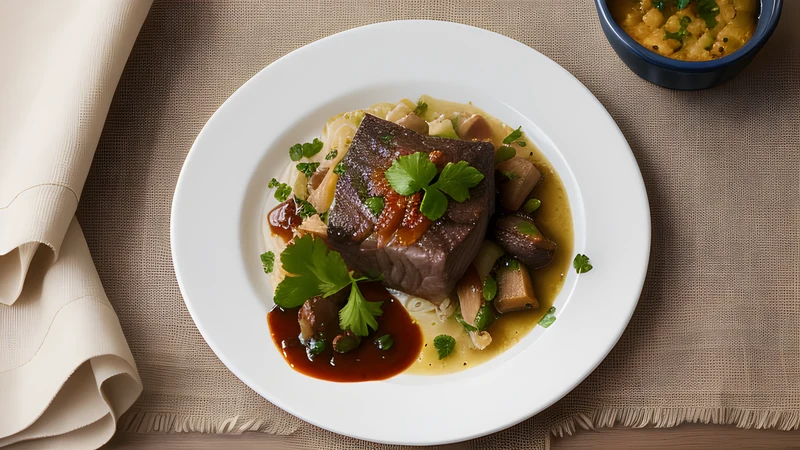
Contents
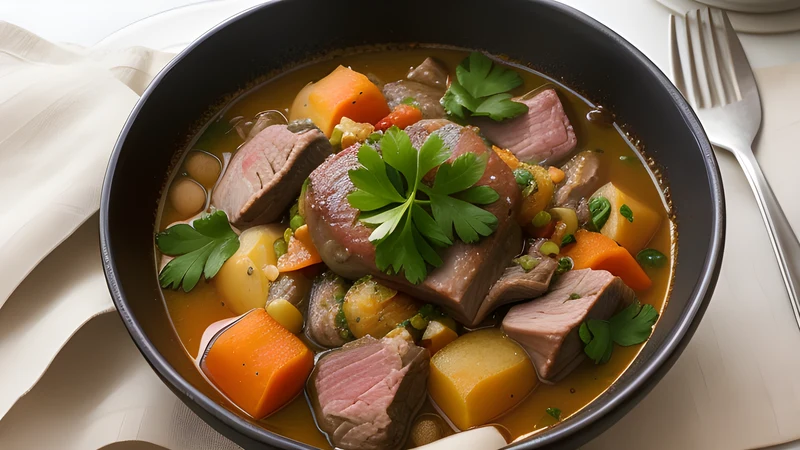
↓ Jump to recipeDaube is what Provence does with the animal that worked. The shin, the cheek, the shoulder — the parts that spent their life pulling something. Long muscle fibres wrapped in collagen, useless under a grill, transcendent after four hours in wine. The dish takes its name from the daubière, a bulbous glazed earthenware pot with a concave lid that was filled with embers so the heat came from above as well as below. The shape mattered: the narrow neck meant almost no evaporation, so the wine reduced slowly and the meat never dried at the surface. Most of us braise in a cast-iron casserole now, which works fine, but it’s worth knowing what the original pot was solving for.
Daube Provençale: The Slow Beef of the South
Ingredients
- 1.6 kg beef shin, cut into 5 cm chunks
- 750 ml red wine, a peppery southern one such as Côtes du Rhône
- 2 onions, halved and sliced 5 mm thick
- 3 carrots, cut into 2 cm rounds
- 6 garlic cloves, peeled and lightly crushed
- 2 wide strips orange peel, pared with a peeler, no white pith
- 3 bay leaves
- 4 sprigs thyme
- 1 tsp juniper berries, crushed
- 8 black peppercorns
- 2 cloves
- 3 tbsp olive oil
- 150 g smoked lardons or thick-cut streaky bacon, cut into 1 cm strips
- 2 salted anchovy fillets, rinsed
- 2 tbsp tomato purée
- 300 ml beef or chicken stock
- 1 strip dried orange peel, for the pot
- 16 stoned black olives, Niçoise or Taggiasca
- 1.5 tsp fine salt
- 0.5 tsp freshly ground black pepper
- 2 tbsp chopped flat-leaf parsley, to finish
Method
- The night before, combine the beef, wine, onions, carrots, garlic, orange peel, bay, thyme, juniper, peppercorns and cloves in a large bowl. Cover and refrigerate for 12 to 24 hours.
- Tip the marinade through a colander set over a bowl. Keep the liquid. Pick out the beef and dry every piece hard with kitchen paper — wet meat steams instead of browning. Keep the vegetables and aromatics separate.
- Heat the olive oil in a heavy casserole over medium-high heat. Brown the beef in three or four batches, 3 to 4 minutes a side, until deeply coloured. Move each batch to a plate. Do not crowd the pan.
- Lower the heat to medium. Add the lardons and cook 5 minutes until the fat runs and the edges crisp. Add the drained marinade vegetables and cook 8 minutes, stirring, until the onion slumps.
- Add the anchovy fillets and mash them against the base of the pot with a wooden spoon for 1 minute until they dissolve completely. Stir in the tomato purée and cook 2 minutes more.
- Pour in the reserved marinade liquid. Raise the heat and boil hard for 5 minutes, scraping the base. Add the stock, the beef and any resting juices, the dried orange peel, salt and pepper.
- Bring to a bare simmer — a bubble every two seconds, no more. Cover and cook in a 140C fan oven for 4 hours, until a fork slides into the beef with no resistance.
- Lift out the beef with a slotted spoon. Skim the fat from the surface, then boil the sauce uncovered for 10 to 15 minutes until it coats a spoon. Fish out the bay, thyme stalks and orange peel.
- Return the beef, add the olives and warm through for 5 minutes. Taste for salt. Scatter with parsley and rest the pot off the heat for 20 minutes before serving.
What separates a daube from a bourguignon
They look like cousins and they are, but the accents are different. Beef bourguignon is a northern dish: butter, mushrooms, pearl onions, a Burgundy that leans elegant. Daube is southern. Olive oil replaces butter. Orange peel and juniper come in. Olives arrive at the end. And the wine is a rougher, peppery Rhône or Provençal red with grenache in it — a wine with grip, which is what you want when it’s going to be boiled down and concentrated for hours.
The other structural difference is the overnight marinade. Bourguignon often skips it. Daube almost never does. Twelve hours in wine does two useful things: the acid loosens the surface proteins so the meat takes seasoning deeper, and the aromatics — juniper, clove, orange — get a head start that a four-hour braise alone can’t replicate. Juniper and clove are slow-release flavours. They need time in liquid before they’ll give anything up.
The two anchovies
Here’s the twist, and it’s the one thing in this recipe that people push back on before they taste it. Two salted anchovy fillets, mashed into the pot until they vanish.
Nobody will taste fish. What they’ll taste is that the beef tastes more like beef. Anchovies are cured for months, and that cure produces free glutamates and inosinates — the same compounds that make aged parmesan and dried mushrooms taste savoury and deep. Drop them into a red-wine braise and they do the work that a veal stock would do if you had one sitting in the fridge, which you don’t.
The technique matters more than the ingredient. Add the anchovies to hot fat with the onions already softened and press them flat against the base of the pot. They break down in under a minute. If you dump them into cold liquid instead, they’ll bob about as recognisable fish shapes and someone will find one and know. Melt them first.
Southern French cooking has always done this quietly. Anchovies underpin pissaladière, they’re the backbone of salade niçoise, and they turn up in Provençal lamb studs and daube variants across the region. The idea that anchovy is a background seasoning rather than a headline is not something I invented — it’s just something the recipe books tend to leave out of the daube.
Choosing the meat
Beef shin. Not braising steak, which is a supermarket euphemism covering four different cuts of varying quality. Shin is the foreleg, it’s the hardest-working muscle on the animal, and it has more collagen per gram than anything else in the butcher’s window. Collagen is the entire point of a braise: below about 70C it’s tough connective tissue, and above it, held there for hours, it dissolves into gelatine and gives the sauce a texture you cannot get from flour.
Ask for it cut into 5 cm chunks with the seam of connective tissue left in. Butchers sometimes trim it out to make the meat look nicer. Tell them not to. Cheek works too and is arguably better — silkier, more gelatinous — but it’s twice the price now that restaurants discovered it, which is a shame for those of us who remember it being cheap.
Whatever you buy, buy one third more than you think. Shin loses around 30 per cent of its weight over four hours. 1.6 kg of raw meat gives you six honest portions, and not much more.
The braise, in detail
Dry the meat. After a night in wine the beef is soaked. Pat every face of every chunk until the paper comes away barely damp. Water on the surface has to boil off before the meat can reach browning temperature, and while it’s boiling off, the pan is cooling and the meat is going grey. Three minutes with kitchen paper buys you the entire Maillard reaction.
Brown in batches. Four batches for this quantity, in a 28 cm casserole. Each chunk needs a centimetre of clear space around it. If the pan hisses and then goes quiet and starts to look like a stew, you’ve overloaded it — pull half out and start again.
Boil the wine hard. Five minutes at a proper rolling boil before the stock goes in. Raw wine in a braise tastes tinny and thin even after four hours, because the volatile compounds that make it taste raw are exactly the ones that don’t cook off at a simmer. Boil them away up front.
140C fan, lid on, four hours. The oven is better than the hob for this because the heat comes from every direction and you cannot accidentally scorch the base. You want the surface barely moving. A vigorous simmer squeezes the muscle fibres and gives you meat that’s technically tender and eats like sawdust — the collagen has melted but the fibres have wrung themselves dry.
Test with a fork. Four hours is a guide and the fork is the instrument. The daube is ready when a fork twisted in a chunk of shin meets nothing. If it resists, it needs another 30 minutes, and another after that if it still resists. Undercooked braise is the single most common failure and the only fix is time.
Reducing and finishing
Lift the beef out before you reduce. If you boil the sauce with the meat in it, the meat overcooks in the last fifteen minutes of hard heat and the pieces collapse into strings. Out it comes, into a bowl, covered.
Skim the fat properly. There will be a lot — shin is fatty, lardons are fatty, and it all rises. A ladle held flat on the surface takes off most of it. If you’ve made the daube a day ahead, the fat sets into a disc you can lift off in one piece, which is one of several reasons this dish is better on day two.
Then reduce until the sauce coats the back of a spoon and a finger drawn through leaves a clean line. This usually takes 10 to 15 minutes of open boiling. There’s no flour in this recipe and there shouldn’t be — the gelatine from the shin does the thickening, and it gives a glossy, lip-sticking body that a roux only imitates.
The olives go in at the end, warmed through for five minutes. Any longer and they leach brine into the sauce and turn it aggressive. Buy olives with stones still in and stone them yourself; pre-stoned olives sit in brine for months and taste of the jar.
Variations across the region
Daube is a family of recipes, and the variations tell you about the terrain.
Daube à l’avignonnaise swaps beef for lamb shoulder and drops the braise to two and a half hours. Lamb has less collagen and more fat; it gets there faster and falls apart if you push it to four.
Daube de sanglier uses wild boar and doubles the juniper. Boar is lean and gamey and the extra juniper is there to meet it rather than to perfume it. If you use farmed boar, which is most of what’s sold, add 100 g of extra lardons — it has almost no intramuscular fat.
Camargue daube finishes with a handful of small black olives and a spoon of capers, and is often made with bull beef from the Camargue herds. Bull is darker and coarser than steer and wants five hours.
Some cooks in the Var add a square of very dark chocolate at the end. It sounds like a stunt and it isn’t — bitter chocolate contributes tannin and a faint roasted note that reads as more depth. Ten grams for this quantity, stirred in during the final reduction, and nobody guesses.
The one variation I’d resist is thickening with flour, whether dusted on the meat before browning or whisked in at the end. Shin gives you all the body you need. Flour mutes the wine and gives the sauce a slightly chalky opacity where you want it glossy and translucent.
Storage, make-ahead and what to eat it with
Daube keeps four days in the fridge and improves for the first two. The gelatine sets the whole pot into a wobble you can cut with a spoon, which is normal and melts back on reheating. Warm it gently — 150C oven, covered, 40 minutes — rather than blasting it on the hob.
It freezes well for three months, though the olives go slightly leathery, so if you’re freezing deliberately, hold them back and add on reheating.
For the plate: in Nice the traditional partner is daube niçoise served over pasta with the sauce, which surprises people who expect potatoes. It’s a Ligurian inheritance and it’s excellent. Otherwise, gratin dauphinois if you want to be indulgent, boiled potatoes with parsley if you want the sauce to be the star, or a heap of soft polenta.
A word on the wine you drink alongside it, since it comes up. Match the weight rather than the region: the sauce has been reduced to something intense and slightly sweet from the orange, and a delicate red disappears against it. Drink what you cooked with. And make it the day before — the daube doesn’t care about your timetable, but you’ll enjoy the meal considerably more if you’re not standing over the pot at eight o’clock wondering whether the shin is done.
Related Content