Daifuku: Mochi Filled With Sweet Bean Paste
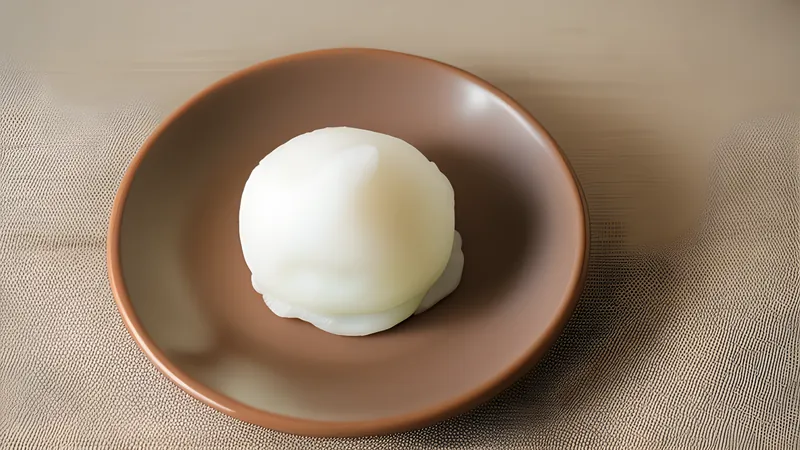
Pounded rice, dusted with starch, wrapped around cold anko
Contents
↓ Jump to recipeDaifuku: Mochi Filled With Sweet Bean Paste
Ingredients
- 150g mochiko (glutinous rice flour)
- 180ml water
- 50g caster sugar
- 1 tbsp honey
- 300g sweetened adzuki bean paste (anko), chilled
- 80g potato starch or cornflour, for dusting
Method
- Divide the chilled anko into 10 portions of about 30g each, roll into smooth balls, and keep covered in the fridge.
- In a microwave-safe bowl, whisk the mochiko, water, sugar and honey together until completely smooth with no lumps.
- Cover loosely with cling film and microwave on high for 1 minute, then remove and stir vigorously with a wet spatula.
- Microwave again for 1 minute, stir, then a final 30 seconds; the dough should turn from cloudy white to a translucent, glossy pale colour throughout.
- Dust a large tray or work surface generously with the potato starch.
- Turn the hot dough out onto the starch and dust the top; using a bench scraper or wet hands, divide into 10 equal pieces once cool enough to touch.
- Working with one piece at a time, dust off excess starch, flatten into a disc about 8cm across, and place a ball of anko in the centre.
- Gather the edges of the dough up and around the filling, pinching firmly to seal completely at the top.
- Turn the sealed daifuku seam-side down, dust off excess starch with a pastry brush, and set aside.
- Serve within a few hours at room temperature; do not refrigerate once made.
The name means great luck, and the shape used to mean something else
Daifuku translates roughly as “great luck,” a name attached sometime in the Edo period to a mochi that had previously gone by a much less flattering one — harabuto mochi, “fat-bellied mochi,” a reference to its round, swollen shape once filled. The rebrand from fat-bellied to lucky is a good snapshot of how Japanese confectionery names evolved: a shape that once read as slightly comic got reframed as auspicious once the filling (originally salted, only later sweetened with anko) made it popular enough to be sold widely rather than made only at home.
The rice used isn’t the same rice you’d cook for dinner. Mochiko is milled from glutinous rice — sometimes called sticky or sweet rice, though it contains no gluten at all; the name refers to its starch structure, which is almost entirely amylopectin rather than the amylose-amylopectin mix in regular rice. Amylopectin is what gives cooked glutinous rice its stretchy, cohesive texture instead of falling into separate grains, and it’s the reason mochi dough behaves like nothing else in a Western baker’s repertoire — pulling into long elastic strands rather than crumbling or setting rigid.
The microwave shortcut, and why it actually works
Traditional mochi is made by steaming glutinous rice and then pounding it in a large stone mortar with a wooden mallet, a physically demanding process (traditionally a two-person job, one pounding and one turning the dough between strikes) that develops the same starch structure a microwave method achieves far more easily. Steaming and pounding both apply heat and mechanical force to gelatinise the starch fully and align it into that stretchy, cohesive dough. A microwave delivers the heat; the vigorous stirring between bursts delivers enough of the mechanical work to get a genuinely good result without a mortar.
The colour change during microwaving is the real indicator to watch, more reliable than time alone because microwave wattages vary. Raw mochiko batter looks cloudy and opaque, almost like wallpaper paste. As the starch gelatinises fully it turns glossy and translucent, and this happens unevenly at first — a ring around the edge of the bowl will turn translucent before the centre does, which is exactly why the recipe stops for a vigorous stir between each burst, redistributing the translucent gelatinised dough from the edges into the still-opaque centre so the whole batch heats evenly rather than overcooking the rim while the middle lags behind.
Starch, not flour, for dusting
Potato starch (katakuriko) or cornflour dusts the work surface and the finished daifuku to stop the intensely sticky dough from welding itself to your hands, the tray, and itself. Plain flour doesn’t do this job well — it clumps and gets gummy on contact with the wet dough rather than staying a dry, slippery barrier. Use it generously; a light dusting isn’t enough to stop this particular dough from sticking, and it’s far easier to brush off excess starch at the end than to fight dough that’s stuck fast partway through shaping.
Working fast while the dough is still warm matters because mochi dough firms and becomes noticeably less pliable as it cools — a batch left to sit for ten minutes before shaping will crack at the edges when you try to stretch it around the filling rather than stretching smoothly. If it does cool too much to work, a very short 10-15 second blast in the microwave brings the pliability back.
Sealing properly, and why it matters the next morning
The pinch at the top where the dough gathers over the filling is the single point most likely to fail, and a poor seal shows up hours later rather than immediately — daifuku that looked fine when made can split open at that seam by the next morning as the dough continues to firm slightly and any weak point in the seal gives way under the pressure of the filling settling. Pinch firmly enough that the seam disappears into a smooth join rather than leaving a visible pucker or ridge; a visible seam is a weak one.
Because daifuku is meant to be eaten the same day it’s made — the texture is at its best within a few hours, when the wrapper is still at its softest and most pliable — refrigeration is worth avoiding specifically. Cold temperatures cause the starch in mochi to retrograde: the amylopectin chains that give mochi its stretch re-crystallise into a firmer, chalkier structure, the exact process that makes leftover rice go hard in the fridge, just more pronounced in glutinous rice. A refrigerated daifuku turns tough and slightly grainy within hours, a texture that doesn’t fully reverse even once it’s back at room temperature.
Weighing rather than eyeballing keeps every piece even
Daifuku dough firms as it cools, which means any piece shaped later in the batch than the first is working with slightly stiffer dough than the piece before it — the practical fix is to portion everything, both dough and filling, on a scale before you start wrapping rather than dividing by eye as you go. Weigh the full dough ball once it’s out of the microwave and divide that total by ten to get a consistent per-piece target, and do the same with the anko before you start rolling it into balls. Consistent portions mean consistent wrapping too: a piece of dough that’s noticeably thinner than its neighbours is far more likely to tear or leave a filling-thin patch that splits within hours.
Kinako and yomogi: the two other classic wrappers
Plain white daifuku, coloured only by the potato starch dusting, is the most common version, but two other wrappers turn up regularly on Japanese confectionery counters and are worth knowing if you want variety beyond the anko filling itself. Kinako daifuku swaps the potato starch dusting for roasted soybean flour, which clings to the mochi in a way that adds a nutty, faintly sweet coating rather than the neutral, purely functional starch dusting — it’s dusted on exactly the same way, generously, after shaping. Yomogi daifuku works the mugwort herb directly into the dough itself: blanched, finely chopped fresh mugwort (or a spoonful of dried mugwort powder, rehydrated) is kneaded into the mochi dough after the microwave stage, while it’s still warm and pliable, turning it a deep green and adding a slightly bitter, grassy note that’s traditionally paired with sweeter fillings like anko to balance it.
Filling variations and a strawberry note
Ichigo daifuku, with a whole strawberry embedded in the centre of the anko, is the best-known variation and works well with this method: push a hulled strawberry into the centre of each anko ball before wrapping, so the fruit sits fully enclosed rather than poking through the dough. Use slightly less anko per piece, around 20g, to leave room for the fruit without making the finished daifuku too large to wrap cleanly. A whipped cream and strawberry filling (no anko at all) is a modern café variation that swaps the traditional bean paste out entirely; it needs the daifuku eaten within an hour or two, since dairy filling doesn’t hold at room temperature as safely as bean paste does.
Mochi versus daifuku: a distinction worth keeping straight
In English-language writing the words mochi and daifuku often get used interchangeably, but in Japanese they mean different things and it’s a useful distinction to keep. Mochi is the pounded glutinous rice itself, the base substance, used in dozens of forms — grilled plain, dropped into soup, cut into bars, or wrapped around a filling. Daifuku is specifically the filled, ball-shaped confection this recipe makes: mochi is the material, daifuku is one particular thing built from it. Other mochi-based sweets, like the grilled, unfilled rice cakes served at New Year (kagami mochi) or added to soups like ozoni, use the same dough logic but none of the filling and wrapping steps that define daifuku specifically.
Troubleshooting a dough that won’t cooperate
A dough that stays cloudy and won’t turn glossy even after the full microwave time usually means the batter wasn’t whisked completely smooth before cooking started — any pocket of dry, unmixed mochiko will resist gelatinising properly even with extra microwave time, and extending the cooking time to compensate risks scorching the parts of the dough that are already fully cooked. The fix is prevention: whisk the raw batter until it’s completely uniform, checking the bottom and sides of the bowl where flour likes to hide, before it goes anywhere near the microwave.
A dough that tears the moment you try to stretch it around the filling, rather than stretching smoothly, is almost always a temperature problem rather than a recipe problem — it’s cooled too much since coming out of the microwave. Rather than fighting a cool, stiff piece of dough, give it a very short reheat, 10 to 15 seconds, which restores enough elasticity to stretch cleanly. Repeated small reheats through a batch of ten are completely normal and not a sign anything has gone wrong with the recipe itself.
A seasonal note
Daifuku shops in Japan rotate their fillings with the seasons far more than most Western bakeries rotate anything — strawberry daifuku appears specifically in late winter and early spring when strawberries are at their best, chestnut versions turn up in autumn alongside other kuri-flavoured sweets, and a lighter, more floral sakura-flavoured version (using salted cherry blossom leaves folded into the dough) is a spring-only item tied to cherry blossom season. None of this is essential to making good daifuku at home, but it’s worth treating the filling as changeable through the year rather than fixed to plain anko every time, in the same spirit those seasonal shop rotations follow.
Daifuku sits alongside taiyaki and dorayaki as one of the three classic anko vehicles worth knowing, and of the three it’s the one where the wrapper itself, rather than the filling, does most of the textural work. If mochi’s stretch has you curious about other pounded-rice desserts, butter mochi with brown butter and coconut uses the same glutinous rice flour baked rather than steamed, and a cup of matcha whisked properly is the standard pairing at any shop that sells daifuku by the box.
Related Content