Currywurst: Berlin's Sausage in Curried Tomato
A fried Bratwurst, a sauce built from bloomed spice, and the dusting that finishes it
Contents
↓ Jump to recipeCurrywurst is street food that has been argued about for seventy-five years. It is a fried Bratwurst, chopped into coins, drowned in a sweet-sour curried tomato sauce, and then — this is the part that everybody skips at home — dusted with dry curry powder on top of the wet sauce. That second dusting is the entire dish. Without it you have a sausage in tomato sauce; with it you have the smell that hits you outside every Berlin U-Bahn station at eleven at night.
The version below takes forty minutes and produces something considerably better than the Imbiss does, for the straightforward reason that most Imbiss stands squeeze the sauce out of a five-litre bottle of industrial curry ketchup. Building it yourself takes one pan and gives you a sauce with a bass line under the sugar.
Currywurst: Berlin's Sausage in Curried Tomato
Ingredients
- 4 good pork Bratwurst, about 120 g each
- 2 tbsp sunflower oil
- 1 large onion, finely chopped
- 2 garlic cloves, crushed
- 3 tbsp mild curry powder (a turmeric-forward German-style blend)
- 1 tsp sweet smoked paprika
- 1/2 tsp ground fenugreek
- 2 tbsp tomato purée
- 500 ml passata
- 60 ml apple juice
- 2 tbsp cider vinegar
- 2 tbsp dark brown sugar
- 1 tbsp Worcestershire sauce
- 1 tbsp sharp German mustard
- 1/2 tsp fine salt
- 1 tsp cornflour (optional)
- 1 tbsp curry powder, extra, for dusting
- 1/4 tsp ground toasted fenugreek, for dusting
Method
- Make the dusting powder first: mix the extra 1 tbsp curry powder with the ground toasted fenugreek and set aside in a small dish.
- Heat 1 tbsp of the oil in a heavy saucepan over medium-low heat. Add the onion and a pinch of salt and cook gently for 12 minutes, stirring, until soft, sweet and pale gold. Add the garlic and cook for 1 minute.
- Turn the heat to low. Add the 3 tbsp curry powder, the paprika and the 1/2 tsp fenugreek, and stir constantly for 60-90 seconds, until the spices darken slightly and the pan smells toasted. Keep it moving; burnt turmeric is bitter and unfixable.
- Stir in the tomato purée and cook for 2 minutes more, until it turns brick red and sticks to the base.
- Pour in the passata, apple juice, vinegar, brown sugar, Worcestershire, mustard and salt. Scrape the base clean.
- Simmer uncovered on the lowest heat for 25 minutes, stirring every few minutes, until it is glossy and thick enough to coat a spoon. If it still runs, slake the cornflour in 1 tbsp cold water, stir it in and simmer for 1 minute.
- Taste and balance. It should be sweet first, sour second, and savoury underneath. Add vinegar a teaspoon at a time if it is flat.
- Heat the remaining oil in a frying pan over medium heat. Fry the Bratwurst for 10-12 minutes, turning often, until they are deep brown all over and cooked through. Give them room; a crowded pan steams them.
- Cut the sausages into 2 cm coins on a board, straight away, and pile them into four shallow trays or bowls.
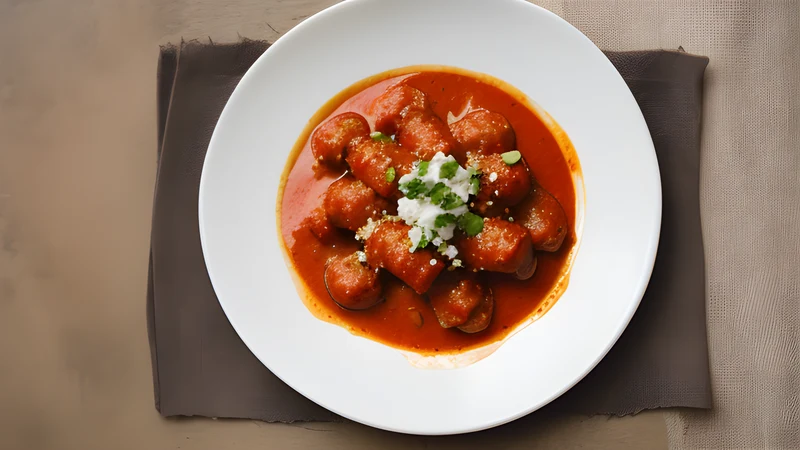
- Spoon the hot sauce over so every piece is coated, then dust generously with the reserved curry powder mix. Serve at once, with a small wooden fork.
Herta Heuwer, 4 September 1949
The origin here is unusually well documented for a piece of street food, and the reason is that the inventor had the presence of mind to register a trademark.
Herta Heuwer ran a stall on the corner of Kantstraße and Kaiser-Friedrich-Straße in Charlottenburg, in a Berlin that was still largely rubble and still rationed. She traded with British soldiers for ketchup, Worcestershire sauce and curry powder, mixed them with her own spices, poured the result over a fried sausage, and by her own account first sold it on 4 September 1949. It worked. At her peak she was shifting around 10,000 servings a week from a shack, and in 1959 she registered her sauce as a trademark under the name Chillup, which is the kind of detail that makes the whole story checkable. She died in Berlin in 1999. There is a plaque at Kantstraße 101.
Hamburg disputes it, largely on the strength of Uwe Timm’s 1993 novel Die Entdeckung der Currywurst, which places the invention in Hamburg in 1947 with a fictional canteen cook called Lena Brücker. It is a very good novel and it is a novel. Berlin’s date has paperwork behind it.
The dish then split into dialects. Berlin eats it mit Darm — with the casing on, so it snaps — or ohne Darm, skinless, which the Ruhr and much of the west prefers. The Ruhr deep-fries rather than pan-fries and takes the whole subject with a seriousness that Berlin finds funny. And then there is Wolfsburg, where Volkswagen has been making its own Currywurst in-house since 1973, stamped with the part number 199 398 500 A, sold in the works canteen and in supermarkets, and produced at a rate that in some years has exceeded the number of cars the company built. It is a real part number in a real catalogue.
Berlin opened a Currywurst Museum in 2009 and closed it in 2018, which is roughly the correct arc for a museum about a sausage.
Blooming, which is the whole technique
Here is why homemade Currywurst usually tastes worse than the stall’s, despite being made from better things: the curry powder was stirred into cold tomato and never woke up.
Curry powder is mostly ground seeds and roots — coriander, cumin, fenugreek, turmeric, chilli — and the compounds that make them taste of anything are fat-soluble and volatile. Suspended in a watery tomato sauce, they never dissolve into anything. They stay as gritty particles, they taste dusty and slightly raw, and the turmeric asserts itself as the flat, mustardy note that people mistake for “curry”.
Ninety seconds in hot fat changes them completely. The oil dissolves the aromatic compounds and carries them through the sauce, and gentle heat pushes a Maillard reaction in the ground seed that generates new, rounder, nuttier flavours that were never in the jar. This is the first thing any Indian kitchen does and the last thing a German recipe blog mentions.
It is also the easiest place to ruin the dish. Turmeric burns fast and turns acridly bitter, and there is no rescuing it. Low heat, constant stirring, and the tomato purée going in the moment the pan smells toasted — that purée’s moisture is what stops the reaction dead.
The tomato purée then gets its own two minutes, which is a separate step and worth the time. Raw purée is sharp and metallic; cooked until it darkens to brick and starts catching, it goes sweet and deep and gives the sauce a body that passata alone never has.
Balancing it, and the mustard
A curry sauce is a balancing act with three dials and the stall gets two of them wrong. Commercial curry ketchup is sweet, sweeter, and then sweet again.
Sugar at 2 tablespoons for 500 ml of passata is enough. It is there to round the tomato’s acidity, and to caramelise slightly against the sausage.
Acid comes from the cider vinegar, and it is what stops the whole thing tasting like a jar. Add it in stages and taste; passata varies enormously in its own acidity, and a sauce that tastes flabby needs vinegar rather than salt nine times out of ten.
Savouriness is the dial everyone forgets. Worcestershire brings anchovy and tamarind, which is glutamate and sourness in one bottle, and it is historically correct since Heuwer was getting hers from a British quartermaster. The tablespoon of sharp mustard is my addition and it is the thing I would keep if I could keep only one — a proper Düsseldorfer Senf adds a spine of bitterness and heat that survives the sugar, and it stops the sauce collapsing into jam. The heat mostly cooks off, which is fine; what remains is the seed’s savoury weight.
The apple juice is doing what a grated apple does in a German kitchen: sweetness with fruit acid attached, rather than sweetness alone.
The sausage, and the second dusting
Fry it properly. A Bratwurst wants 10-12 minutes over medium heat with regular turning, and the goal is a deep brown skin all round. Two things go wrong: high heat, which splits the casing and pushes the fat out before the middle is hot, and a crowded pan, which drops the temperature and steams the sausages grey. Four in a large pan is the limit.
Berlin stalls often boil the sausages first and fry them to order, which is a service decision rather than a cooking one — it means the wurst hits the fat already hot and browns in three minutes flat. At home, fry from raw.
Cut it hot and cut it on a board. The coins should be about 2 cm, and cutting them the moment they leave the pan means the cut faces are still steaming when the sauce lands, and the sauce clings instead of sliding off. The purpose-built Currywurstschneider — a chopping machine on the counter that reduces a whole sausage to coins in one push — exists for exactly this reason.
Then the dusting. Curry powder scattered over the wet sauce sits there as dry powder for the first few seconds and hits your nose before the fork does, which is a completely different sensory event from the same powder dissolved into the sauce twenty minutes ago. A quarter-teaspoon of toasted ground fenugreek in that dusting is my one liberty — fenugreek is what gives commercial curry powders their characteristic maple-savoury smell, and a little extra of it, toasted, is the difference between a dusting that reads as “spice” and one that reads as “Currywurst”.
Which curry powder, and which sausage
The blend matters, and the German one is a specific thing. Curry powder in a German kitchen means a mild, turmeric-heavy, coriander-forward mixture with very little chilli — the descendant of the tins that Victorian and Edwardian grocers sold, which is exactly what a British quartermaster would have had in 1949. A Madras blend will work and will make the sauce hotter and redder than any Berliner would recognise. A Thai curry paste has nothing to do with this at all.
If you want to mix your own, the proportions that land closest are four parts ground coriander, two parts turmeric, two parts cumin, one part fenugreek, one part ginger, half a part each of black pepper, cinnamon, clove and cayenne. Toast the whole seeds separately before grinding and it is transformed. Bought powder loses most of its aroma within about six months of the seal breaking, so if your jar has been open since a previous flat, that alone may be the problem.
The sausage should be a coarse-ground pork Bratwurst with a proper snap. Thüringer Rostbratwurst is the benchmark and it is worth seeking out — protected, marjoram-heavy, coarse. Nürnberger are too small and too finely spiced with marjoram to survive the sauce. A good British butcher’s pork sausage with a high meat content and no rusk-heavy filler works fine; a cheap sausage full of breadcrumb turns to paste under a wet sauce and disintegrates on the fork.
The ohne Darm question is worth trying both ways. Skinless sausage soaks the sauce up and goes soft and yielding, which is what the Ruhr wants. With the casing on, each coin keeps a rim of snap and the sauce stays on the outside, which is the Berlin texture and the better one to my mind. Ask for skinless at a German counter and you will get it without comment; ask in Britain and you will get a look.
What goes wrong
Bitter sauce. Burnt turmeric during the bloom. Start again; nothing masks it.
Gritty, dusty texture. The powder went in with the liquid and never bloomed.
Cloying. Too much sugar or not enough vinegar. Correct with vinegar, a teaspoon at a time, off the heat.
Thin sauce that pools. Under-reduced. Twenty-five minutes uncovered on the lowest heat should do it, and the cornflour is the honest shortcut when it does not.
Grey, split sausages. Pan too hot, or too full.
What goes with it
Pommes rot-weiß — chips with a stripe of ketchup and a stripe of mayonnaise — is the canonical partner, and a tray of very hot crispy roast potatoes does the job at home with less oil and no regret. A soft white Brötchen on the side, used to mop, is the Berlin alternative.
The sauce keeps a week in the fridge and freezes for three months, and it improves overnight as the spices settle. It is also excellent on other things: over a slice of fried Leberkäse, which is heresy in Munich and delicious in a kitchen, or beside Frikadellen. If you like where the spice is going, a jar of tomato kasundi shows what the same tomato-and-mustard-seed logic does when a Bengali kitchen runs it instead. And if you want to see the far end of German sausage seriousness, Weisswurst is the sausage that is forbidden to meet curry powder at all.
Related Content