Croquembouche: The Tower of Choux and Spun Sugar
A cone of caramel-welded buns, cardamom crème pâtissière, and a veil of spun sugar
Contents
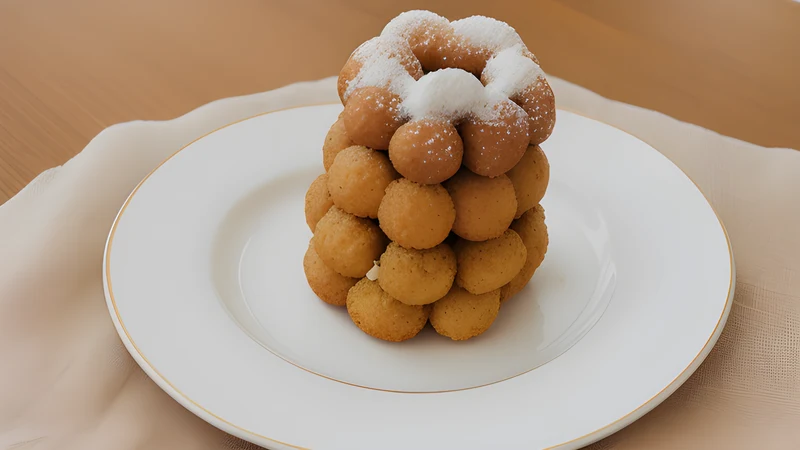
↓ Jump to recipeA croquembouche is sixty choux buns, a bucket of caramel and about ninety minutes of holding your nerve. It is also the only dessert I know of whose name is a warning: croque-en-bouche, “crunches in the mouth”. The correct way to eat one is to reach over, snap a bun off the side with your fingers and put it in your mouth whole, and the entire tower is engineered around that gesture. A knife has no business anywhere near it.
Croquembouche: The Tower of Choux and Spun Sugar
Ingredients
- For the choux (double batch): 200ml water
- 200ml whole milk
- 170g unsalted butter, cubed
- 8g fine salt
- 12g caster sugar
- 220g strong white bread flour
- 7 to 8 medium eggs, beaten (about 380g)
- For the cardamom crème pâtissière: 900ml whole milk
- 20 green cardamom pods, bashed open
- 1 vanilla pod, split and scraped
- 9 egg yolks
- 180g caster sugar
- 80g cornflour
- 60g unsalted butter, cubed
- 200ml double cream, cold
- For the caramel: 600g caster sugar
- 150ml water
- 2 tbsp liquid glucose or golden syrup
- Flavourless oil, for the cone and the tray
Method
- Make the pastry cream first. Warm the milk with the bashed cardamom pods and the vanilla until steaming, take off the heat and leave to infuse for 30 minutes, then strain and press the pods hard. Top the milk back up to 900ml if needed.
- Whisk the yolks, sugar and cornflour to a smooth paste. Bring the infused milk back to a simmer, pour it onto the yolks while whisking, return everything to the pan and cook over medium heat, whisking hard into the corners, until it thickens and boils for a full minute. Beat in the butter, spread into a cold tray, press cling film onto the surface and chill at least 4 hours.
- Make the choux in two batches so the pan is manageable. For each, bring half the water, milk, butter, salt and sugar to a full rolling boil. Tip in half the flour at once and beat to a smooth ball, then keep beating over medium heat for 90 seconds until a film forms on the pan base.
- Beat the paste in a mixer on low for 2 minutes to cool it to about 60C, then add beaten egg gradually until the paste drops from the beater in a slow V and a piped line holds a soft peak. Stop before it slackens.
- Pipe buns of 3cm with a 10mm plain nozzle onto lined trays, 4cm apart, flattening any peaks with a wet fingertip. You want about 60. Bake at 180C fan for 22 to 25 minutes until deep golden and light for their size.
- Pierce the base of each bun with a skewer and return them to the switched-off oven, door ajar, for 10 minutes to dry out. Cool completely on racks.
- Build a cone. Roll stiff card into a cone about 35cm tall with a 16cm base, tape it firmly, and wrap it in baking paper or foil. Oil the outside lightly and stand it on a serving board.
- Beat the cold pastry cream smooth. Whip the double cream to soft peaks and fold it through. Fit a piping bag with a 5mm nozzle and fill each bun through its skewer hole until it feels heavy. Chill the filled buns while you make the caramel.
- Make the caramel. Warm the sugar, water and glucose in a heavy pan over medium heat without stirring, brushing the sides down with a wet brush in the first minute. Cook to a mid-amber, about 175C, then take off the heat and sit the pan in a bowl of warm water.
- Build the tower. Working from the bottom, dip each bun on one side and its base into the caramel and press it against the cone, forming a tight ring. Build ring on ring, each one slightly inset, until you reach the top. Leave 20 minutes to set hard.
- Ease the tower off the cone by twisting the card gently and lifting it out through the top. Set the tower on the serving board.
- Spin the sugar. Reheat the remaining caramel until fluid, let it cool until a lifted fork trails long threads rather than dripping. Dip two forks held back to back, then flick them back and forth over the tower in long arcs so the threads catch and wrap. Serve within 3 hours.
The wedding tower
The croquembouche is the French wedding cake — the pièce montée that stands where an English tiered fruitcake would. Antonin Carême, the pastry cook who did more than anyone to formalise French patisserie in the early nineteenth century, is usually given the credit for codifying it. Carême was obsessed with architecture; he wrote that pastry was the principal branch of it, and he meant that seriously, drawing his showpieces as elevations before building them in sugar and choux. The croquembouche is what happened when a man who wanted to build temples was given choux paste.
The tradition it grew out of is older and stranger. Medieval French wedding guests brought small cakes and piled them in a heap in front of the couple, who tried to kiss over the top of the mound without knocking it down. Doing so predicted a prosperous marriage. The pièce montée is that heap, professionalised — the pile made deliberate, cemented with caramel and stood up straight.
It still turns up at French weddings, baptisms and first communions, usually decorated with sugared almonds and sometimes with a candied violet at the summit. Bakers deliver it built. That should tell you something about the transport problem, which we will come to.
The cardamom
My change is in the cream. Twenty green cardamom pods, bashed open and infused into the milk for half an hour before the custard is made.
Cardamom and choux is a Scandinavian instinct rather than a French one, and it earns its place through contrast. A croquembouche is fundamentally sixty mouthfuls of the same thing, and even excellent vanilla pastry cream becomes wallpaper by the fourth bun. Cardamom carries eucalyptol and terpinyl acetate — bright, cooling, faintly camphorous aromatics — that cut through both the caramel and the dairy and reset the palate between buns. It keeps the tower interesting to the bottom.
Bash the pods and use them whole. Ground cardamom loses its volatile oils within weeks of grinding and tastes dusty; the seeds inside a fresh green pod are still oily and fragrant. Strain the milk and press the pods hard, then check the volume, because a long infusion evaporates more milk than you expect and a short measure gives you cement instead of custard.
Sixty buns that stay up
The scale is what makes choux hard here. A single tray of profiteroles forgives a slack paste; sixty buns holding up a 35cm cone do not. Every bun is load-bearing, and a squat or collapsed one shows as a dent in the wall.
Choux fails in one direction — it rises magnificently and then sinks into a leathery pouch as it cools — and there are three causes. The paste was too wet, because the drying stage was rushed; ninety seconds of hard beating over heat after the flour goes in is the minimum, and a visible film on the pan base is the signal that the starch has gelatinised and the water has gone. The egg went in by the recipe rather than by eye, when the amount you need depends entirely on how much water you drove off; stop when a lifted beater drops the paste in a slow V and a piped line holds a soft peak. Or the oven door was opened in the first eighteen minutes, before the crust had set, and the steam that was holding the shell up escaped.
The skewer-and-dry step is worth the ten minutes it costs. Piercing each base lets the trapped steam out; the residual oven heat then dries the interior walls. Skip it and the buns steam themselves soft from the inside within the hour, which for a tower means the bottom ring slowly compressing under the weight of the top.
Pipe them as evenly as you can. Draw 3cm circles on the underside of your baking paper if it helps. A tower of matched buns looks deliberate; a tower of mixed sizes looks like an accident, and it also builds crooked, because every ring assumes the one below it is level.
Caramel is the dangerous part
Read this before you start. Caramel is at 175C, it adheres to skin, and it goes on burning after it lands. Every serious burn in a domestic kitchen that I have heard about came from sugar rather than from fat or flame. Have a large bowl of iced water on the counter before the pan goes on the heat, and if you catch yourself, plunge straight in and hold it there.
For a tower you are dipping sixty times, which means sixty chances. Use tongs or a dipping fork rather than fingers. Keep children and dogs out of the room. Work on a cleared counter, with the cone already standing and the buns already filled and lined up, so there is no moment where you are carrying a pan of molten sugar and looking for something.
The caramel itself is undramatic if you leave it alone. No stirring — a single seed crystal will cascade through the whole pan and turn it to grit. Wash the sides down with a wet brush in the first minute. The glucose is structural insurance: it is a different sugar and it physically obstructs sucrose crystals trying to line up. Pull the pan off a shade lighter than you want, because the residual heat drives it two shades darker in twenty seconds.
Sitting the pan in warm water is what makes a tower possible at all. It holds the caramel workable for the twenty-odd minutes of building instead of the four you would otherwise get.
Building without a disaster
The cone is a jig, and it comes out at the end. Card, taped, wrapped in paper, lightly oiled. Do not skip the oil; caramel welds to paper with real conviction and you will end up serving the jig.
Build from the bottom in complete rings, each ring stepped in by about half a bun. Dip each bun on the side that will touch its neighbour and on the base. The caramel is glue and it sets in about five seconds, so place decisively; a bun repositioned twice will be crooked and sticky. Press each one against both its neighbour and the ring below, so the load travels down through the structure rather than hanging off the cone.
Leave a full twenty minutes before extracting the cone. Then twist the card gently — it should release from the oiled paper — and lift it out through the top. If the tower shifts, stop, leave it another ten minutes, and try again.
Spinning sugar
This is the theatrical bit and the easiest. Let the leftover caramel cool in the pan until it has thickened — around 150C, when a lifted fork trails long threads instead of dripping. Too hot and it flies off in droplets; too cool and it lumps.
Hold two forks back to back, dip, and flick them in long arcs over the tower with a loose wrist. Threads will fly, catch on the buns and wrap. Put newspaper down first, because a good deal of it lands on the floor. Spin it as late as you can: spun sugar is hygroscopic and will slump into a sticky mat within two or three hours in a humid room.
The filling, and how much
Fill each bun until it feels heavy in the hand and offers a little back-pressure at the nozzle. Underfilled buns are the commonest fault and they are invisible until someone eats one — a hollow bun in a croquembouche is a disappointment with a caramel hat.
Folding whipped cream through the finished pastry cream is worth the extra bowl. Straight pâtissière is dense and, at sixty buns, wearying; lightened with 200ml of whipped double cream it becomes crème légère, which is airier, pipes more easily through a 5mm nozzle, and eats better against the hard caramel shell. It also stretches the yield, which matters when you are filling this many.
Beat the cold pastry cream smooth before you fold anything into it. Chilled pâtissière sets to a solid block and looks ruined; thirty seconds with a whisk turns it glossy and pipeable again. That is the starch behaving normally, and it catches people out every time.
Timings, weather and storage
Spread the work. Day one: bake the buns, dry them, store airtight; make the pastry cream. Day two: fill, caramelise, build, spin.
Weather decides more than skill here. Caramel pulls water out of the air, so a wet day is a bad day for this — the glaze goes tacky and the tower sweats. Aim for a dry day and a cool room, avoid running a kettle nearby, and never, under any circumstance, put a finished croquembouche in the fridge, which is the most humid box you own. It lives on the counter and it lives for about four hours. This is a dessert you build on the afternoon of the party.
It does not travel. Every professional who delivers one has a story about a roundabout, and the reason bakers assemble on site is that a tower is a rigid structure with sixty brittle joints and no give in it at all. Build it where it will be eaten, on the board it will be served from.
Sugared almonds pressed into the caramel as you build, or candied violets at the summit, are the traditional decorations and both are worth it — they break up the beige and give the eye somewhere to land. Add them ring by ring while the caramel is still tacky, because nothing sticks to set caramel afterwards.
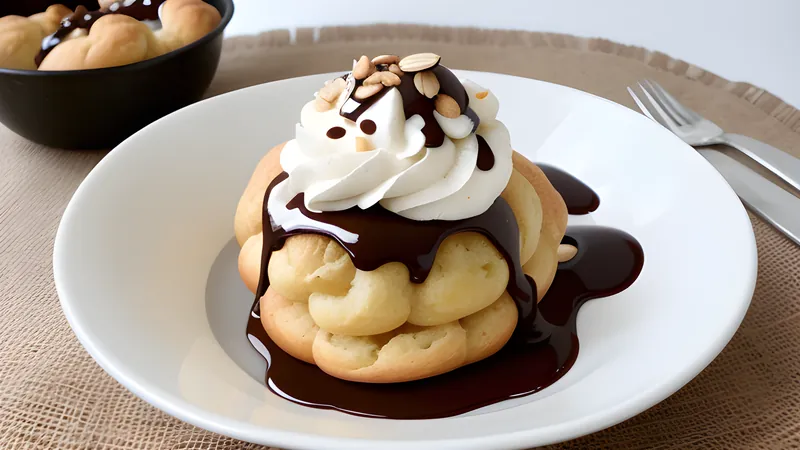
If sixty buns is more commitment than today can take, the components are all worth knowing on their own. Profiteroles with warm chocolate sauce is the same choux and the same filling with none of the engineering, and éclairs with coffee crème pâtissière is where you learn to read the paste. For the sugar work, salted caramel sauce teaches the pan without the height, and crème brûlée is the shortest route to understanding what a caramel does to a custard.
Related Content