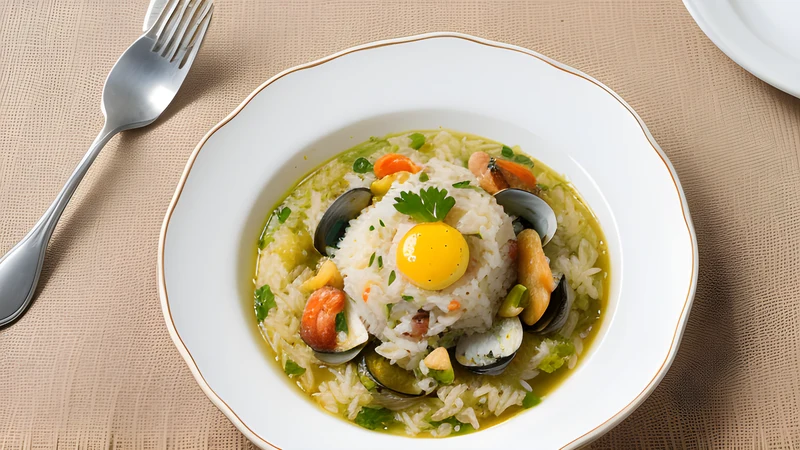
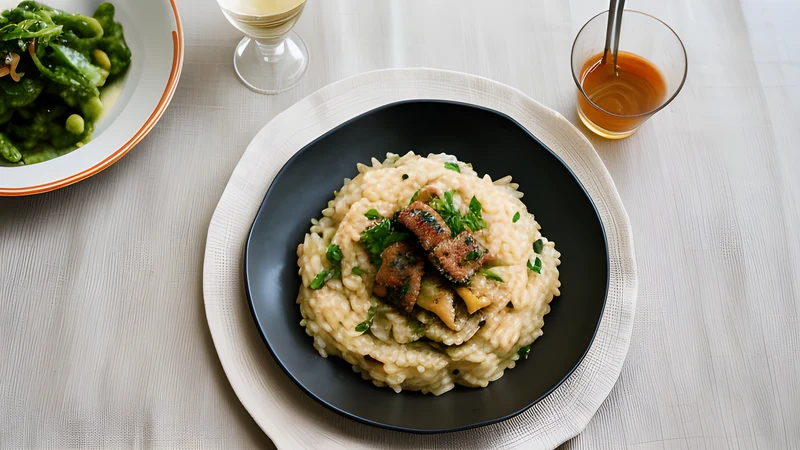
Črni Rižot: Croatian Black Cuttlefish Risotto
Ink, cuttlefish, and a risotto that stains everyone at the table
Contents
↓ Jump to recipeThere is a specific social contract around eating črni rižot, which is that everyone at the table accepts they are going to have black teeth for the next hour and nobody is allowed to mention it. On the Dalmatian coast it is served at lunch, in daylight, in restaurants where the waiter brings it and then quietly puts a napkin down without comment. My first one was in Rovinj, and I spent the afternoon walking around Istria grinning at people who grinned back, and it took me until dinner to understand why.
It is worth it. Cuttlefish ink tastes of the sea in a way that no other ingredient manages: briny, faintly bitter, mineral, iron-adjacent, and it has a viscosity that makes a risotto glossy in a way butter alone cannot.
Črni Rižot: Croatian Black Cuttlefish Risotto
Ingredients
- 800g whole cuttlefish, or 600g cleaned cuttlefish plus 8g cuttlefish ink
- 300g arborio or vialone nano rice
- 1 large onion, finely diced
- 5 garlic cloves, finely chopped
- 150ml dry white wine, ideally Pošip or another Dalmatian white
- 1.2 litres light fish stock or water
- 60ml extra virgin olive oil, plus more to finish
- 2 tbsp tomato purée
- 1 tsp fine sea salt
- 1/2 tsp coarsely ground black pepper
- 1 small bunch flat-leaf parsley, leaves chopped, stalks reserved
- 1 bay leaf
- 1 strip orange peel, pared with a peeler
- 1 tbsp red wine vinegar
- 30g cold unsalted butter, diced
Method
- If using whole cuttlefish, pull the head away from the body. Locate the silvery ink sac behind the eyes, cut it free carefully, and drop it into a small bowl with 3 tbsp of water. Reserve.
- Pull out the cuttlebone and the guts. Cut off the tentacles above the eyes and squeeze out the hard beak. Peel off the outer membrane under a cold tap.
- Cut the cuttlefish bodies into 1.5cm strips and the tentacles into 3cm lengths. Pat everything very dry with kitchen paper.
- Warm the stock with the bay leaf, the orange peel and the parsley stalks in a pan over a low heat and keep it at a bare simmer.
- Heat 2 tbsp of the olive oil in a wide heavy pan over a high heat. Add half the cuttlefish in a single layer and sear for 90 seconds without moving it, until it takes colour. Remove and repeat with the rest.
- Drop the heat to medium-low, add the remaining oil and the onion with a pinch of salt, and cook for 10 minutes until soft and translucent.
- Add the garlic and cook for 1 minute. Add the tomato purée and cook, stirring, for 3 minutes until it darkens to brick.
- Return the cuttlefish to the pan. Add the wine, raise the heat, and boil hard for 2 minutes.
- Cover, drop to the lowest heat, and braise for 25 minutes, until the cuttlefish yields to a knife tip.
- Add the rice and stir for 2 minutes over a medium heat until the grains are coated and translucent at the edges.
- Add hot stock a ladleful at a time, stirring, waiting until each addition is nearly absorbed before the next. This takes 16-18 minutes.
- Burst the ink sacs against the side of their bowl with a fork, stir, and strain the black liquid through a fine sieve into the pan at the 12-minute mark. Stir until uniformly black.
- Taste the rice at 16 minutes. It should be tender with a firm centre. Add the salt and pepper.
- Take off the heat. Beat in the cold butter, the vinegar and half the parsley. The risotto should slump and spread when spooned onto a plate.
- Rest for 2 minutes. Serve in shallow bowls, scattered with the remaining parsley and a thread of raw olive oil.
Cuttlefish, and why it must be cuttlefish
The Croatian name is crni rižot and the cephalopod is sipa, cuttlefish, and this matters more than substitutability usually does in cooking.
Squid ink and cuttlefish ink are different products. Squid ink is thinner, sharper, more purely salty. Cuttlefish ink is thicker, darker, more viscous and considerably more complex — earthier, with a bitterness that reads almost like unsweetened cocoa. Most jarred “squid ink” sold in Britain is in fact cuttlefish ink, because that is the one the industry harvests, which is a happy accident.
The flesh differs too. Cuttlefish is thicker-walled, meatier and more collagenous than squid, and it responds to a completely different cooking strategy. Squid goes tender in ninety seconds or in forty minutes and is rubber in between. Cuttlefish is more forgiving in the middle range, and a twenty-five minute braise gets it genuinely tender while leaving it something to bite.
Buy it whole if you possibly can. A whole cuttlefish gives you the ink sac, which is fresher and better than jarred, and it gives you the trimmings for stock. Fishmongers will clean it for you and will usually save the sacs if you ask when you order. The ink sac is silvery, about the size of a thumbnail, sitting behind the eyes, and it ruptures easily — cut it free with the tip of a knife and put it straight into a bowl of water, because a burst sac on a chopping board is a genuine mess.
If you buy cleaned cuttlefish and jarred ink, use 8g. Jarred ink is concentrated and salted, so hold back on the salt until the end.
The Dalmatian rice question
Here is the thing that took me longest to accept: črni rižot is not trying to be an Italian risotto, and judging it as one leads you to make it wrong.
Dalmatia sat under Venice for four hundred years and the rice arrived with the Venetians, so the technique is genuinely related to what happens in the Veneto — the same as risotto alla Milanese or risotto al Barolo in its bones. But it drifted, and it drifted in a specific direction.
Croatian rižot is looser, wetter and less emphatically emulsified. The Venetian target is all’onda, wave-like: a risotto that ripples when you shake the pan, held together by starch beaten into a glossy suspension. The Dalmatian target is closer to a very thick soup that happens to be mostly rice. It slumps and spreads on the plate. It is eaten with a spoon, from a shallow bowl, and there is broth visible at the edges.
There is also, crucially, no cheese. Parmesan in a seafood risotto is an Italian taboo too, so this is less a divergence than an agreement, but it means the entire emulsion in črni rižot comes from rice starch, cuttlefish collagen, ink viscosity and a little butter at the end. That is a thinner emulsion by construction, and trying to force it to Venetian tightness by beating it harder just breaks the grains.
So: aim looser than you think. If it holds a peak on the spoon, add another ladle of stock.
The twist: orange peel in the stock
A single strip of orange peel, pared thin, dropped into the simmering stock with the bay leaf and parsley stalks.
Cuttlefish ink has a heavy, dark, iron-mineral quality, and across a whole bowl it can turn oppressive — you get to the two-thirds point and everything tastes like the same low, brackish note. Orange oil sits on top of that in exactly the right place. The limonene in the peel is aromatic and volatile and lifts the ink without adding sweetness, and it echoes a citrus note that is already in the Dalmatian larder, where everything grows next to an orange tree.
Peel only, no pith, no juice. Pith is bitter and the ink has bitterness covered. One strip in 1.2 litres, steeped for the twenty minutes the stock sits warm, and then it comes out with the stock.
Nobody tastes orange. What they notice is that the last spoonful tastes as good as the first.
Method notes that matter
Sear the cuttlefish first, dry and hard, in batches. This is the step most recipes skip because the cuttlefish gets braised afterwards anyway. It is worth ninety seconds a side. Dry cuttlefish on a hot pan browns, and that browning is the only Maillard flavour in a dish that is otherwise entirely about brine and starch. Crowd the pan and it steams instead, and the difference in the finished bowl is obvious.
Cook the tomato purée out. Three minutes, stirring, until it goes from red to brick. Raw tomato purée tastes tinny and that tinniness survives an hour of cooking.
Braise before the rice. Twenty-five minutes covered on the lowest heat. The cuttlefish needs it and the rice does not, and putting them in together means either raw cuttlefish or destroyed rice. Braising first also builds the liquid the rice will absorb — by the time the grains go in, the pan is full of cuttlefish-flavoured wine and juice, and that is where the depth comes from.
Ink goes in late. Around the twelve-minute mark of the rice. Ink boiled hard for half an hour goes flat and slightly bitter, and its colour dulls from jet to grey-brown. Late means the flavour stays sharp and the black stays black. Strain it — the sac membrane will otherwise give you rubbery flecks.
Vinegar at the end. A tablespoon. Ink and cuttlefish and rice are all round, low, soft flavours and there is no acid anywhere in the dish otherwise. It reads as definition rather than sourness.
What the ink is actually for
The ink is a defence mechanism and understanding that explains how it behaves in a pan. A cuttlefish under threat fires a cloud of it and bolts, and the cloud works because the ink is engineered to hang in seawater in a coherent shape for several seconds rather than dispersing. That coherence comes from mucus: the sac is roughly half melanin pigment and half mucopolysaccharide, a long-chain sugar that gives the ink its body.
That mucus is doing most of the work in your risotto. Melanin is a pigment and contributes surprisingly little flavour on its own; it is dark and faintly bitter and that is about it. The polysaccharides are what make ink viscous, what make the finished rice glossy rather than matte, and what let a black risotto hold together with no cheese in it. Ink is functionally a thickener that happens to be the colour of tar.
It also carries free amino acids — glutamate among them — from the ink sac fluid, which is where the savoury depth comes from. This is why fresh ink from a whole cuttlefish tastes noticeably better than the jarred stuff: the jarred product is pasteurised and salted for shelf life, and pasteurisation degrades both the polysaccharide chains and the volatile aromatics. Jarred ink gives you colour and salt and about two-thirds of the flavour. It is still perfectly good, and I use it half the time.
One practical consequence: never boil the ink hard. Heat breaks the long sugar chains, and a risotto whose ink has been boiled for forty minutes goes thin and dull and needs more butter to hold together. Late addition is a texture decision as much as a flavour one.
Venice, and four hundred years
Rice does not grow in Dalmatia. It grows in the Po valley, and it reached the eastern Adriatic in the holds of Venetian ships, along with the technique for cooking it.
Venice held most of the Dalmatian coast from 1409 until Napoleon dissolved the Republic in 1797, and the culinary residue is everywhere once you look for it: rižot, fritule, brodet against brodetto, pašticada with its debts to Venetian sweet-sour braising. The vocabulary came across almost intact. What changed was the economics. Rice was an import and therefore expensive, so Dalmatian rice dishes were built to stretch it — more liquid, more seafood, fewer grains per person than a Venetian would use. That is the origin of the looser texture, and it is a poverty adaptation that outlived the poverty and became the preference.
Cuttlefish, meanwhile, was free. It is abundant in the shallow sandy bays of the Adriatic, it was caught in enormous quantities in spring when it comes inshore to spawn, and it was the cheap catch — the thing fishermen ate rather than sold. Black risotto is the meeting point of an expensive import and a worthless local abundance, which is the origin story of a surprising proportion of the food anyone actually wants to eat.
Where it goes wrong
Rubbery cuttlefish. Braise was too short, or the heat was too high and it seized. Give it another fifteen minutes; it will come back.
Grey rather than black. Not enough ink, or ink added too early and boiled out. Use 8g minimum for four people.
Stodgy, claggy risotto. Over-stirred, or under-liquid. This wants to be loose.
Grainy, gritty rice. Under-cooked, or you added cold stock. Cold stock drops the pan temperature and stalls the starch release.
Overwhelmingly bitter. Too much ink, or you included pith with the peel, or you crushed the beak into the pan.
Serving, storage and variations
Shallow bowls, a thread of raw olive oil on top, chopped parsley, and nothing else. No cheese, no lemon wedge, no cream. Bread on the side to wipe the bowl.
Črni rižot does not keep. Rice risotto in general reheats poorly, and this one loses its ink brightness overnight and turns to a black paste. Make what you will eat. If you do have leftovers, roll them into balls around a cube of mozzarella and fry them, which is a betrayal of two cuisines and delicious.
Variations are mostly additive and mostly unnecessary. Some konobas add a handful of prawns or clams in the last three minutes, which brings sweetness. A chopped fresh chilli with the garlic is a Kvarner habit. In Istria you will occasionally get it finished with a spoonful of grated hard sheep cheese, which the rest of the coast considers vandalism.
The same white wine, the same garlic and the same olive oil turn up all along that coast — pour whatever is left of the Pošip alongside a peka the next day and you have most of a Dalmatian weekend.
Related Content