Vanilla Creme Brulee
Silky custard under a glassy caramel crack
Contents
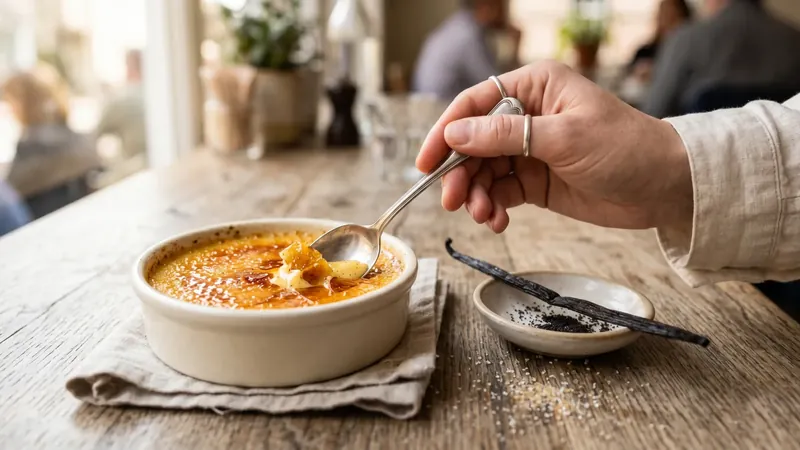
↓ Jump to recipeThere is real theatre in the moment a spoon shatters the lid of a creme brulee, breaking the glassy caramel to reveal cool, fragrant custard beneath. The twist here is no twist at all but a return to the basics done properly: a genuine vanilla custard, flecked with seeds from a real pod, set gently in a water bath and finished with a torched caramel top that cracks like thin ice. It is unhurried, generous and far simpler than its restaurant reputation suggests.
Vanilla Creme Brulee
Ingredients
- 300ml double cream
- 100ml whole milk
- 1 vanilla pod, split and seeds scraped
- 4 large egg yolks
- 50g caster sugar, plus 4 tbsp for the tops
- Pinch of fine salt
Method
- Heat the oven to 150C/130C fan/gas 2 and sit four ramekins in a deep roasting tin.
- Warm the cream, milk and split vanilla pod with its seeds in a pan until barely steaming, then remove from the heat and leave to infuse for 10 minutes.
- Whisk the egg yolks, 50g caster sugar and salt until pale and slightly thickened.
- Pour the warm cream slowly onto the yolks, whisking constantly, then strain through a sieve into a jug.
- Divide the custard between the ramekins and pour just-boiled water into the tin to come halfway up their sides.
- Bake for 35-45 minutes, until set at the edges but with a faint wobble in the centre.
- Lift the ramekins out, cool to room temperature, then chill for at least 3 hours or overnight.
- Just before serving, scatter 1 tbsp caster sugar evenly over each custard.
- Torch the sugar until it bubbles and turns deep amber, or place under a fierce grill, watching closely.
- Rest for a minute so the caramel hardens into a sheet, then serve at once.
The Story
Creme brulee, literally “burnt cream”, belongs to a wide European family of cooked creams finished with a brittle sugar crust. The earliest printed recipe usually tied to the name appears in Francois Massialot’s 1691 cookbook Cuisinier royal et bourgeois, written for the great households and court kitchens of Louis XIV’s France, where a custard was set and its surface caramelised with a red-hot iron. Curiously, when Massialot revisited a similar recipe in a later edition he called it crème à l’Angloise, “English cream”, so even the man with the first printed claim seemed unsure whose dish it was.
That uncertainty has fed a friendly three-way rivalry ever since. England leans on Trinity College, Cambridge, which has served a near-identical “burnt cream” branded with the college arms since 1879, and calls it Trinity or Cambridge cream; the tale that the college invented the dish is charming but almost certainly later folklore. Catalonia keeps its own crema catalana, older in feel and different in method, thickened on the stove with starch and scented with lemon zest and cinnamon rather than baked in a bain-marie. Three custards, three crusts, one argument that will never be settled and does not need to be.
What unites all of them is contrast: cold, soft custard against warm, glassy caramel. Getting the custard right is the whole craft, and it is the same discipline that a good vanilla panna cotta demands, though that one sets with gelatine rather than eggs. Cooking a baked custard slowly and gently, surrounded by water, keeps the eggs below the temperature at which they scramble and gives the smooth, trembling set that defines the dish. Straining the mixture before it goes in removes any threads of cooked egg and the spent vanilla pod, leaving a flawless surface to caramelise.
The custard, and why the water bath matters
Egg yolks begin to set somewhere around 65 to 70C and curdle into scrambled egg not far above that. Left in a dry oven, the edges of a custard race ahead of the middle and turn grainy long before the centre firms up. The bain-marie, a tin of just-boiled water reaching halfway up the ramekins, buffers that heat: water cannot climb above 100C, so the custard cooks evenly and slowly from all sides. Pull the ramekins when the edges are set but the centre still wobbles like a shy jelly; it will firm up as it chills over the next few hours. A custard baked until the middle is solid has gone too far and will taste of egg.
The hero ingredient is unquestionably the vanilla. Pods are the cured seed cases of a climbing orchid native to Mexico, hand-pollinated and cured over months, and now grown chiefly in Madagascar; their flavour is a long way from synthetic vanillin. Scraping the tiny black seeds directly into the cream and then steeping the empty pod alongside draws out both the seeds’ aromatic punch and the gentler, almost floral notes held in the casing. Those visible flecks are the honest signature of a custard made the long way, the same trick that lifts a slice of vanilla and orange French toast.
The caramel lid, and how to crack it
The caramel top is best made at the very last minute. Sugar scattered too early simply dissolves into the custard and goes soft, so torch the lid only when the dessert is about to be eaten. Scatter a thin, even tablespoon of caster sugar over each; too thick a layer bakes into a bitter slab that will not shatter cleanly. A cook’s blowtorch gives the most control: hold it about 8cm away, keep it moving in small circles, and take the sugar to a deep amber rather than pale gold, because the darker caramel gives that clean, glassy crack and a faint bitterness that offsets the sweet custard. If you have no torch, a fiercely hot grill works, but the ramekins must be watched without pause and turned so they colour evenly. Rest the finished custards for a minute so the caramel hardens into a sheet, then serve at once.
Make-ahead, substitutions and troubleshooting
Creme brulee is a gift for entertaining because the custards must be made ahead: bake them, chill them and hold them, uncaramelised, for up to two days in the fridge under cling film pressed to the surface, then torch the tops just before serving. Do not caramelise in advance, as the crust weeps and softens within an hour.
No vanilla pod? Use 1 tsp of good vanilla bean paste stirred into the warm cream, though the flavour is a touch less rounded. For a citrus version, steep a wide strip of orange or lemon zest with the vanilla and remove it before baking. If your custard turns out grainy, the oven ran too hot or it baked too long; next time drop the temperature by 10C and check earlier. If it never sets, the water bath was probably too shallow or the custard came out before the edges firmed, so return it to the oven for a few more minutes. Either way, the reward at the table is that first unmistakable crack.
The ratio, and why it works
The proportions here are deliberate and worth understanding, because creme brulee lives or dies on its richness. Using mostly double cream with a splash of whole milk gives a custard that sets firm enough to hold a caramel lid yet stays voluptuous on the spoon; an all-milk custard sets too lean and rubbery, while an all-cream one can feel cloying and heavy. Four yolks to 400ml of dairy is the classic balance: yolks alone, without the whites, are what give creme brulee its silk. The whites contain proteins that set firm and springy, closer to a baked flan, so leaving them out is precisely what separates this from a set custard tart. Save those whites for meringues or an egg-white omelette rather than throwing them away.
Sugar plays two roles, and the recipe uses it in two places for two reasons. The 50g whisked into the yolks sweetens the custard and, just as importantly, protects the eggs: sugar raises the temperature at which yolk proteins coagulate, buying you a wider margin before the custard curdles. The caster sugar on top is a separate job entirely, existing only to caramelise into that brittle sheet. Do not be tempted to use icing sugar for the lid, which burns before it melts cleanly, or granulated, whose coarse crystals give an uneven crust; fine caster sugar is the right choice.
Getting the caramel right every time
If your first caramel comes out patchy, with pale gaps between the amber, the sugar layer was uneven; tilt and tap the ramekin after scattering so the sugar spreads in a single thin coat before you torch it. A common frustration is a caramel that tastes acrid rather than pleasantly bitter, which means it tipped past deep amber into black; pull the flame away the moment the last of the sugar liquefies and darkens, as residual heat carries it a shade further. And always work on cold custards straight from the fridge: a warm base lets the heat of the torch soften the surface into a mess rather than sealing a crisp lid over chilled cream.
Related Content