Cozonac: The Romanian Sweet Bread With Walnut Swirl
An enriched dough, a walnut and cocoa paste, and a plait that took a village
Contents
↓ Jump to recipeThere is a photograph in my head of a Romanian kitchen table at Easter with six cozonaci cooling on it, tea towels over them, and a woman who had been awake since four telling everyone to stop touching them. That is the correct scale. Nobody makes one cozonac. The dough takes so long and demands so much attention that making a single loaf is an insult to the effort, so you make four, and you give two away.
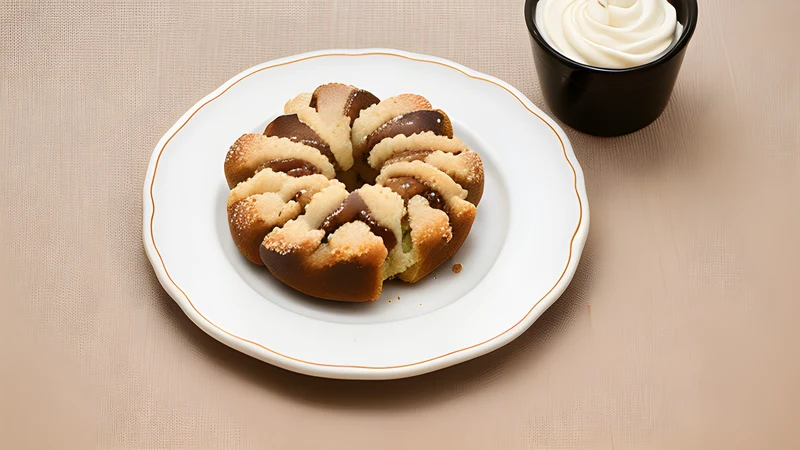
It is the bread of Easter and Christmas in Romania, and it is the thing Romanians abroad miss most reliably. A tall, enriched, brioche-adjacent loaf, plaited, with a dark spiral of walnut and cocoa paste running through every slice.
Cozonac: The Romanian Sweet Bread With Walnut Swirl
Ingredients
- 600g strong white bread flour
- 180ml whole milk, warmed to 35C
- 14g dried instant yeast
- 140g caster sugar
- 4 egg yolks, at room temperature
- 1 whole egg, at room temperature
- 8g fine sea salt
- 140g unsalted butter, cold and cut into 1cm cubes
- Finely grated zest of 1 lemon and 1 orange
- 1 tsp vanilla extract
- 1 tbsp dark rum
- 250g walnuts, toasted and coarsely ground
- 80g caster sugar, for the filling
- 20g cocoa powder
- 2 egg whites
- 60ml whole milk, for the filling
- 1 tsp ground cinnamon
- 80g raisins, soaked in 2 tbsp rum for 30 minutes and drained
- 1 egg yolk beaten with 1 tbsp milk, to glaze
- 2 tbsp granulated sugar, to finish
Method
- Whisk the yeast and 1 tbsp of the sugar into the warmed 180ml milk and leave for 10 minutes until foaming. If it does not foam, the yeast is dead and nothing that follows will save it.
- Put the flour, remaining 140g sugar, salt, both zests, vanilla and rum in a stand mixer bowl fitted with a dough hook. Add the yeast milk, the 4 yolks and the whole egg.
- Mix on low for 3 minutes to combine, then on medium for 10 minutes until the dough is smooth and elastic and cleans the bowl. It will be slack and slightly tacky at this stage — resist adding flour.
- With the mixer running on medium, add the cold butter cubes one at a time, waiting until each is fully absorbed before the next. This takes 12–15 minutes and the dough will look broken and greasy at the halfway point. Keep going. It comes back together into a glossy, silky dough that pulls into a windowpane.
- Cover and prove at 24–26C for 2–2.5 hours until doubled. Enriched dough proves slowly — this is normal and cannot be rushed with extra yeast.
- Meanwhile make the filling. Whisk the 2 egg whites to soft peaks, then fold in the walnuts, 80g sugar, cocoa, cinnamon and 60ml milk to a thick, spreadable paste. Stir in the drained raisins.
- Knock back the dough gently and divide into 4 equal pieces of about 300g. On a lightly floured surface, roll each into a 25cm x 35cm rectangle about 5mm thick.
- Spread a quarter of the filling over each rectangle, leaving a 2cm border along one long edge. Roll up tightly from the opposite long edge into a log, pinching the seam closed.
- Twist 2 logs around each other into a two-strand plait and lay in a greased and lined 900g loaf tin. Repeat with the other 2 logs and a second tin. The dough should fill each tin no more than halfway.
- Prove uncovered at room temperature for 60–75 minutes until risen to just above the tin rim.
- Heat the oven to 170C fan. Brush the loaves with the egg glaze and scatter with granulated sugar.
- Bake for 40–45 minutes until deep brown and an internal temperature of 92C. Cover loosely with foil at 25 minutes if the tops are colouring too fast.
- Cool in the tins for 10 minutes, then turn out onto a rack. Cool completely — at least 3 hours — before slicing. Cutting a warm cozonac tears the swirl and compresses the crumb.
The bread of the two feasts
Cozonac belongs to a wide family. Bulgarian kozunak, Greek tsoureki, Ukrainian and Russian paska, Italian panettone and pandoro, Jewish challah — all enriched wheat breads for feast days, all built on the same idea. That idea is straightforward once you see it: eggs, butter, sugar and white flour were expensive, and a bread made of them was a statement that the fast had ended.
The fasting is the key. Orthodox Lent runs seven weeks and is strict — no meat, no dairy, no eggs. A household came out of it with hens that had been laying the whole time and nothing to do with the eggs, and a genuine physiological craving for fat. Cozonac is the answer to both. It is deliberately, almost aggressively rich: nine egg components and 140g of butter in 600g of flour, which is a ratio in panettone territory.
The name most likely comes via Greek kouzounas through the Balkans, and the dish arrived in the Romanian principalities through Ottoman-era Constantinople sometime around the eighteenth century, first among boyars and city households, then everywhere. By the nineteenth century it was universal enough that the phrase a se face cozonac — “to turn into cozonac” — meant to become a soft, useless mess, which is a fair description of what happens when the dough goes wrong.
Regional versions vary more than outsiders expect. Moldova favours the walnut and cocoa swirl this recipe uses. Muntenia often adds Turkish delight, cut into cubes and studded through. Transylvania makes a version with poppy seed paste that is nearly black inside. Dobrogea sometimes skips the filling entirely and relies on the dough. All of them are cozonac, and all of them will be defended to the death.
The butter, and why it goes in last and cold
This is the technical heart of the recipe, and the step almost every home version gets wrong.
The instinct is to soften the butter and add it with everything else, the way you would in a cake. Do that here and you get a dense, greasy loaf. The reason is gluten. Fat coats flour proteins and physically blocks them from linking to each other, which is the whole mechanism of shortening a pastry. Add 140g of butter at the start and the gluten network never develops properly, so the dough has no structure to hold the gas the yeast produces.
The sequence that works is the brioche sequence. Build the gluten first with flour, liquid and eggs, mixing until the dough is elastic and cleans the bowl. Only then start feeding in butter, slowly, so it laminates into an already-formed network rather than preventing one. Cold butter matters because it goes in as discrete pieces that get sheared and distributed; softened butter goes in as a slick and coats everything at once.
There is a moment, around seven or eight minutes into the butter stage, when the dough breaks. It looks curdled and greasy and wrong, and it is at this point that most people conclude they have ruined it and add flour. Do not. Keep the mixer running. It comes back — the emulsion re-forms and the dough turns glossy and silky and starts slapping the side of the bowl. That recovery is the recipe working.
The proving problem
Enriched dough proves slowly, and this one is at the heavy end. Sugar is hygroscopic and competes with the yeast for water; fat coats the yeast cells and slows their access to sugars; and 140g of sugar in 600g of flour puts genuine osmotic pressure on the yeast. Two and a half hours for the first prove is normal. Four is possible in a cold kitchen.
Fourteen grams of yeast — double what a lean bread needs — is compensation for that. The temptation is to double it again. Resist: too much yeast produces a beery, sour flavour that has nowhere to hide in a sweet bread, and it exhausts the sugar before the crumb has set.
Temperature is the lever that actually works. At 24–26C the dough is happy. Below 20C it sulks. An oven with the light on, or a bowl of hot water in a closed microwave, gets you there.
The plait, and why two strands
The twisting is the part that looks decorative and is structural.
A single rolled log in a tin gives you a loaf with one spiral, and that spiral sits as a continuous sheet of wet filling through the middle of a wet dough. It slides. The two-strand twist breaks that sheet into a series of interrupted pockets, each anchored by dough on both sides, and the result holds together when you slice it. It also doubles the number of swirl faces on every slice, which is the visual everyone is actually after.
Twist firmly and evenly, and keep the cut faces of the logs pointing outwards where you can. Pinch the ends together underneath so the twist cannot unwind as the dough expands. The half-full tin rule matters here: cozonac has enormous oven spring, and a tin filled two-thirds at the shaping stage produces a loaf that climbs out and mushrooms over the sides.
Some households plait three or four strands and bake free-form on a tray. It looks magnificent and it spreads sideways, giving you a flatter loaf and a lower, denser crumb. The tin is doing real work: it forces the rise upwards, which is where the height comes from.
Ingredient notes worth the trouble
Flour. Strong white bread flour, 12–13% protein, and nothing less. This dough needs every bit of gluten it can build before the butter arrives to interfere with it. Plain flour produces a cozonac that cannot lift its own weight of butter and egg.
Egg yolks. Four yolks plus one whole egg is the ratio that gives colour and richness without the drying effect of too much white. The yolks contribute lecithin, a genuine emulsifier, which is quietly helping the butter incorporate. Save the whites — the filling wants two of them, which is tidy.
Zest. Both lemon and orange, and grate them fine. Citrus zest earns its place structurally: it is what keeps a very rich, very sweet loaf from cloying by the third slice. The oils sit in the fat and release as you chew.
Rum. A tablespoon in the dough and two in the raisins. Romanian recipes often use rom, the local rum essence, which is a distinct product with a strong synthetic note that Romanians abroad hunt for specifically. Real dark rum is better and less nostalgic.
Where it goes wrong
Dense, heavy, tight crumb. The butter went in too early, or the dough was under-kneaded before the butter stage. No windowpane, no loaf.
Greasy, with butter weeping out during the bake. The dough broke and never recovered — the mixer stopped too soon.
The swirl separates from the crumb, leaving a gap. The filling was too wet, or the log was rolled loosely. Roll it tight enough to feel resistance.
A raw, gummy line under the top crust. Under-baked. Take the internal temperature; 92C is the number, and a cozonac lies about doneness by colour because the sugar browns early.
It collapses on cooling. Over-proved on the second rise. Just above the tin rim is the target, and it will spring further in the oven.
Dry after a day. Over-baked, or too little butter. This should stay soft for four days.
Pale and soft-sided despite a full bake. Two tins crowded onto one shelf. Give them space and air, or bake in two batches — the second lot will hold happily on a second prove in a cool room.
The filling, and the whipped whites
The egg whites in the walnut paste are doing something specific. They lighten it so it stays spreadable and slightly aerated, and — more usefully — they set as the loaf bakes, which stops the filling turning into a dense wet band that pulls away from the dough. A filling bound with milk alone gives you the classic gap under the swirl.
Toast the walnuts. Ten minutes at 170C is enough, and the difference between toasted and raw walnut in a paste this quantity is the difference between a warm nutty depth and a slightly bitter, tannic, papery flavour. Grind coarsely, so there is still texture.
The cocoa is my preference and it is common in Moldova. Twenty grams turns the swirl properly dark and adds a bitterness that stops the whole loaf reading as one-note sweet. The rum in the raisins does the same job. Neither is negotiable in my kitchen and both are optional in Romania.
Slicing, keeping, and afterwards
Cool it completely. Three hours minimum, and the loaf is genuinely better the next day, once the crumb has set and the filling has stopped being molten. A warm cozonac tears rather than slices and compresses under the knife into exactly the soft useless mess the old idiom describes.
Wrapped in a tea towel and then loosely in a bag, it keeps four days at room temperature. Never the fridge, which stales enriched bread faster than anything else you can do to it. It freezes well whole or in thick slices.
Stale cozonac is a resource rather than a failure. Thick slices, griddled in butter, are excellent. It makes an outstanding bread and butter pudding — the walnut swirl does most of the work for you and you can cut the sugar in the custard by half. And it sits alongside papanași at the sweet end of a Romanian table without either being redundant, since one is dairy and acid and the other is butter and nut.
Related Content