Traditional Cornish Pasty
A crimped parcel of beef and swede
Contents
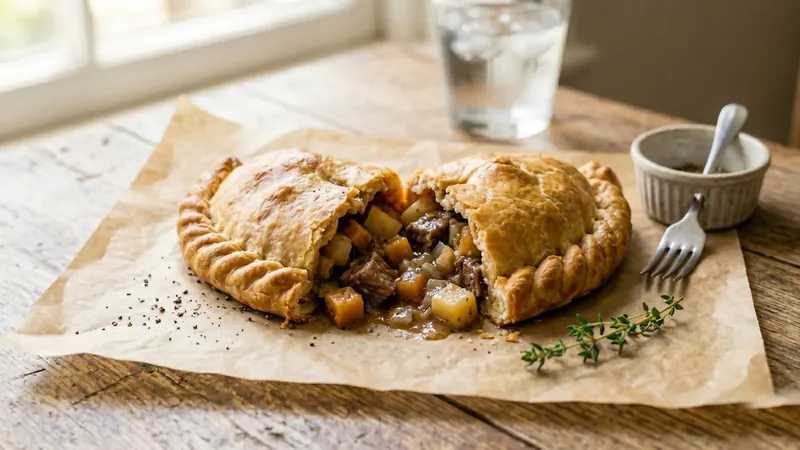
↓ Jump to recipeA proper Cornish pasty needs no reinvention, only respect for its traditions: raw beef skirt, swede, potato and onion sealed inside a sturdy shortcrust and baked slowly until the filling cooks in its own steam. The honest twist here is method rather than flavour, a robust, properly crimped crust strong enough to hold everything together and seal in all the savoury juices. Hearty, portable and deeply satisfying, it is a complete meal in a single golden parcel.
Traditional Cornish Pasty
Ingredients
- 500g strong white bread flour, plus extra for dusting
- 120g cold butter, cubed
- 120g cold lard, cubed
- 1 tsp salt
- 175ml cold water
- 350g beef skirt, cut into 1cm pieces
- 200g swede, peeled and finely diced
- 200g potato, peeled and finely diced
- 1 medium onion, finely chopped
- Plenty of salt and black pepper
- 25g butter, in small knobs
- 1 egg, beaten
Method
- Rub the butter and lard into the flour and salt until the mixture looks like coarse breadcrumbs.
- Add the cold water and bring together into a firm dough, then knead briefly until smooth.
- Wrap the pastry and chill for at least 1 hour.
- Mix the beef, swede, potato and onion in a bowl and season very generously with salt and pepper.
- Divide the pastry into four and roll each piece into a circle about 20cm across.
- Pile a quarter of the filling onto one half of each circle, leaving a clear border, and dot with butter.
- Brush the edge with beaten egg, fold the pastry over the filling and press to seal.
- Crimp the sealed edge by folding it over in a rope pattern along the curved side.
- Brush the pasties all over with beaten egg and cut a small steam hole in the top of each.
- Bake at 200C/180C fan/gas 6 for 15 minutes, then lower to 170C/150C fan/gas 3 and bake for 35 more minutes until deep golden.
- Cool for 10 minutes before eating, as the filling stays very hot.
The Story
The Cornish pasty is one of Britain’s most fiercely protected regional foods. After a nine-year campaign by the Cornish Pasty Association, the European Commission granted it Protected Geographical Indication (PGI) status in February 2011, with registration confirmed that July. That means a pasty sold as genuinely Cornish must be made in Cornwall, and it puts the pasty in the same protected company as Champagne, Melton Mowbray pork pies and Jersey Royal potatoes. The recipe is precise: a filling of beef, swede, potato and onion, seasoned and sealed raw inside shortcrust pastry, then crimped on one side into the distinctive D shape. Anything with a different filling or a seam crimped across the top is, strictly speaking, just a pasty.
Its history is bound up with the county’s tin-mining industry, which peaked in the eighteenth and nineteenth centuries. The pasty was the ideal lunch for a miner: a self-contained meal of meat and vegetables wrapped in a case sturdy enough to be carried underground and eaten by hand without cutlery or a plate. The thick ropey crimp was more than decoration. The popular story holds that it formed a handle a miner could grip with dirty, arsenic- or tin-stained fingers, then throw away, so no contamination reached the food. Historians treat that detail with some caution, and it may be as much folklore as fact, but it captures exactly why the pasty is built the way it is. Some accounts add that a pasty could be baked with meat at one end and jam or apple at the other, a two-course meal in a single crust, though how common that really was is hard to pin down.
The filling is famously simple and always raw when it goes in. Beef skirt is the traditional cut, prized because it is full of flavour and full of connective tissue that breaks down to tenderness over a long, gentle bake without drying out, in the same way the shin does in a beef bourguignon. Swede, confusingly called turnip across much of Cornwall, brings a faint sweetness and earthiness, while potato and onion round out a balanced, savoury whole. Crucially, everything is diced small and left uncooked. As the pasty bakes, the vegetables release moisture that steams the meat and reduces down into a natural gravy inside the sealed crust. Season the filling much more heavily than feels comfortable, because that steam dilutes it and an underseasoned pasty tastes of nothing.
The pastry, and why it holds
The pastry must be robust, closer to a strong shortcrust than the delicate stuff you would use for a fruit tart. A mixture of butter and lard gives both flavour and structure: butter for taste and browning, lard for the shortness and strength that lets a pasty survive being picked up and eaten out of hand. Strong bread flour, rather than plain, supplies extra gluten so the case can hold a heavy raw filling for the best part of an hour without splitting. This is the same reasoning behind the pastry on a beef empanada or a shepherd’s pie lid: the crust is a container first and a pleasure second, though a good one manages both.
Keep the fats and water cold and handle the dough as little as possible, then rest it in the fridge for at least an hour so the gluten relaxes and the pastry rolls without shrinking back. Baked with an initial blast of heat to set and colour the crust, then dropped low so the raw filling cooks through gently, the pasty emerges deep golden with its contents perfectly done. The steam hole in the top is not optional: it lets the filling’s steam escape in a controlled way rather than bursting a seam.
The crimp, and what goes wrong
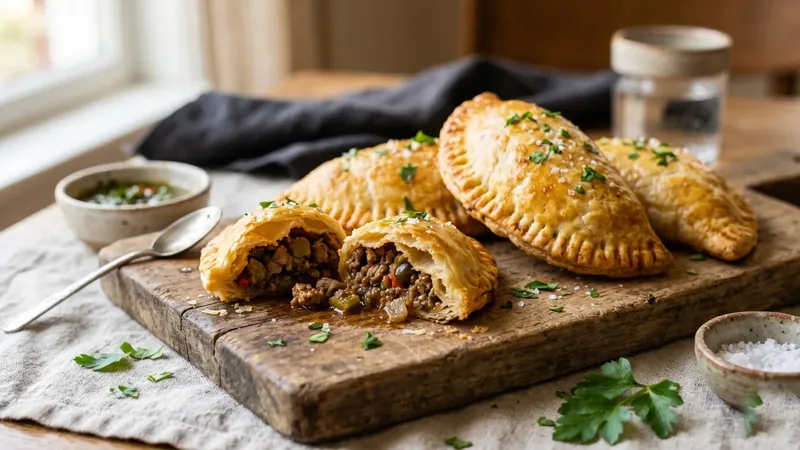
The crimp is the pasty’s signature, and it is worth practising. A genuine Cornish crimp runs along the curved edge, not across the top, and it is made by folding a small section of the doubled pastry edge over on itself, pressing it down, then folding the next section over that, working steadily along the seam to build the rope pattern. It looks fiddly but settles into a rhythm after the first pasty. The point is not decoration but strength: each fold locks the seal so the natural gravy inside cannot leak out and split the case during the long bake. If the pastry cracks as you fold, it is either too cold and firm, in which case let it sit for a couple of minutes, or too dry, in which case a light brush of water along the edge helps it stretch.
The commonest failure is a pasty that bursts and weeps its juices onto the tray. Almost always the culprit is a poor seal: filling pushed too close to the edge so the pastry cannot grip, or an edge that was not brushed with egg before folding. Leave a clear 2cm border of bare pastry all the way round, press the two halves firmly together before you crimp, and the seam will hold. The second failure is a soggy base, which comes from filling that is too wet or a bake that started too cool; the initial 15 minutes at 200C is what sets and crisps the bottom before the vegetables release their moisture. Bake the pasties on a preheated heavy tray to drive heat into the base from the start.
Substitutions, storage and reheating
If you cannot get beef skirt, use another well-marbled braising cut such as chuck or feather, diced small; avoid lean cuts like rump, which dry out over the long bake. Swede is traditional and hard to better, but a firm turnip works at a pinch. For a vegetarian pasty, replace the beef with 200g of diced firm mushrooms and a handful of cooked lentils, and add a teaspoon of Marmite to the filling for savoury depth.
Baked pasties keep in the fridge for up to three days and freeze well for three months, cooked or raw. To reheat, warm them in a 180C oven for 15 to 20 minutes from chilled, or longer from frozen, until piping hot right through; the microwave works but softens the crust. Raw pasties can go straight from freezer to oven, adding around 15 minutes to the bake. Cool for 10 minutes before eating: the filling holds its heat fiercely and will scald an impatient mouth. Eaten warm in the hand, it is a complete and thoroughly honest meal.
Freezing raw is my preference if you are making a batch. Assemble and crimp the pasties fully, then open-freeze them on a tray until solid before bagging, so they keep their shape and do not stick together. Baking from frozen, rather than defrosting first, keeps the pastry crisp and stops the raw filling weeping as it thaws. Brush them with egg while still frozen, cut the steam hole, and give them the extra quarter of an hour in the oven. A freezer stocked with a few of these is one of the more useful things a home cook can arrange, ready for a day when you want a proper lunch with almost no effort.
Related Content