Coda alla Vaccinara: The Oxtail of Testaccio
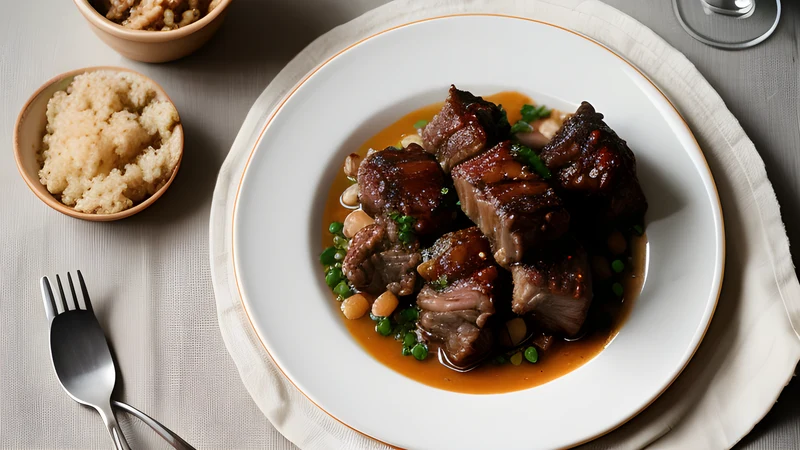
Oxtail braised for four hours with celery, tomato, pine nuts and bitter chocolate
Contents
↓ Jump to recipeTestaccio is a small rectangle of Rome built on a hill made of broken amphorae, and for a century it contained the city’s abattoir. The workers there were paid partly in offal and the parts nobody with money wanted — the fifth quarter, il quinto quarto — and what they did with those parts became the most distinctive cooking in the city.
Oxtail is the aristocrat of that inheritance. Four hours of work and it turns into the single most unctuous thing you can put on a plate.
Coda alla Vaccinara: The Oxtail of Testaccio
Ingredients
- 1.6kg oxtail, cut into 4cm sections through the joint
- 80g pork lard, or 4 tbsp extra-virgin olive oil
- 100g guanciale or pancetta, cut into 5mm dice
- 1 large white onion, finely chopped
- 2 carrots, finely chopped
- 1 whole head of celery
- 3 garlic cloves, crushed
- 250ml dry white wine
- 800g tinned whole plum tomatoes, hand-crushed
- 500ml beef stock or water, hot
- 2 cloves
- 1/4 tsp ground cinnamon
- 2 bay leaves
- 30g sultanas
- 30g pine nuts
- 10g unsweetened cocoa powder, or 15g 85% dark chocolate
- 2 tsp fine sea salt
- Freshly ground black pepper
- 1 tbsp red wine vinegar
- Small handful flat-leaf parsley, chopped
Method
- Trim any thick slabs of external fat from the oxtail, leaving the fat between the joints. Pat the pieces bone dry and season all over with the salt. Leave at room temperature for 30 minutes.
- Melt the lard in a large heavy casserole over medium-high heat. Brown the oxtail in batches, 4 minutes a side, until deeply mahogany on every surface. Do not crowd the pan. Set the pieces aside.
- Pour off all but 3 tablespoons of fat. Lower the heat to medium and add the guanciale, cooking for 5 minutes until its fat renders. Add the onion, carrots, garlic and the finely chopped inner heart and 3 outer sticks of the celery. Cook gently for 15 minutes until soft and sweet, scraping the browned base of the pan.
- Add the wine, raise the heat and let it bubble for 4 minutes until reduced by half. Add the tomatoes, cloves, cinnamon and bay, and return the oxtail with any juices.
- Pour in enough hot stock to come two-thirds up the meat. Bring to a bare simmer, cover with a lid left slightly ajar, and cook on the lowest heat, or in an oven at 150C, for 3 hours 30 minutes to 4 hours. Turn the pieces every hour. It is done when the meat retreats from the bone and pulls away under no pressure at all.
- Meanwhile, cut 4 more celery sticks into 5cm batons. Add them to the pot for the final 30 minutes so they soften without collapsing.
- Lift the oxtail and celery out onto a warm dish. Skim the fat from the surface of the sauce with a ladle — there will be a great deal. Boil the sauce hard for 8 to 10 minutes until it coats a spoon.
- Off the heat, stir in the sultanas, pine nuts, cocoa and vinegar. Taste for salt and pepper. Return the oxtail and celery, warm through for 5 minutes, and rest for 15 minutes before serving with the raw celery leaves and parsley scattered over.
The fifth quarter, and who ate it
The Mattatoio di Testaccio opened in 1890 and ran until 1975, killing several thousand animals a week. A carcass was divided into four quarters that went to the restaurants, the nobility, the clergy and the bourgeoisie. What remained — tail, tripe, sweetbreads, spleen, heart, lungs, brain, trotters — was the fifth quarter, and it went home with the vaccinari, the men who did the slaughtering.
The word vaccinaro meant a cattle-worker and, more specifically, a hide-tanner, since the same guild handled the skins. Coda alla vaccinara is the tanner’s tail. It is one of very few dishes whose name records the occupation of the person who invented it.
The result is a cuisine of extremely cheap ingredients that require extraordinarily long cooking, which is exactly what a household with more time than money can afford to do. Oxtail is around forty per cent bone by weight, riddled with connective tissue, and worth almost nothing on the carcass. It is also, once the collagen has surrendered, the best-textured meat on a cow.
The dish’s other oddity is the sweet-spiced finish: sultanas, pine nuts, cinnamon, cloves and bitter chocolate. This is a Renaissance survival. Papal Rome’s cooking used sugar and spice in savoury dishes as a matter of course, in the medieval European manner, and while most of Italy dropped the habit in the eighteenth and nineteenth centuries, a handful of Roman dishes kept it. The chocolate arrived later, after cacao reached Europe, and it stuck.
Buying and preparing the tail
Ask the butcher for oxtail cut into 4cm sections through the joints rather than sawn through bone. A cut through the cartilage leaves clean bone ends and lets the marrow and gelatine out; a sawn cut leaves bone dust and splinters in the sauce.
Buy thick pieces from the top of the tail, where the meat-to-bone ratio is generous. The thin tip sections are almost entirely bone and gristle, and while they contribute gelatine, a pot of them gives you nothing to eat. A 1.6kg tail yields roughly 700g of edible meat, which is why the shopping weight looks alarming.
Trim only the thick external slabs of fat. The fat between the vertebrae and around the joints is where the gelatine lives and it must stay. You will skim vast quantities of rendered fat off the sauce later, so there is no need to be brave about it now.
Dry the pieces properly and salt them thirty minutes ahead. Salt draws moisture out and then, as it dissolves, the brine is reabsorbed and the surface dries — which is precisely the condition you need for browning.
The browning, which is a third of the flavour
Four minutes a side, in batches, in fat hot enough to sizzle instantly. Deep mahogany on every face.
This is where most home versions fail, and the mechanism is worth understanding. The Maillard reaction runs meaningfully above about 140C and water boils at 100C, so any wet surface caps itself below the temperature at which flavour is made. Crowd the pan and the released moisture drops the temperature; the meat greys and steams and you have wasted twenty minutes producing nothing.
Two pieces of guidance that actually help. Use a pan wide enough that the pieces are not touching, and do it in three batches even though it takes half an hour. And use lard rather than olive oil if you can get it — pork lard has a smoke point around 190C and no water in it, so it browns harder and faster, and it is what a Testaccio kitchen would have had.
The brown crust left welded to the base of the pan is the fond, and it is an ingredient. The white wine dissolves it in about ninety seconds of scraping, and it goes straight into the sauce.
The soffritto, and the fifteen minutes people skip
Fifteen minutes for onion, carrot and celery sounds like padding on a recipe that already takes four hours. It is the load-bearing stage.
A soffritto cooked for five minutes is chopped raw vegetables warmed in fat. The onion still tastes of onion, the carrot is still crunchy at the core, and both of them will sit in the finished sauce as distinct, slightly harsh flavours that four hours of braising softens without ever quite dissolving. Fifteen minutes on medium heat is enough for the cell walls to break down completely, for the onion’s sulphur compounds to convert to the sweet, mellow ones, and for the carrot’s sugars to start caramelising at the edges. What you are building is a base that disappears into the sauce and leaves only depth behind.
The proportions are Roman rather than the standard northern Italian trinity. Celery leads here, and heavily — the whole inner heart plus three outer sticks against one onion and two carrots. That is deliberate. Most Italian soffritti are onion-forward and sweet, and this one is green and slightly bitter from the start, because the tail brings so much fat and gelatine that a sweet base would make the whole pot cloying by hour three.
Chop everything to roughly the same size, around 3mm. Uneven pieces cook unevenly and you end up with some vegetable dissolved and some still raw in the middle. A food processor pulses it to a wet mush that steams instead of frying, so do it with a knife; it takes ten minutes and it is the only knife work in the recipe.
Scrape the base of the pan while the vegetables cook. They release enough water in the first few minutes to lift most of the fond, and the vegetables take that colour on themselves — by minute fifteen the whole mass should be a deep russet brown rather than pale gold.
Four hours, and how to know
Collagen is the whole game. Oxtail is dense with it, and collagen is tough, chewy and inedible until it hydrolyses into gelatine — a conversion that runs slowly from about 70C and needs several hours at 80 to 90C to complete. Rush it at a boil and the muscle fibres contract violently and squeeze their water out before the collagen has converted, giving you meat that is simultaneously dry and chewy, which is a genuinely impressive failure.
So: bare simmer, lid ajar, three and a half to four hours. A single lazy bubble every second or two is exactly right. An oven at 150C is easier than a hob because the heat comes from all sides and there is no hot spot.
The test is unambiguous. Push a piece with a spoon: the meat should slide off the bone under its own weight, and the sauce on your fingers should be sticky enough to glue them together. That stickiness is the gelatine, and it is the reason this dish needs no flour and no thickener.
Turn the pieces every hour so the exposed tops stay moist.
The celery, twice — and it is the whole dish
Roman cooks call this coda alla vaccinara and Roman cooks will tell you the celery matters as much as the tail. Use the whole head.
The inner heart and three outer sticks go in finely chopped at the soffritto stage, where they dissolve over four hours into the sauce and provide the aromatic backbone. Four more sticks go in as 5cm batons for the final thirty minutes only, so they soften while holding their shape and their bite.
This is my one liberty and it is a small one: I also keep the pale inner leaves back entirely and scatter them raw over the finished dish. Celery leaf contains a high concentration of phthalides and apiole — the compounds responsible for celery’s green, faintly medicinal bitterness — and they are volatile enough that four hours of braising destroys them completely. Raw, scattered on top, they land as a cold green slap against four hours of collagen and pork fat, and they reset your palate between mouthfuls. A very rich dish needs a bitter edge somewhere or the third forkful tastes like the twentieth.
The chocolate, the skim, and the rest
Ten grams of unsweetened cocoa goes in off the heat at the end. It reads as depth and a faint bitterness underneath the tomato, and nobody at the table identifies it as chocolate. Cocoa’s tannins bind the astringency of the tomato and the sweetness of the sultanas together, and its own bitterness sits alongside the celery leaf doing the same job.
Use unsweetened cocoa or 85% chocolate. Anything sweeter tips the dish towards mole, which is a fine thing to eat and a different country.
Skim ruthlessly first. Oxtail renders an enormous amount of fat — expect 150ml or more — and it sits in a clear orange layer on top. A ladle held flat on the surface takes it off cleanly. Better still, cook the dish a day ahead, chill it overnight, and lift the solid fat cap off in one piece. Keep it; it is beef dripping and it roasts potatoes beautifully.
Then reduce the skimmed sauce hard for eight to ten minutes until it coats a spoon, and add the tablespoon of vinegar. That vinegar is the last piece of the balance and it should not be tasted as vinegar.
Tips, swaps and storage
Make ahead. This is better on day two and best on day three. Cook it fully, chill, skim, and reheat gently for 30 minutes. The gelatine sets to a firm jelly in the fridge, which is exactly what you want to see.
Freezing. Three months, meat on the bone in its sauce. Thaw overnight in the fridge.
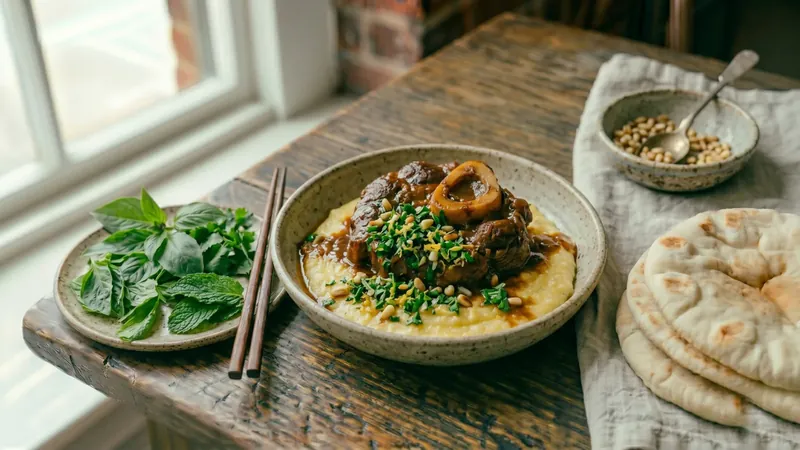
Serving. Rome eats it alone, with bread, and that is right. Rigatoni tossed in the skimmed sauce is the classic second-day trick, and mashed potato or soft polenta both work.
Substitutes. Beef shin cut into 5cm chunks needs 2 hours 30 minutes and gives you more meat and less gelatine. Add a split trotter to compensate.
If it tastes flat after four hours, it needs salt and the vinegar rather than more cocoa.
For the other end of the slow-braise spectrum, osso buco does the same collagen trick on veal shin in half the time, and pappardelle with beef shin ragù is where the leftovers of this one want to go. If you like the sweet-spiced Renaissance register, rigatoni alla Genovese plays a related game with onions instead of tomatoes.
Related Content