Cochinillo Asado: Segovia's Suckling Pig Carved With a Plate
Salt, water, lard, fire — and skin like glass
Contents
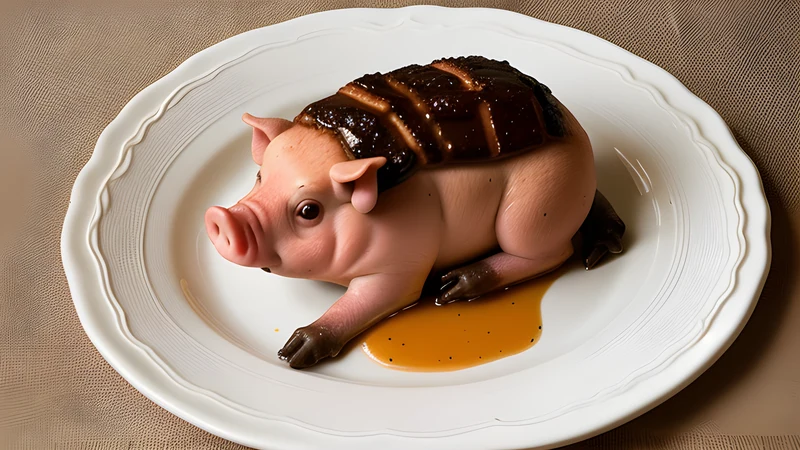
↓ Jump to recipeThe theatre is real, and it is also a proof. In Segovia, the waiter brings the pig to the table in its earthenware dish, holds up an ordinary white plate, and carves the animal into portions with the plate’s edge — down through skin, flesh and rib. Then he drops the plate on the floor and it smashes, and everyone applauds, and you have just been shown something that a knife could not have shown you. A knife cuts anything. A plate only cuts a pig that has been cooked correctly.
That is the entire argument of this dish. Two ingredients, salt and water, plus the fat the animal brought with it, and a result so tender that crockery is a sufficient tool.
Cochinillo Asado: Segovia's Suckling Pig Carved With a Plate
Ingredients
- 1 half suckling pig, about 2.5 kg, split lengthways by the butcher
- 25 g fine sea salt
- 4 dried bay leaves, crumbled to a coarse powder
- 40 g pork lard, softened
- 400 ml water, plus more as needed
- 1 whole head of garlic, halved across the equator
- 2 more bay leaves, whole
- Flaky sea salt, to finish
Method
- The day before: pat the pig completely dry. Mix the fine salt with the crumbled bay and rub it thoroughly into the flesh side only, working into the leg and shoulder. Wipe any stray salt off the skin with a damp cloth, then dry the skin again.
- Sit the pig skin side up on a rack over a tray and refrigerate uncovered for 12 to 24 hours. The skin should end up dry and papery to the touch.
- Take the pig out of the fridge 1 hour before cooking. Heat the oven to 150C fan / 170C conventional.
- Pour the 400 ml water into a large, deep roasting tin or earthenware dish and add the halved garlic head and whole bay leaves. Lay the pig in it skin side DOWN, so the flesh sits in the water and the skin is submerged.
- Roast for 90 minutes. Check at 60 minutes and top up with hot water if the tin is close to dry — there should always be a shallow layer.
- Lift the pig out onto a board. Pour off all but 100 ml of the liquid and reserve it. Return the pig to the tin skin side UP, standing clear of the liquid, and pat the skin bone dry with kitchen paper.
- Rub the softened lard evenly over the skin with your hands. Do not prick it.
- Raise the oven to 220C fan / 240C conventional and roast for 25 to 35 minutes, turning the tin once, until the skin is deep amber and covered in fine blisters. The thickest part of the shoulder should read at least 75C on a probe.
- Rest, uncovered and somewhere warm, for 10 minutes. Never cover it with foil — trapped steam softens the skin within 2 minutes.
- Carve into four or five pieces using the edge of a sturdy plate, pressing straight down. Scatter with flaky salt and serve with the skimmed pan juices.
Cándido, the aqueduct, and a piece of stagecraft
The plate trick has an inventor with a name and a date. Cándido López Sanz took over an inn at the foot of Segovia’s Roman aqueduct in 1931 — the building had been feeding travellers since at least 1786 — and turned it into the Mesón de Cándido, which is still there and still smashing plates. He was a showman of the first order. He carved for Grace Kelly, for Hemingway, for Franco, and he collected the photographs and hung them on the walls, where they remain. In 1941 Castile made him Mesonero Mayor, chief innkeeper, a title that meant nothing administratively and everything commercially.
Cándido did not invent roast suckling pig. Castile has been eating it for as long as Castile has kept pigs, and the technique belongs to the region’s bread ovens: the hornos de asar, wood-fired brick chambers that hold heavy, damp, falling heat for hours after the fire is raked out. Villages had one shared oven, and a family brought their pig in a clay dish and collected it cooked. What Cándido did was find the gesture that made the tenderness legible to a tourist in ninety seconds. It is one of the most efficient pieces of restaurant marketing anyone has ever devised, and the fact that it is also honest is what has kept it alive for ninety years.
The animal is regulated. Cochinillo de Segovia holds a protected geographical indication, and the specification is strict: a piglet of the Large White, Landrace or Duroc breeds, slaughtered at around three weeks, weighing four to six and a half kilos, and fed on nothing but its mother’s milk. That last clause is the one that matters. A pig that has never eaten grain has fat that is soft and low-melting, skin that is thin and unkeratinised, and connective tissue that has not yet toughened. It is a fundamentally different material from pork, and it wants a fundamentally different treatment — which is why every instinct you have developed roasting a Danish flæskesteg will mislead you here. That dish wants a scored rind and dry heat throughout. This one wants the opposite for the first ninety minutes.
Whether it is a cruel thing to eat is a question people reasonably ask, and I will not pretend to settle it. The Castilian answer, worked out over centuries of subsistence farming, is that a sow raises more piglets than she can feed to weight, and the surplus was eaten early because feeding it through winter was not possible. That logic has largely gone. What remains is a dish that treats a small animal with enormous care and wastes none of it.
Why the skin goes down first
This is the part that reads as a typo and is the whole method. For ninety minutes the pig lies skin down in a shallow bath of water, which means the skin is being poached at 100°C while the flesh above steams gently in the humid oven.
Two things happen down there. The collagen in the skin and in the shoulder and leg joints hydrolyses into gelatine, which is what produces the plate-edge tenderness — this needs sustained wet heat above about 70°C and simply does not happen in a dry oven at the same temperature. At the same time, the water holds the skin at a hard temperature ceiling of 100°C, so it cannot brown, cannot tighten, and cannot start rendering its fat prematurely. It comes out of the bath pale, slack and fully hydrated, with all of its fat still in place.
Then you flip it, dry it, grease it and blast it. Now the skin has nowhere to lose heat to, so it races past 100°C, the remaining water flashes out of it, and the subcutaneous fat renders and fries the skin from underneath. The blisters are steam pockets lifting a sheet that has become rigid. Thirty minutes of that gives you a surface like toffee glass. It is the same physical trick as a Chinese roast pork belly, arrived at independently.
Do not prick the skin. Suckling pig has a thin fat layer and pricking lets it drain into the tin instead of frying the skin in place, which gives you leathery patches. The instinct comes from cooking older pork with a centimetre of back fat, where there is a surplus to get rid of. Here there is not.
The overnight dry-brine, and the bay in it
Segovia would salt the pig on the day and think that sufficient, and for a wood oven with a two-hour steam phase it probably is. In a domestic electric oven, which is drier and less generous with radiant heat, I want a head start on the skin, so the pig goes into the fridge uncovered overnight.
The point is desiccation. Refrigerators are dehumidifiers, and twelve hours of cold moving air pulls a surprising amount of water out of a skin surface. Since the final blistering stage is essentially a race between drying the skin and overcooking the meat beneath it, starting the race with dry skin means you win it by ten minutes and the loin stays juicy.
The bay is the smaller idea. Crumbled dry bay leaf rubbed into the flesh with the salt behaves like a rub rather than an infusion: the salt draws out moisture, dissolves in it, and carries the bay’s aromatic oils back into the meat as it reabsorbs. Twelve hours is enough for that exchange to reach a centimetre or so in. You get a faint resinous, almost tea-like note under the pork that stops the richness reading as flat. It is the same principle as the bay-and-bacon backbone in braised Puy lentils, used on a much larger animal.
Salt only the flesh. Salt on the skin dissolves, forms a brine film, and rehydrates exactly the surface you spent all night drying.
Practicalities and what goes wrong
A whole cochinillo is five kilos and about seventy centimetres long, and it does not fit a standard 60 cm domestic oven without being flattened, which most butchers will do if asked. Half a pig is the sensible domestic unit, fits any oven, and behaves identically — just order it a week ahead, because no butcher stocks it speculatively.
Add the water to the tin cold, before the tin goes anywhere near heat. Pouring water into a hot tin holding rendered fat will throw scalding fat out of it. If you are topping up mid-roast, use hot water and pour it down the side of the tin away from you.
The failure mode is a soft, chewy skin, and it has exactly three causes: a wet skin at the flip, foil at the rest, or an oven that never truly hit 220°C. Fan ovens routinely run 10 to 15°C below their dial. If your skin is stubbornly pale at 35 minutes, move the pig to the top shelf and give it five more; if you have a grill, thirty seconds under it will finish the job, watched constantly, because it goes from amber to black in about forty seconds.
The pan liquid is the sauce, and it needs no work beyond skimming. Pour it into a jug, wait three minutes, and spoon the fat off the top. What is left underneath is a thin, pale, intensely porky gelatine that sets to jelly in the fridge and is the best thing in the dish after the skin. Save the fat, too — it is soft, sweet lard, and it makes the best roast potatoes you will eat all year.
Carving, and whether the plate really works
It does, and you should try it, with two caveats. Use a plate you do not love, because it is going to chip along the working edge even if it survives. And use a heavy one — a thick porcelain side plate with a plain, unrolled rim, roughly 18 cm across. Fine bone china is too thin and will crack across the middle under downward pressure, which is a genuinely unpleasant thing to have happen while you are leaning on it.
The technique is to press, straight down, in one committed movement, with the heel of your hand on the plate’s centre. Sawing does nothing; the plate has no teeth. On a correctly cooked pig it goes through skin and flesh in a second and stops at the board. The ribs are the honest test — a half suckling pig’s ribs are cartilage more than bone at three weeks, and a properly gelatinised one gives way with a soft crunch. If you meet real resistance, your pig needed another twenty minutes in the water bath, and you should quietly finish the job with a knife and tell nobody.
Segovia divides the pig into four numbered pieces and there is a hierarchy: the shoulder ends are richest, the leg ends have the most meat, and everyone competes for the crackling from the back. Let the table argue.
Leftovers, and the rest of the animal
There will be leftovers, and they are worth planning for, because reheated cochinillo skin never returns to glass. Accept that and use the meat differently. Strip it off the bone while warm, shred it coarsely, and fry it hard in a dry pan until the edges catch — the fat still in the meat is enough, no oil needed. That gives you something very close to carnitas in texture, and it is superb in a soft roll with pickled onion.
The bones go straight into a pot with an onion and cold water for a stock that sets like rubber at three hours. It is almost too gelatinous to sip and it is transformative in beans.
The jellied pan juices keep five days sealed in the fridge, and a spoonful melted into any braise adds body no stock cube can imitate. The pig itself keeps three days, tightly wrapped once fully cold. Wrapping it warm is what turns a good pig into a wet one overnight.
Drinking and eating alongside
Segovia serves this with nothing at all: no potatoes, no vegetable, a green salad afterwards and bread throughout. After ten minutes with it, I understand the restraint — anything you put on the plate is just competing with the skin.
The wine is Ribera del Duero, which is a forty-minute drive north and is no accident of proximity. The tannin in a young Tempranillo does a mechanical job on the fat, scrubbing the palate between mouthfuls so the fifth bite tastes like the first. A cold, sharp Spanish cider does the same job by a different route and costs a third as much.
If you must have a vegetable, make it acidic and raw: escarole with sherry vinegar, or thin-sliced onion soaked in cold water for ten minutes to knock the harshness out. The last thing this pig wants is anything else roasted, buttered or creamed beside it.
Related Content