Churros with Dark Chocolate Dip
Crisp, cinnamon-sugared and made for dunking
Contents
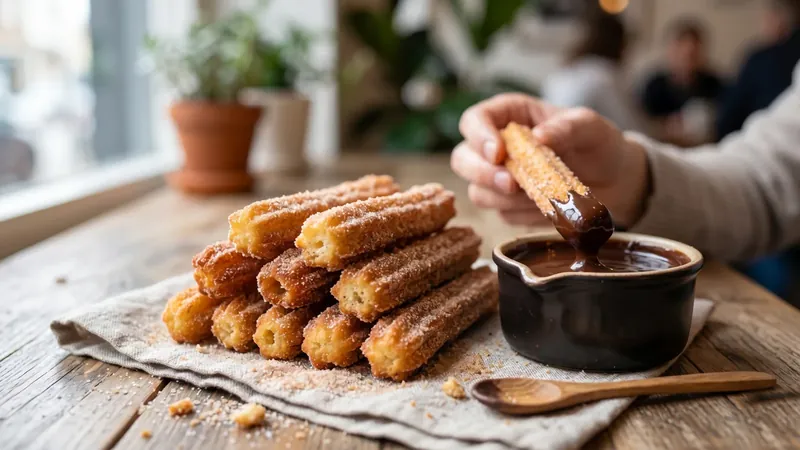
↓ Jump to recipeCrisp and ridged on the outside, soft within, these churros are tossed warm in cinnamon sugar so it clings to every crevice. The twist is the dip: not a thin drinking chocolate but a thick, glossy ganache made with dark chocolate and cream, deep enough to coat each piece generously. Piped straight into hot oil and fried until deep gold, they are best eaten within minutes, perched at the kitchen counter with the chocolate still warm.
Churros with Dark Chocolate Dip
Ingredients
- 250ml water
- 60g unsalted butter
- 1 tbsp caster sugar
- A pinch of salt
- 150g plain flour
- 2 eggs, beaten
- 1 litre sunflower oil, for frying
- 100g caster sugar, for rolling
- 1 tbsp ground cinnamon
- 150g dark chocolate (70%), chopped
- 150ml double cream
- 1 tbsp golden syrup
Method
- Bring the water, butter, tablespoon of sugar and salt to a gentle boil in a saucepan.
- Tip in the flour all at once and beat hard with a wooden spoon until the dough comes away from the sides in a smooth ball.
- Cool for 5 minutes, then beat in the eggs a little at a time until you have a thick, glossy, pipeable dough.
- Spoon the dough into a piping bag fitted with a large star nozzle.
- Mix the rolling sugar with the cinnamon on a plate and set aside.
- Heat the oil to 180C in a deep pan.
- Pipe 12cm lengths of dough straight into the oil, snipping with scissors, and fry 3-4 at a time for 3-4 minutes until deep golden.
- Drain on kitchen paper, then roll the warm churros in the cinnamon sugar.
- For the dip, heat the cream and golden syrup until steaming, then pour over the chopped chocolate.
- Leave for a minute, then stir until smooth and glossy.
- Serve the churros warm with the dark chocolate dip alongside.
A street food with a long, disputed past
Churros are one of Spain’s great street foods, sold from dedicated stalls and cafés known as churrerías and traditionally eaten for breakfast or as a late-night restorative after an evening out. In Madrid, the ritual of chocolate con churros at first light, or at the end of a long night, is close to institutional; the century-old Chocolatería San Ginés has been serving them around the clock since 1894.
Their origins are genuinely disputed, and I would rather be honest about that than repeat a tidy legend. One popular account credits Spanish shepherds in the mountains, who fried a simple flour-and-water dough over open fires where fresh bread was hard to come by, naming the coils after the horns of the churra sheep they tended. Another traces the technique to Portuguese sailors returning from Ming China with youtiao, the fried dough sticks eaten at breakfast there, which they then adapted at home. Food historians have not settled the question, and both stories are plausible; what is certain is that the fried, sugared dough took firm root across Spain and, through empire and migration, across Latin America, where it picked up local forms such as the filled churros of Mexico and the thicker porras of southern Spain.
Their defining feature is the ridged, star-shaped cross-section, formed by piping the dough through a fluted nozzle. Those ridges are not merely decorative: they increase the surface area, giving the churro more crisp edges and more places for the sugar to cling, which is part of why the texture is so satisfying.
The dough, and why it works
The dough is a simple flour-and-water paste, here enriched with egg, cooked briefly on the stove before being piped and fried. This technique — beating flour into hot liquid to form a thick paste, then working in eggs — is exactly the same one behind French choux pastry, the base of profiteroles and éclairs. What is happening is that the hot water gelatinises the starch in the flour, and the eggs then provide structure and a little lift, so the churro fries up with a sturdy, faintly hollow interior that crisps readily in the oil. Beating the flour in hard, until the dough comes cleanly away from the sides of the pan in a smooth ball, is what drives off enough moisture to let the eggs be absorbed later.
It is worth knowing that the classic Spanish street churro is often made with nothing but flour, water and salt, no egg at all, which gives a denser, chewier stick. The egg-enriched version here is closer to the choux idea and fries up lighter and crisper, with a hollower centre, which I prefer for eating at home. Add the eggs a little at a time and stop as soon as the dough is thick, glossy and just holds a soft peak on the spoon; if you beat in every last drop you can loosen it too far, and a slack dough spreads and loses its ridges the moment it hits the oil.
Making them, step by step
Bring 250ml water, 60g unsalted butter, 1 tablespoon caster sugar and a pinch of salt to a gentle boil in a saucepan. Tip in 150g plain flour all at once and beat hard with a wooden spoon until the dough comes away from the sides in a smooth ball. Cool for 5 minutes, then beat in 2 beaten eggs a little at a time until you have a thick, glossy, pipeable dough. Spoon it into a piping bag fitted with a large star nozzle, and mix 100g caster sugar with 1 tablespoon ground cinnamon on a plate.
Heat 1 litre of sunflower oil to 180C in a deep pan. Pipe 12cm lengths of dough straight into the oil, snipping them free with scissors, and fry 3 or 4 at a time for 3 to 4 minutes until deep golden. Drain on kitchen paper, then roll the warm churros in the cinnamon sugar. For the dip, heat 150ml double cream with 1 tablespoon golden syrup until steaming, pour over 150g chopped dark chocolate, leave for a minute, then stir until smooth and glossy. Serve the churros warm with the dip alongside.
Getting the frying right
Oil temperature is the single most important step, and a thermometer earns its place here. Too cool, below about 170C, and the churros sit in the oil drinking it up, turning heavy and greasy; too hot, above 190C, and the outside browns and the ridges scorch before the inside has cooked through, leaving a raw, doughy centre. Hold it at 180C, fry in small batches so the oil temperature does not crash when the cold dough goes in, and let it recover between batches. Roll them in the cinnamon sugar while they are still warm, so the sugar sticks; wait until they cool and it simply falls off.
The chocolate, and the twist
The pairing of churros with chocolate is firmly rooted in Spanish tradition, where a cup of thick, almost pudding-like drinking chocolate — closer to a warm custard than a drink, often thickened with a little cornflour — is the classic dunking companion. The twist in this recipe takes that same impulse a step further, swapping the drinking chocolate for a proper ganache of dark chocolate and cream. The result is richer and more intense, with the bitterness of a good 70 per cent chocolate balancing the sweetness of the cinnamon sugar. If you would rather keep to the drinkable version, my chilli sea salt hot chocolate is the thick, spiced cupful to dunk into instead.
Troubleshooting the piping
Two things go wrong at the piping stage, and both are avoidable. The first is churros that burst or spit violently in the oil, which almost always means the dough was still warm when it went in, or that a pocket of steam was trapped inside. Let the cooked paste cool for a full five minutes before you beat in the eggs, and pipe steadily so the ridges stay defined and no air is trapped. The second problem is churros that come out limp and pale rather than crisp, which is a temperature failure: either the oil had dropped too low, or you crowded the pan. Fry no more than three or four at a time and give the oil thirty seconds to recover its heat between batches.
A proper closed star nozzle matters more than people expect. The deep grooves are what create the sharp ridges that crisp so well; an open star or, worse, a plain round nozzle gives you soft, smooth sticks that fry unevenly and never develop the same crunch. If your piping bag is disposable and thin, double it up, because cold, stiff churro dough takes real force to push through and a flimsy bag will split at exactly the wrong moment.
Make-ahead, tips and variations
Churros are unapologetically an eat-now food; they are at their best within minutes of frying and turn leathery within the hour. You can, however, make the dough up to a couple of hours ahead and keep it in the piping bag at room temperature, and the ganache can be made in advance and gently rewarmed over a low heat with a splash more cream to loosen it. If you want to get ahead properly, pipe the raw churros onto a lined tray, freeze them solid, then fry them straight from frozen, adding a minute to the cooking time; this is how the churrerías keep up with demand.
For a filled version, pipe thicker churros, let them cool, then use a small nozzle to inject them with dulce de leche or the same chocolate ganache. A pinch of flaky salt in the ganache sharpens it beautifully, the same move that lifts my dark chocolate mousse with espresso and flaky salt. You can swap the cinnamon sugar for plain caster sugar rubbed with a little orange zest, which is common in parts of Spain, or add a pinch of ground clove and a scrape of nutmeg for a more festive edge. A tablespoon of unsweetened cocoa stirred into the rolling sugar turns them subtly chocolatey before they even reach the dip.
If you do not want to deep-fry, the honest answer is that these do not translate well to an oven or air fryer; without the hot oil they set into dense, bready sticks rather than the shatteringly crisp original, and the ridges never crisp properly. Frying is not optional here, it is the whole point. This version keeps things classic in spirit while letting the chocolate do something a little more indulgent — best eaten standing up, with a friend, and no plans for the next hour.
Related Content